A Complete Shopping Guide for First-Time Visitors
Japanese convenience stores receive a lot of attention from international visitors—and for good reason.
However, if you want lower prices, a wider selection of fresh food, and a closer look at how people in Japan actually shop every day, visit a Japanese supermarket.
Japanese supermarkets offer much more than groceries.
You can find freshly prepared bento meals, sushi, seasonal fruit, local snacks, bakery products, household supplies, and regional specialties—all in one place.
The shopping process is generally simple, but a few parts may be unfamiliar.
For example:
- You may need to pack your own groceries.
- Plastic bags usually cost extra.
- Some supermarkets use semi-self-checkout machines.
- Discount stickers appear on prepared food later in the day.
- Most food labels are written primarily in Japanese.
This guide explains the entire experience, from entering the store to packing your bags.
🇯🇵 Quick Facts
| Item | What to Expect |
|---|---|
| 💰 Prices | Usually lower than convenience stores |
| 🛒 Shopping Style | Basket or shopping cart |
| 💳 Payment | Cash, cards, electronic money, or QR payments depending on the store |
| 🛍 Plastic Bags | Usually available for a small fee |
| 📦 Bagging | Customers normally pack their own groceries |
| 🌍 English Support | Limited, but shopping is usually easy |
| ⭐ Difficulty | Easy |
What Is a Japanese Supermarket?
A Japanese supermarket is usually called a “sūpā” (スーパー).
Unlike convenience stores, supermarkets are designed for larger grocery purchases.
They normally carry:
- Fresh vegetables and fruit
- Meat
- Fish and seafood
- Rice
- Bread
- Dairy products
- Frozen food
- Drinks
- Snacks
- Alcohol
- Prepared meals
- Toiletries
- Cleaning supplies
- Basic household products
Some large supermarkets also include:
- A bakery
- A pharmacy
- Clothing
- Kitchenware
- Cosmetics
- An in-store eating area
- Tax-free services for selected products and eligible customers
Smaller neighborhood supermarkets may focus almost entirely on food.
Supermarkets vs Convenience Stores
Japanese supermarkets and convenience stores sell many of the same products, but they serve different purposes.
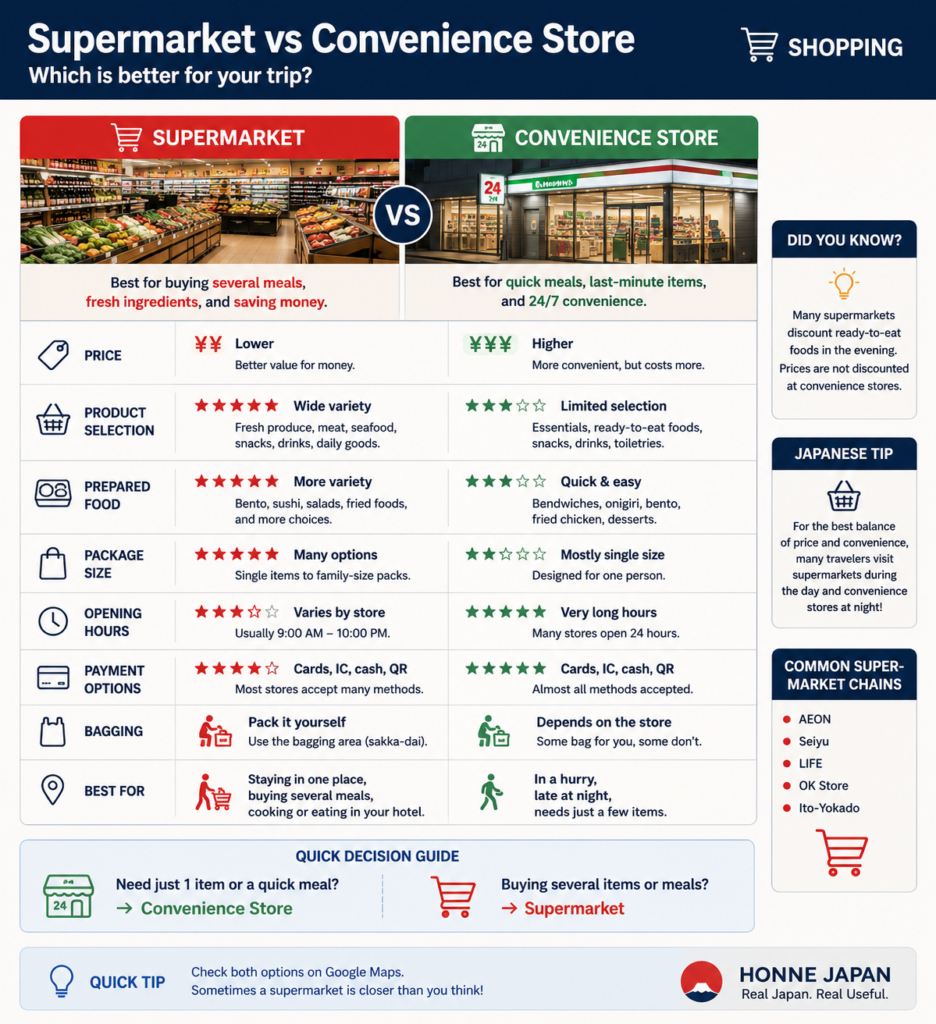
| Feature | Supermarket | Convenience Store |
|---|---|---|
| Price | Usually lower | Usually higher |
| Fresh Produce | Large selection | Limited |
| Meat and Fish | Wide selection | Very limited |
| Prepared Food | Large selection | Convenient individual meals |
| Package Sizes | Small and family-sized | Mostly individual portions |
| Opening Hours | Vary by store | Many operate 24 hours |
| Checkout | Staffed, semi-self, or self-checkout | Usually quick counter service |
| Bagging | Usually pack your own | Staff may help depending on the store |
For one drink or a quick breakfast, a convenience store is easier.
For several meals, fresh food, fruit, or local products, a supermarket is usually the better choice.
Common Japanese Supermarket Chains
The supermarket chains you see will depend on the region.
Well-known examples include:
- AEON
- Ito-Yokado
- Life
- Seiyu
- Maruetsu
- OK
- Inageya
- Summit
- Yaoko
- Gyomu Super
Japan also has many strong regional chains.
This means that travelers visiting Hokkaido, Kyushu, Kansai, or other regions may find supermarkets that are rarely seen in Tokyo.
Regional supermarkets are worth visiting because they often sell local food, sauces, snacks, seafood, and prepared dishes.
How to Shop at a Japanese Supermarket
The basic process is straightforward.
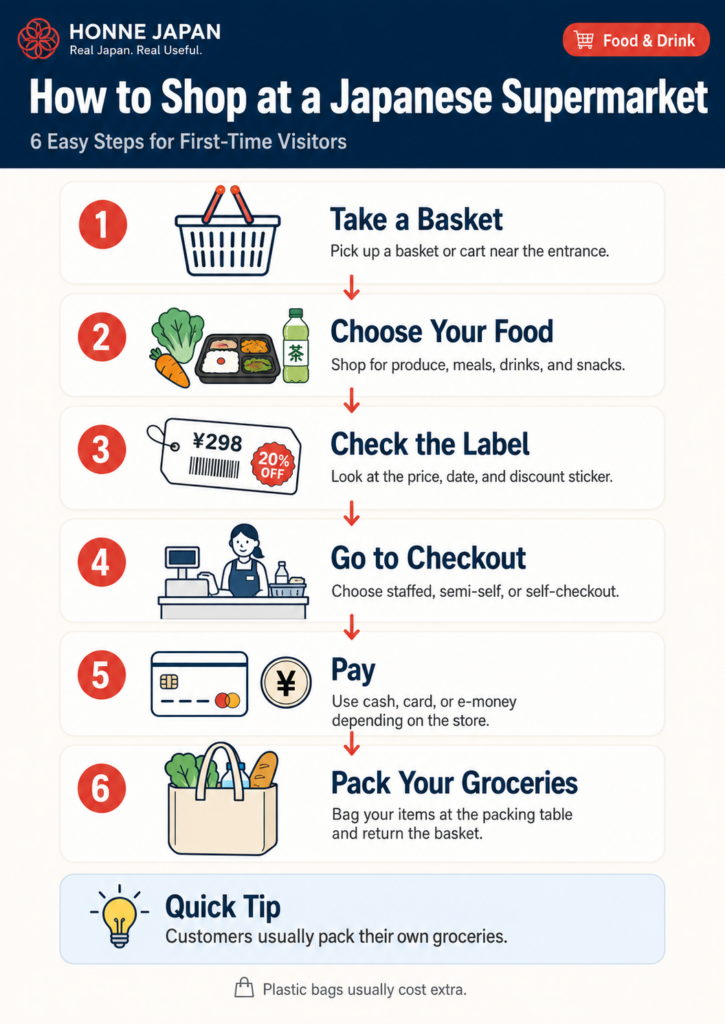
Step 1: Take a Basket or Cart
Shopping baskets are normally located near the entrance.
You may also find:
- Small hand baskets
- Large baskets
- Shopping carts
- Child seats
- Two-level carts for multiple baskets
You do not usually need a coin to use a cart, although systems vary by store.
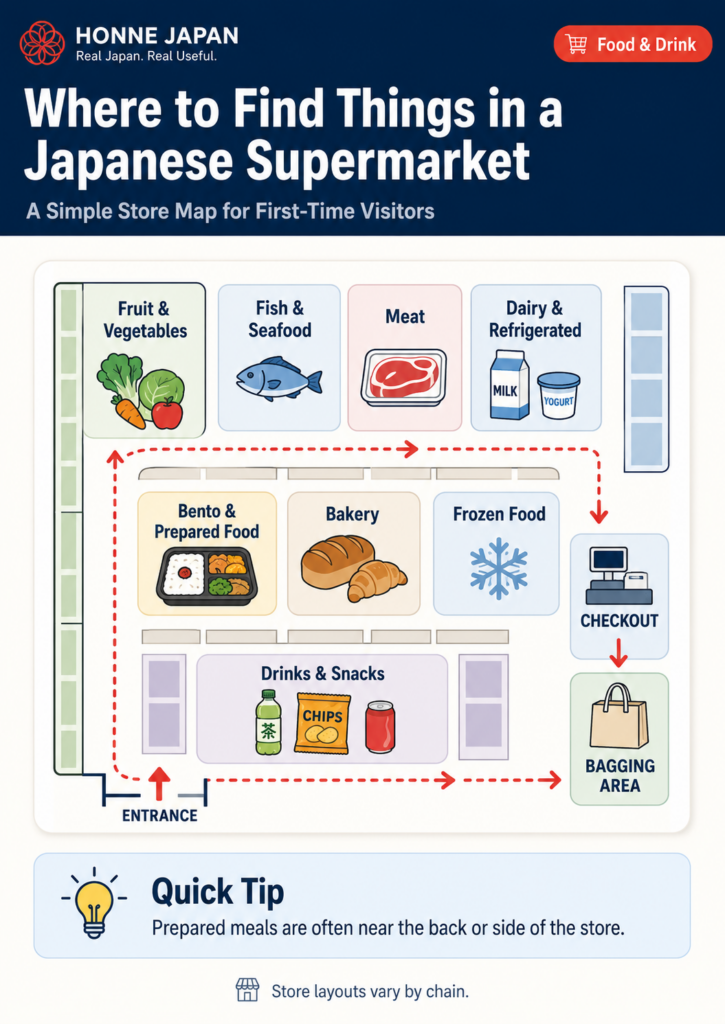
Step 2: Shop by Department
Japanese supermarkets are generally organized into clearly defined sections.
A typical route may look like this:
- Vegetables and fruit
- Fish and seafood
- Meat
- Tofu, noodles, and refrigerated food
- Prepared meals
- Bread and bakery products
- Dairy products
- Frozen food
- Drinks and alcohol
- Snacks and household products
Many supermarkets place colorful fresh produce near the entrance to create a bright and welcoming first impression.
Step 3: Check the Price Label
Most packaged products have a barcode and price label.
You may see:
- The product name
- Weight
- Price before tax
- Price including tax
- Price per 100 grams
- Production area
- Storage instructions
- Use-by or best-before date
For meat and fish, the package often shows both the price per 100 grams and the total price for that package.
You do not need to calculate the final price yourself. The package barcode contains the correct total.
Step 4: Choose a Checkout Lane
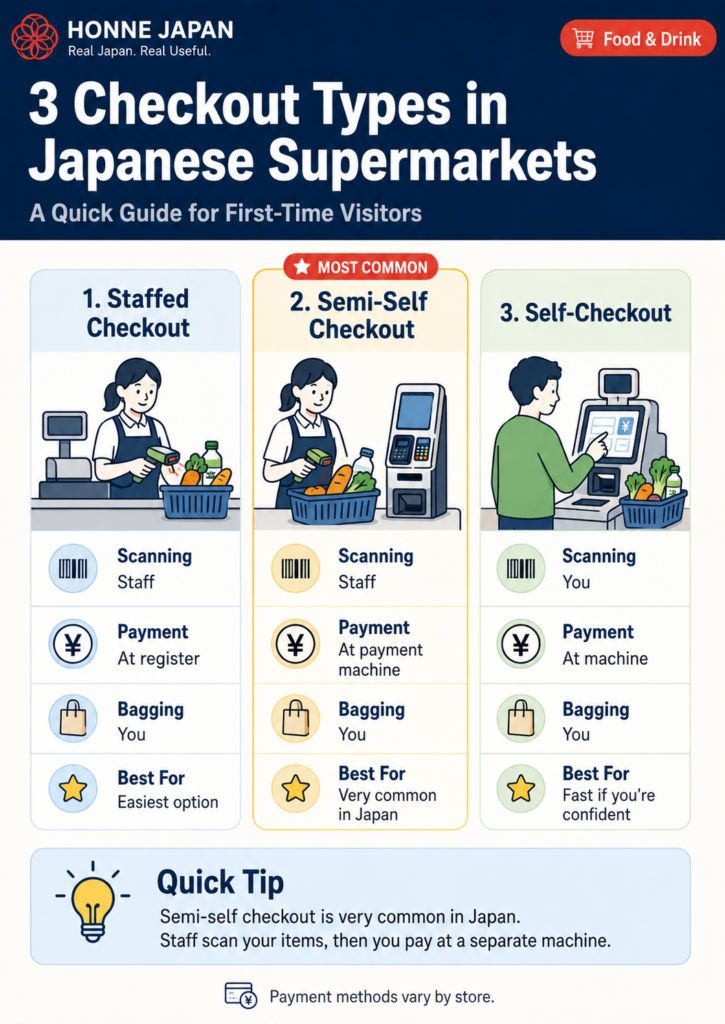
When you are ready to pay, look for one of three checkout systems:
- Staffed checkout
- Semi-self-checkout
- Full self-checkout
The systems may look different, but they all follow the same basic process.
Step 5: Pay
After your products have been scanned, choose your payment method.
Depending on the store, you may be able to use:
- Cash
- Credit card
- Debit card
- Transportation IC cards
- Store electronic money
- Contactless payment
- QR payment apps
Acceptance varies by chain and location.
Look for payment logos near the checkout before you begin.
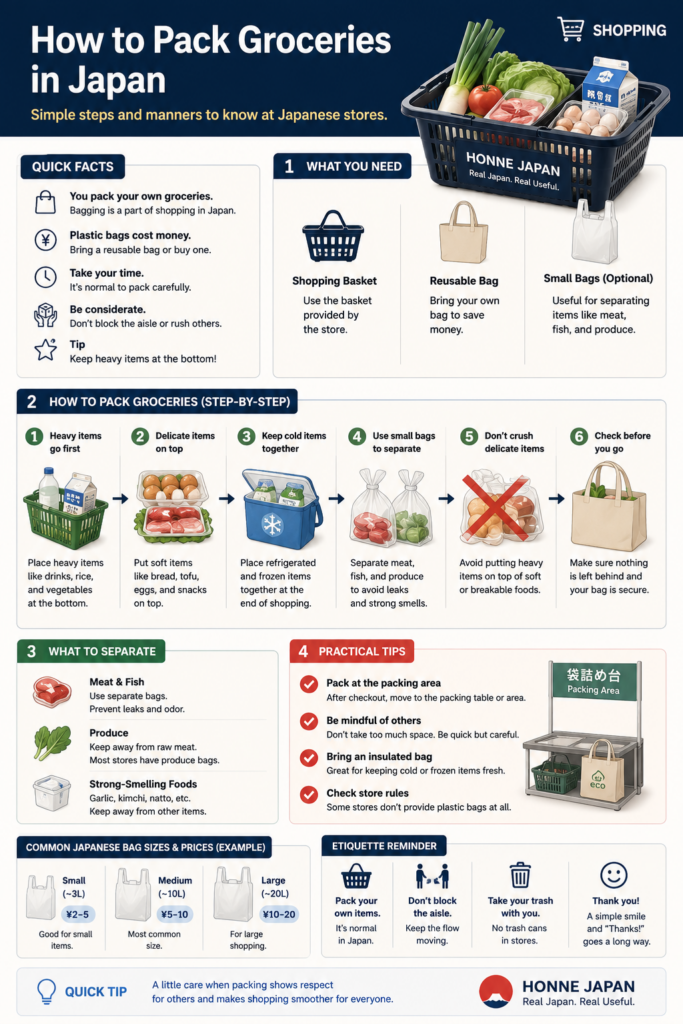
Step 6: Pack Your Groceries
In most Japanese supermarkets, customers pack their own groceries.
After paying, take your basket to the bagging area.
The bagging table may provide:
- Thin plastic produce bags
- Tape
- A damp sponge for opening plastic bags
- Cardboard boxes
- Trash bins for receipts or small packaging
Place your empty basket in the designated return area after packing.
Understanding Japanese Produce Sections
Fresh produce is often sold in several different ways.
Sold by Package
Many vegetables and fruits are already packed.
Examples include:
- A bag of onions
- Three apples
- One package of mushrooms
- A tray of tomatoes
The displayed price normally applies to the entire package.
Sold Individually
Some items are sold by the piece.
You may see labels such as:
1個— one item1本— one long item1玉— one whole round item1袋— one bag1パック— one package
For example, a price next to 1個 means the price is for one piece.
Sold by Weight
Loose produce sold entirely by weight is less common than in some countries, but it does exist.
If an item needs to be weighed, the store may provide:
- A weighing machine
- A label-printing scale
- Instructions near the product
When unsure, look at what other customers are doing or ask a member of staff.
Meat and Seafood Labels
Japanese supermarkets offer an impressive variety of meat and seafood.
Meat is often cut into thin slices for dishes such as:
- Sukiyaki
- Shabu-shabu
- Yakiniku
- Ginger pork
- Stir-fries
Instead of asking a butcher to cut the meat, customers usually select a prepared tray from the refrigerated case.
The label may show:
- Type of meat
- Cut
- Country or region of origin
- Weight
- Price per 100 grams
- Total package price
- Expiration date
Seafood departments may sell:
- Sashimi
- Sushi
- Whole fish
- Fish fillets
- Shellfish
- Dried fish
- Marinated fish
- Grilled fish
Some stores will clean or cut a whole fish for you, although communication may be difficult without Japanese.
The Prepared Food Section
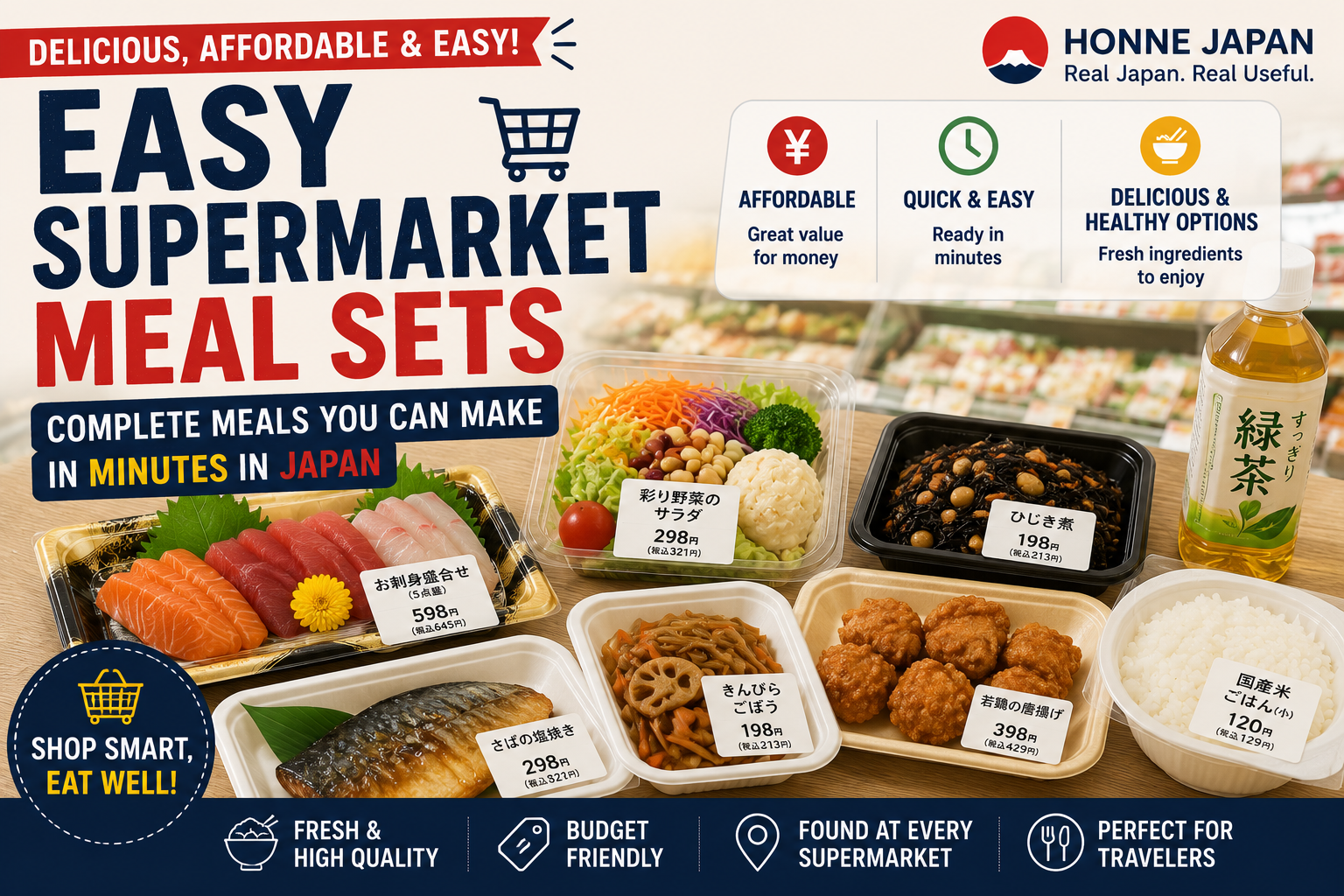
One of the best parts of a Japanese supermarket is the prepared food section.
Prepared dishes are called “sōzai” (惣菜).
Popular items include:
- Bento lunch boxes
- Sushi
- Fried chicken
- Tempura
- Croquettes
- Gyoza
- Yakitori
- Grilled fish
- Salads
- Noodles
- Rice dishes
- Japanese-style side dishes
Supermarket meals are often less expensive than restaurant meals and may offer better value than convenience store food.
They are especially useful for:
- Hotel dinners
- Apartment stays
- Picnics
- Train journeys
- Families traveling with children
- Travelers who want to try several small dishes
Disposable chopsticks may be available near the checkout or provided by staff.
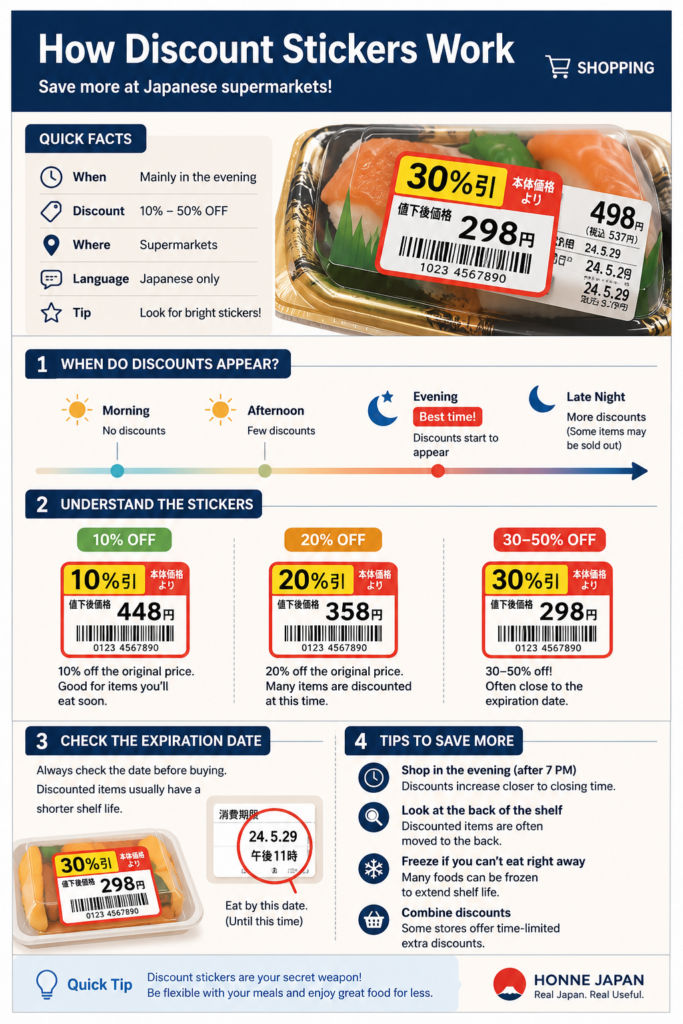
How Discount Stickers Work
Prepared food, sushi, meat, fish, and bakery products may be discounted as their selling deadline approaches.
The timing varies by store.
You may see stickers such as:
10%引— 10% off20%引— 20% off30%引— 30% off50円引— ¥50 off半額— half price
The word “hangaku” (半額) means half price.
Discounts are often applied later in the day, but there is no guaranteed time.
Popular products may sell out before receiving a large discount, so waiting is not always the best strategy.
Good to Know
Do not remove, replace, or move a discount sticker.
The cashier or checkout machine will scan the updated barcode or enter the discount correctly.
How Checkout Works
1. Staffed Checkout
At a traditional checkout, a staff member scans your products.
In many stores, they place the scanned products into a different basket rather than directly into a shopping bag.
After paying, you take the basket to the bagging table and pack everything yourself.
2. Semi-Self-Checkout
Semi-self-checkout is extremely common.
The process is:
- A staff member scans your products.
- You move to a separate payment machine.
- Select your payment method.
- Insert cash or use your card.
- Take your receipt.
- Pack your groceries.
The cashier may point to the payment machine you should use.
A screen or number usually indicates the correct terminal.
3. Full Self-Checkout
At a full self-checkout, you scan and pay without a cashier.
The general process is:
- Choose a language if available.
- Scan each product.
- Place it in the designated bagging area.
- Scan any discount barcode carefully.
- Select whether you need a shopping bag.
- Choose your payment method.
- Pay.
- Take your receipt.
Some machines use weight sensors.
If you move an item too quickly or place it in the wrong area, the machine may stop and call a staff member.
This is normal and does not mean you have done anything serious.
4. Scan-As-You-Shop Systems
Some larger supermarkets offer smartphone or handheld-scanner systems.
Customers scan products as they place them in their cart, then complete payment at a dedicated terminal.
These services are convenient but may require:
- A store application
- Member registration
- Japanese-language instructions
- A supported payment method
For a short visit, a regular checkout may be easier.
Do You Need a Shopping Bag?
Plastic shopping bags are generally not free.
At checkout, you may be asked:
“Fukuro wa irimasu ka?”
Do you need a bag?
Useful answers include:
“Hai, onegaishimasu.”
Yes, please.
“Daijōbu desu.”
No, thank you.
You may need to choose a bag size on the checkout screen.
Common choices include:
- Small
- Medium
- Large
Bringing a reusable bag is normal in Japan.
Thin plastic bags for separating meat, fish, wet products, or vegetables may still be available in the bagging area.
How to Pay
Large Japanese supermarkets often accept more payment methods than small independent stores.
Possible options include:
- Japanese yen
- Visa
- Mastercard
- JCB
- American Express
- Contactless cards
- Suica and PASMO
- WAON
- Store-specific electronic money
- PayPay
- Rakuten Pay
- au PAY
- d払い
However, availability is not universal.
A payment method accepted at one branch may not be available at every branch, particularly when the supermarket contains independent tenants.
Cash remains the safest backup.
Understanding Consumption Tax
Most food and non-alcoholic drinks bought to take away are subject to Japan’s reduced consumption tax rate of 8%.
Alcohol and most non-food products are generally taxed at the standard 10% rate.
This means a supermarket receipt may include products taxed at different rates.
You may see an asterisk or symbol next to items taxed at the reduced rate.
The receipt normally separates the totals automatically, so travelers do not need to calculate the tax themselves.
Understanding Food Expiration Labels
Food packaging in Japan is generally labeled in Japanese.
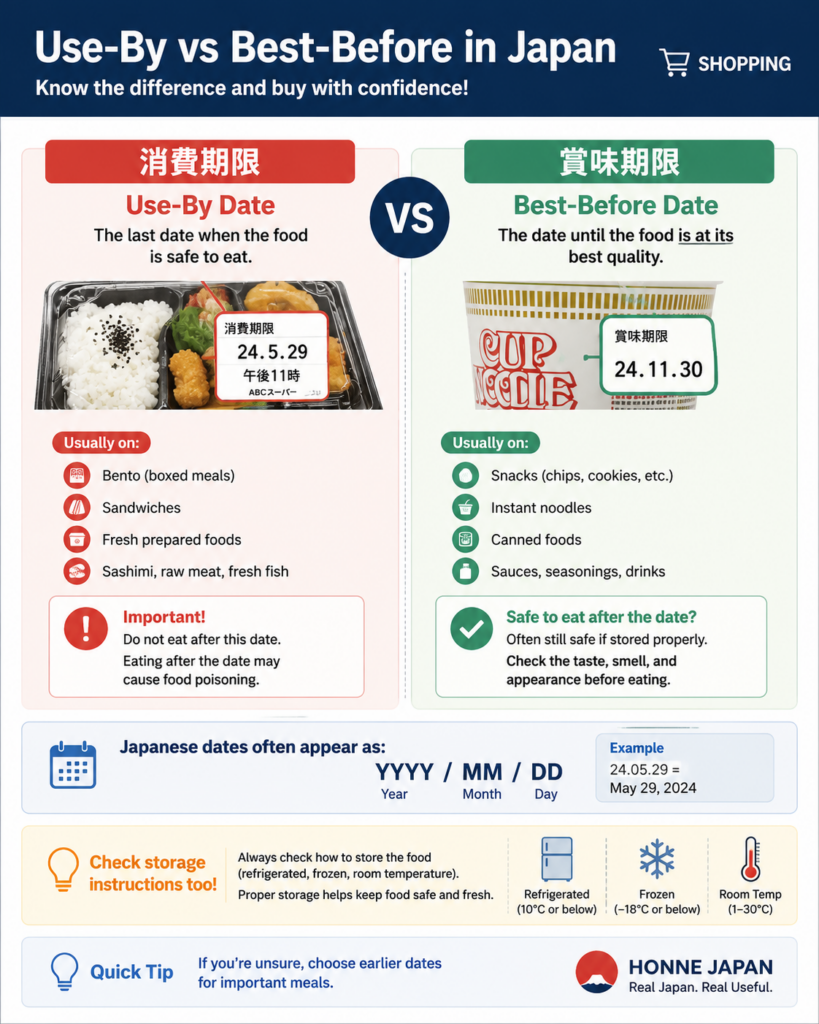
The two most important date labels are:
消費期限 — Use-By Date
Pronounced:
Shōhi kigen
This is used for highly perishable foods such as:
- Bento
- Sandwiches
- Fresh prepared food
- Some dairy products
The product should be consumed by the stated date when stored correctly.
賞味期限 — Best-Before Date
Pronounced:
Shōmi kigen
This indicates the period during which the product is expected to maintain its best quality.
It is commonly used for:
- Snacks
- Instant noodles
- Canned food
- Sauces
- Long-life packaged products
The date format is often:
- Year / Month / Day
- Year / Month
Check the storage instructions as well.
Some products must be refrigerated even before opening.
Allergies and Dietary Restrictions
Shopping with allergies or dietary restrictions can be challenging because labels are usually written primarily in Japanese.
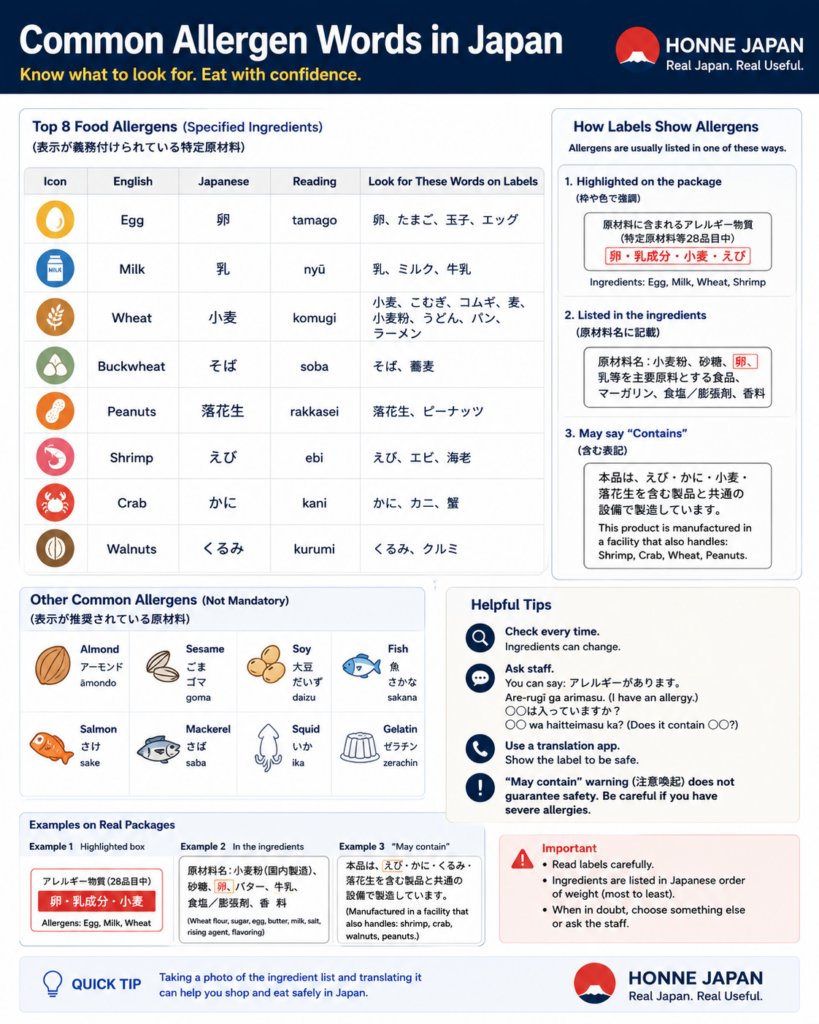
Common allergen words include:
| Japanese | English |
|---|---|
| 卵 | Egg |
| 乳 | Milk |
| 小麦 | Wheat |
| えび | Shrimp |
| かに | Crab |
| そば | Buckwheat |
| 落花生 | Peanut |
| くるみ | Walnut |
Products that appear vegetarian may contain:
- Fish stock
- Bonito extract
- Meat extract
- Gelatin
- Shellfish seasoning
Travelers with serious allergies should not rely only on product photos or translation applications.
Carry a clearly written allergy card and ask for assistance when necessary.
Can You Eat Food Inside the Supermarket?
Some supermarkets have an eat-in area with tables, chairs, water, or microwave ovens.
Others do not.
Look for signs such as:
- Eat-in
- イートイン
- Rest Space
- Food Court
Do not assume you can eat anywhere inside the store.
If there is no eating area, take the food back to your hotel, accommodation, park, or another appropriate place.
Avoid sitting on the floor, blocking the entrance, or eating beside the checkout lanes.
Can You Use the Microwave?
Some supermarkets provide microwaves near the eat-in area.
Others may heat selected prepared foods at the service counter.
Availability varies.
Do not place packaging containing metal, aluminum, or unsuitable plastic in a microwave.
When unsure, ask:
“Atatamete mo ii desu ka?”
Can this be heated?
Japanese Supermarket Etiquette
Shopping etiquette is simple.
Do
- Return unwanted products to the correct shelf.
- Keep refrigerated and frozen doors closed.
- Wait in the marked checkout line.
- Pack your groceries efficiently.
- Return your basket.
- Keep raw meat and fish separate from ready-to-eat food.
- Ask before taking photographs of staff or displays.
Don’t
- Open food before paying.
- Eat while walking around the store.
- Place products in a personal bag before checkout.
- Block aisles with luggage.
- Leave unwanted refrigerated products on a normal shelf.
- Touch loose produce unnecessarily.
- Replace or move discount stickers.
Large suitcases can make narrow supermarket aisles difficult to navigate.
Whenever possible, leave luggage at your hotel or in a coin locker before shopping.
Best Supermarket Foods for Travelers
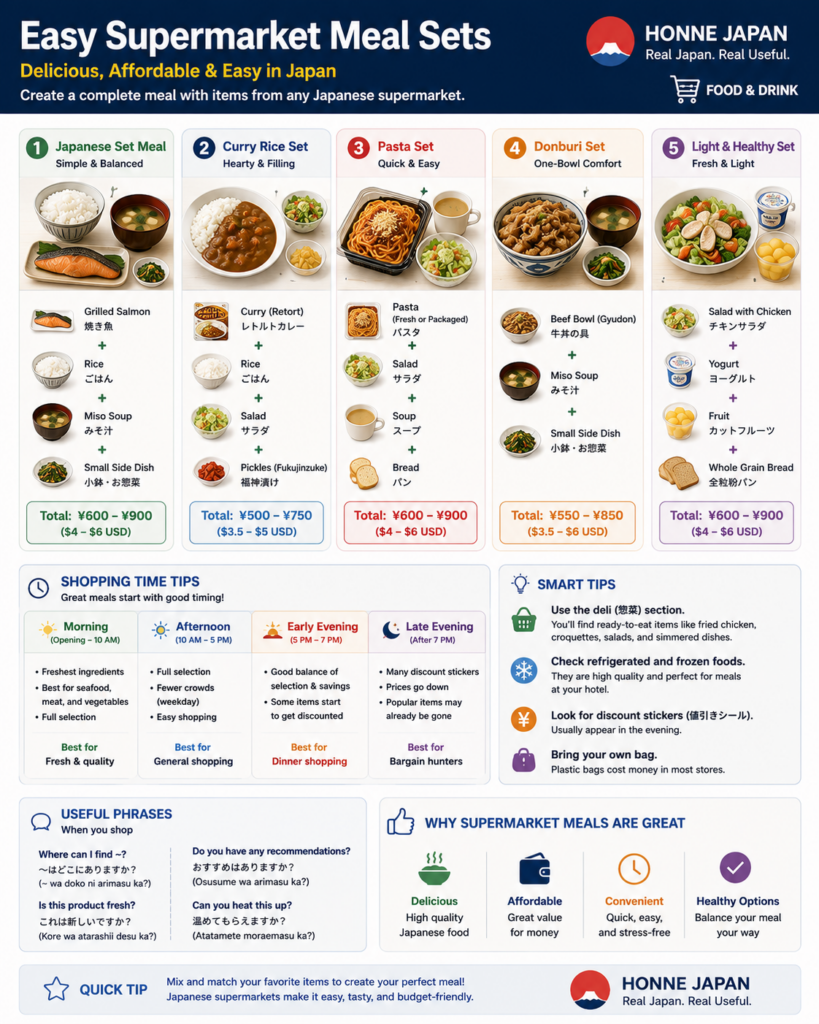
Japanese supermarkets are excellent places to build an affordable meal.
Easy Hotel Dinner
- Bento
- Miso soup
- Salad
- Tea
- Dessert
Sushi Meal
- Assorted sushi
- Miso soup
- Edamame
- Japanese beer or tea
Japanese Breakfast
- Rice ball
- Grilled fish
- Rolled omelet
- Yogurt
- Fruit
Picnic Meal
- Sandwiches
- Fried chicken
- Inari sushi
- Cut fruit
- Bottled drink
Foods Worth Looking For
- Local sushi
- Seasonal fruit
- Japanese bakery bread
- Regional instant noodles
- Tofu
- Pickles
- Matcha sweets
- Local sauces and dressings
- Supermarket-brand snacks
- Seasonal bento
When Is the Best Time to Visit?
The best time depends on your priority.
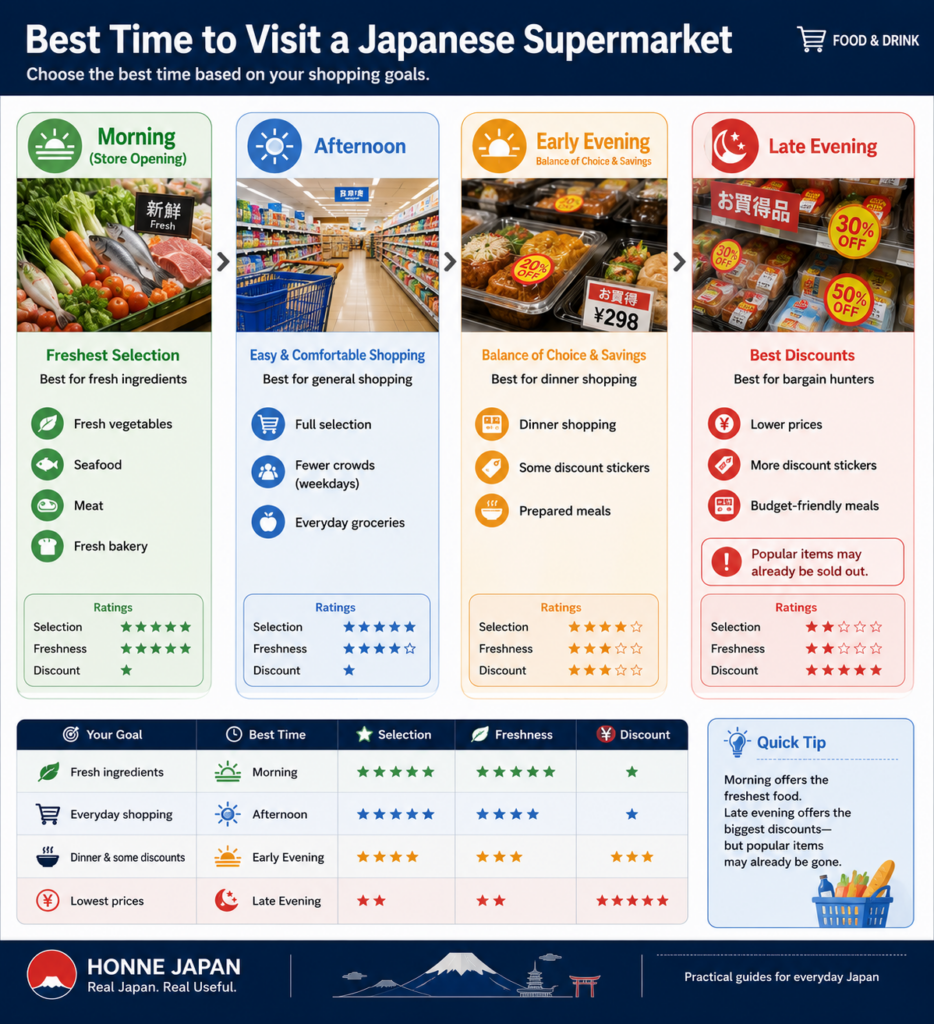
Visit Earlier for the Best Selection
Morning and daytime visits are better for:
- Fresh bakery products
- Popular bento
- Sushi
- Seasonal fruit
- Special promotional products
Visit Later for Possible Discounts
Evening visits may offer discounted:
- Bento
- Sushi
- Prepared dishes
- Meat
- Fish
- Bakery products
However, the selection may be limited.
The ideal strategy is simple:
Visit earlier when you want something specific.
Visit later when price matters more than selection.
Are Japanese Supermarkets Open 24 Hours?
Some are, but many are not.
Opening hours vary widely depending on:
- Location
- Store size
- Shopping center hours
- Local demand
- Day of the week
- Public holidays
Urban stores may stay open late, while smaller regional stores may close earlier.
Always check the specific branch rather than relying on the chain’s general reputation.
FAQ
Are Japanese supermarkets cheaper than convenience stores?
Usually, yes.
Supermarkets generally offer lower prices, larger packages, and a broader selection of fresh food.
Do supermarket staff speak English?
Some do, but English ability varies.
Most shopping can be completed without conversation because products have pictures, prices, and barcodes.
Can I pay with an international credit card?
Many large supermarkets accept international cards, but not every store or checkout system does.
Carry some cash as a backup.
Do I need to bring my own bag?
You do not have to, but bringing one is recommended.
Plastic bags are normally sold at checkout.
Will staff pack my groceries?
Usually not.
Customers generally pack their own groceries at a separate bagging table.
Can I buy alcohol?
Yes, most supermarkets sell alcohol.
Age confirmation may appear on the checkout screen.
You must be at least 20 years old to buy alcohol in Japan.
Can I buy medicine?
Large supermarkets may contain a pharmacy or drugstore section.
However, the supermarket itself may sell only basic health-related products.
For medicine, a dedicated Japanese drugstore usually offers a better selection.
Can tourists use supermarket point cards?
Some point programs are open to visitors, but registration may require:
- A Japanese application
- A local phone number
- A Japanese address
- Japanese-language registration
For a short trip, joining is usually unnecessary unless registration is simple and free.
🇯🇵 HONNE JAPAN PICK
A Japanese supermarket is one of the best places to experience ordinary life in Japan.
For a simple first visit, buy:
- A small sushi or bento set
- One prepared side dish
- Seasonal fruit
- A supermarket-brand snack
- A Japanese drink or dessert
This combination gives you a broader taste of everyday Japanese food than buying a single restaurant meal.
And remember the most important difference:
At a convenience store, you buy something quickly.
At a supermarket, you discover how people in Japan actually eat.
Final Thoughts
Japanese supermarkets are practical, affordable, and surprisingly enjoyable to explore.
You can find everyday groceries, regional specialties, prepared meals, seasonal products, and many foods that never appear in souvenir shops.
The process may seem unfamiliar at first, especially when using a semi-self-checkout or packing your own bags.
However, once you understand the basic flow, shopping is easy:
- Take a basket.
- Choose your food.
- Check the package price.
- Select a checkout.
- Pay.
- Pack your own groceries.
- Return the basket.
Even if you are staying in Japan for only a few days, a supermarket visit is worth adding to your itinerary.
It is not only a place to save money.
It is one of the easiest ways to experience real, everyday Japan.