Japanese Vending Machines: How to Use Them, Pay and Choose Drinks
Japanese vending machines are easy to use even if you cannot read Japanese. Most machines sell drinks and accept cash, while many also accept transportation IC cards such as Suica, PASMO and ICOCA.
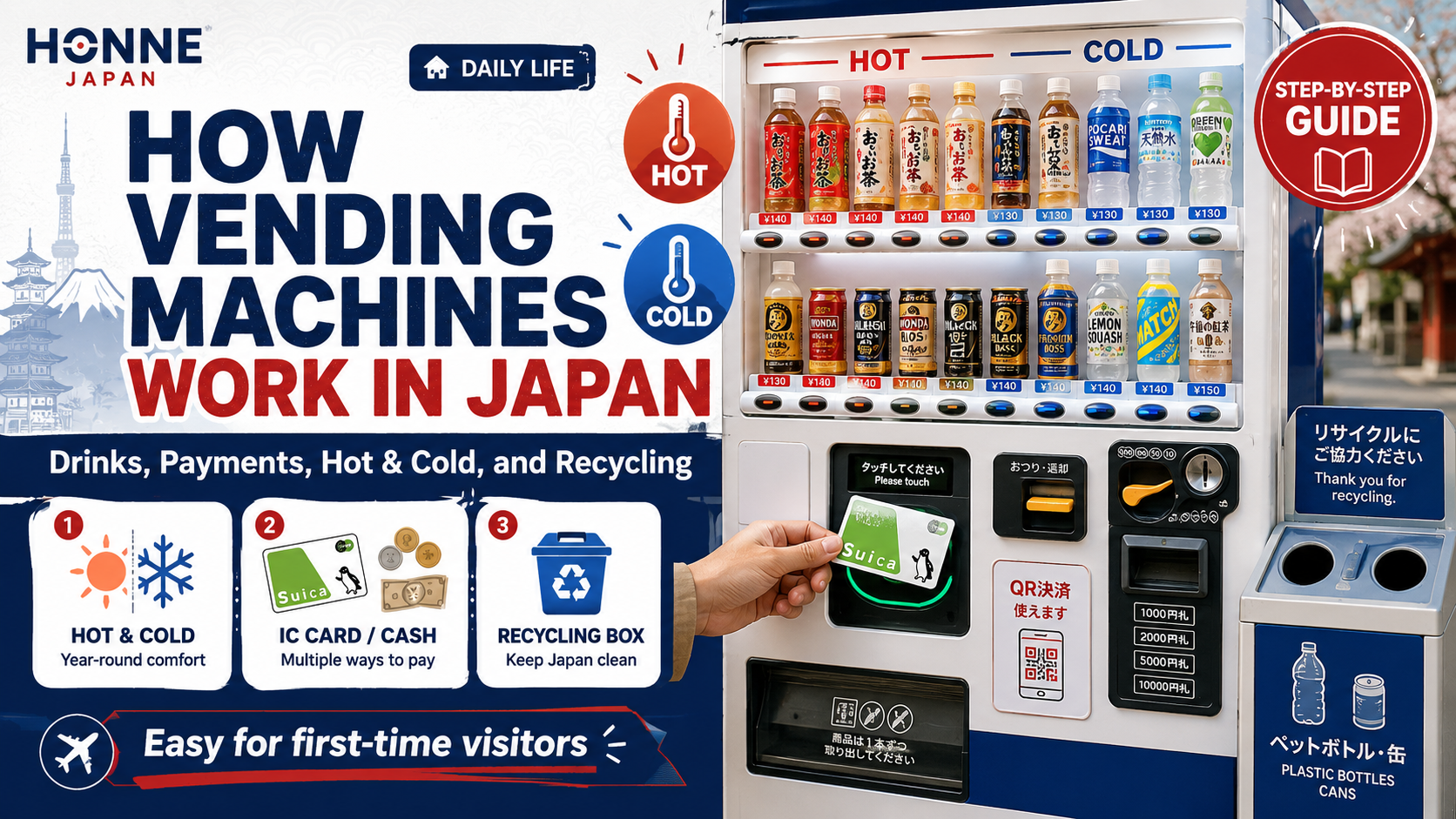
To buy a drink, check the price and temperature label, insert your money or select the product and tap your IC card, then collect the drink from the compartment below. Red labels indicate hot drinks, while blue labels indicate cold drinks.
You can find vending machines at train stations, beside convenience stores, near hotels, outside office buildings and along residential streets. Most sell water, tea, coffee, soft drinks and sports drinks, although machines selling food, ice cream and regional products also exist.
Payment methods and operating steps vary slightly between machines, so always check the logos, illuminated buttons and on-screen instructions before paying.
🇯🇵 Quick Facts
| Item | Details |
|---|---|
| 🥤 Most Common Products | Water, tea, coffee, soft drinks and sports drinks |
| 🔴 Red Label | Hot drink |
| 🔵 Blue Label | Cold drink |
| 💴 Payment | Cash, IC card or mobile payment depending on the machine |
| 🚆 IC Cards | Suica and other compatible cards work on many machines |
| ♻️ Nearby Box | Usually for empty drink containers—not general rubbish |
| 🌍 English Required | Usually unnecessary |
| ⭐ Difficulty | Very Easy |
Japanese drink machines commonly use red labels for hot products and blue labels for cold products.
How Much Do Japanese Vending-Machine Drinks Cost?
The price is displayed below or beside each product, so you can check it before paying.
Prices vary depending on the drink, bottle size, location and machine operator. Water and small cans are usually among the cheaper options, while large bottles, energy drinks and specialty products may cost more.
Vending machines are convenient, but the same drink may sometimes be cheaper at a supermarket, drugstore or discount shop. At train stations, tourist areas or remote locations, you are mainly paying for quick access and convenience.
You do not need exact change. A cash-operated machine normally returns the remaining balance after the purchase, although you should always check the change tray before walking away.
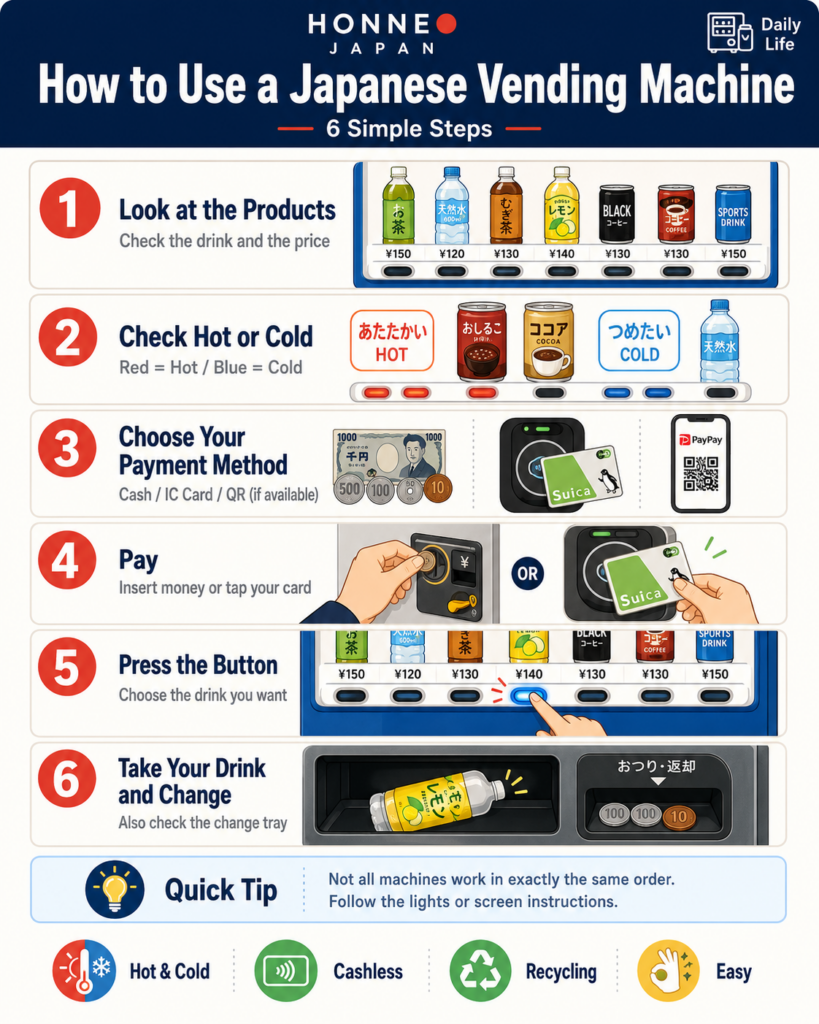
How to Buy a Drink in 6 Steps
Step 1: Look at the Products
Each product has its price displayed below or beside it.
Check:
- The product image
- The price
- The size
- Whether it is hot or cold
- Whether the selection button is available
A lighted or active button normally means the product can be purchased. A sold-out product may display:
売り切れ
Sold Out
Step 2: Check Whether It Is Hot or Cold
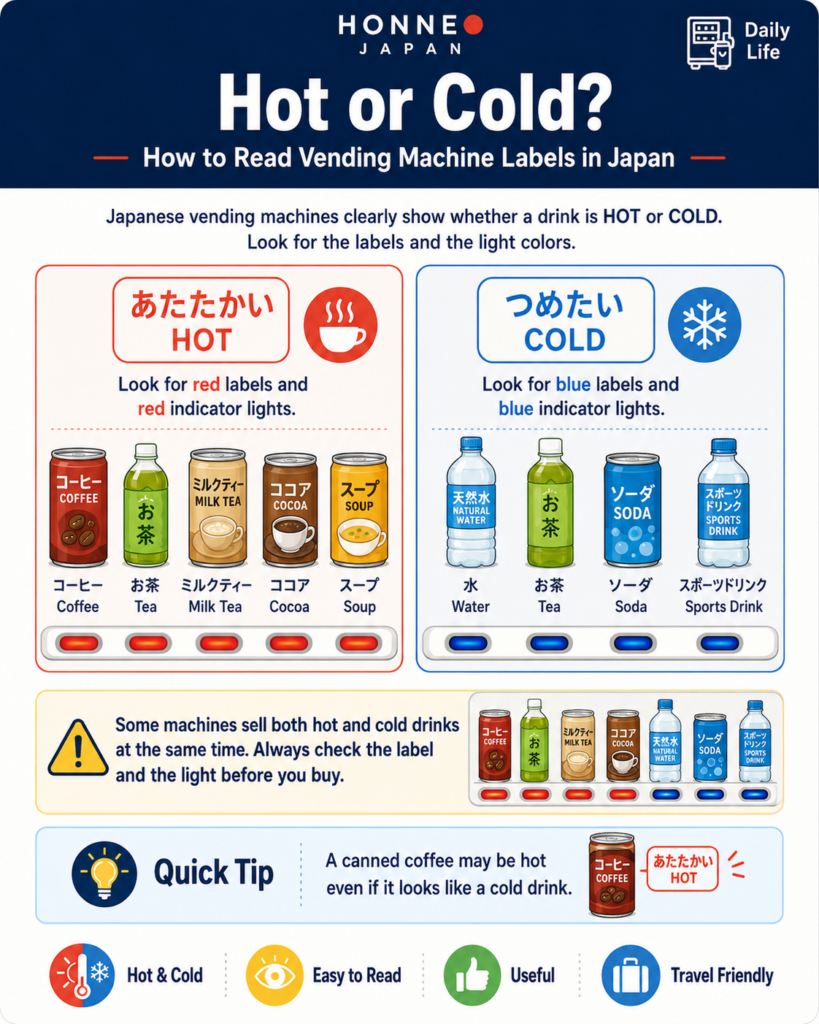
Look at the color below the product.
🔴 Red
あたたかい
Hot
🔵 Blue
つめたい
Cold
Some vending machines sell both hot and cold drinks at the same time, particularly during cooler months. Typical hot products include coffee, tea, café au lait and occasionally canned soup.
Do not assume that a coffee can is cold simply because it is displayed beside bottled water.
What Coins and Bills Can You Use?
A typical Japanese drink vending machine accepts:
- ¥10 coins
- ¥50 coins
- ¥100 coins
- ¥500 coins
- ¥1,000 bills
¥1 and ¥5 coins are generally not accepted. Many standard machines also do not accept ¥5,000 or ¥10,000 bills.
Accepted cash can differ by machine. Check the illustrations beside the coin and banknote slots before inserting money.
Japan introduced new banknotes in 2024, and compatibility may still vary among older machines. If a bill is repeatedly returned, do not force it into the slot. Try coins, use a compatible IC card or buy the drink from another machine.
When paying with cash, insert the money first and then press the illuminated product button. If the machine cannot provide enough change, it may reject a large coin or banknote.
Step 3: Choose a Payment Method
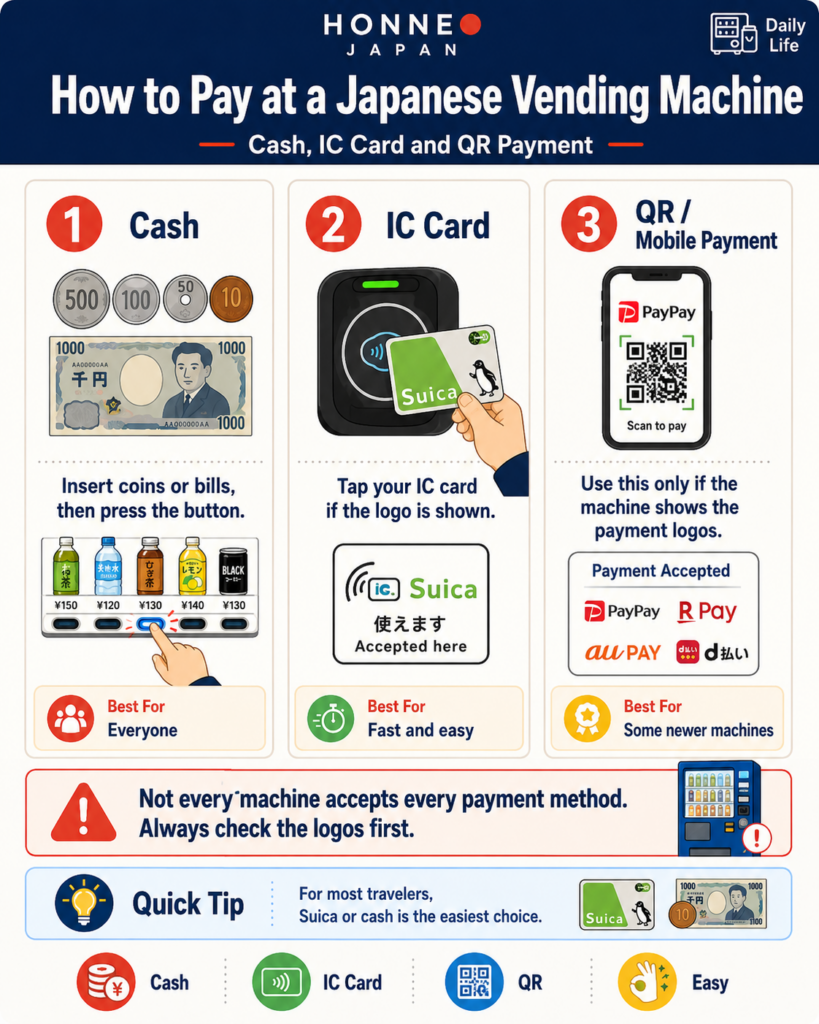
Check the payment area for accepted logos.
Depending on the machine, you may be able to use:
- Cash
- Suica
- PASMO
- Other compatible transportation IC cards
- Electronic money
- Contactless cards
- QR-code payment services
- A dedicated vending-machine app
Many vending machines accept transportation IC cards, but not all of them do. Look for the IC-card logo or reader before trying to tap.
Cashless-enabled machines display stickers or payment panels showing the services they accept. The available options differ by machine.
Step 4: Pay
Paying with Cash
Insert an accepted coin or banknote into the payment slot.
The amount inserted will usually appear on a small display.
Once enough money has been inserted, the available product buttons will light up.
Paying with an IC Card
The order varies slightly by machine, but you will generally:
- Select the product.
- Touch your IC card to the reader.
- Wait for the confirmation sound.
- Collect the drink.
Some machines may ask you to touch the card first and select the product afterward. Follow the lights or screen instructions.
Suica and Welcome Suica can be used for purchases at compatible vending machines displaying the relevant e-money mark.
Paying by QR Code or Smartphone
Some machines allow you to scan a QR sticker, select the product on your phone and choose a supported mobile payment service.
Supported services vary, so always check the payment logos on the machine.
Step 5: Press the Product Button
Press the illuminated button below the product you want.
The machine will release the bottle or can into the collection compartment near the bottom.
On machines with a touchscreen, select the product on the screen and follow the payment instructions.
Step 6: Take Your Drink and Change
Open the product compartment and remove your drink.
When paying with cash, also check:
- The change tray
- The banknote-return area
- The payment display
Some machines return change automatically after the purchase. Others may have a change-return lever or button.
Before walking away, make sure you have collected:
- Your drink
- Your change
- Your IC card or phone
- Any receipt issued by the machine
Can You Use Suica or PASMO?
Yes—on compatible vending machines.
Look for an IC-card logo near the payment reader.
Transportation IC cards can be used at many vending machines, convenience stores and other retail locations, but a machine without the appropriate e-money symbol may require cash or another supported method.
A physical IC card must also have enough stored balance to cover the full price.
Welcome Suica cannot normally combine its stored value with cash for one vending-machine purchase, so recharge the card first when the remaining balance is too low.
Do Japanese Vending Machines Accept Credit Cards?
Some newer machines accept contactless cards or smartphone wallets, but ordinary credit-card acceptance is not universal.
A machine may support:
- Transportation IC cards
- iD
- Rakuten Edy
- Contactless credit cards
- Apple Pay
- Google Pay
- Selected QR-payment services
Only use a payment method whose logo appears on that specific machine. Multi-payment vending machines are marked with a reader panel and acceptance stickers.
For travelers, Suica or cash is often easier than trying several foreign cards.
What Is Coke ON?
Coke ON is Coca-Cola Japan’s smartphone service for compatible vending machines.
Depending on the machine and account setup, users can:
- Connect to a compatible vending machine
- Purchase drinks through a smartphone
- Collect stamps
- Receive drink tickets
- Use supported cashless payment methods
Coca-Cola stated in 2026 that Coke ON was available at more than 530,000 compatible vending machines nationwide.
You do not need Coke ON to use an ordinary Coca-Cola vending machine. It is an optional service for compatible machines.
Hot Drinks from Vending Machines
Hot drinks are one of the features that often surprise first-time visitors.
During cooler seasons, you may find:
- Black coffee
- Café au lait
- Milk tea
- Green tea
- Lemon drinks
- Cocoa
- Corn soup
- Other canned soups
Red labels indicate hot products, while blue labels indicate chilled products.
Be careful when first holding a hot can or bottle, as it may feel warmer than expected.
Where Can You Find Vending Machines in Japan?
Drink vending machines are especially common in places where people need a quick refreshment, including:
- Train and subway stations
- Bus terminals and highway rest areas
- Outside convenience stores and supermarkets
- Near hotels and tourist attractions
- Office and university buildings
- Parks and sports facilities
- Residential streets
- Rural roads and sightseeing areas
Outdoor machines are often accessible 24 hours a day. Machines inside stations, shopping centers, hotels and other facilities are only available while the surrounding area is open.
If one machine does not accept your preferred payment method, another nearby machine may support cash, an IC card or contactless payment.
What Else Can You Buy?
Although beverages are the most common products, Japan also has vending machines selling:
- Ice cream
- Snacks
- Frozen food
- Ramen
- Rice
- Soup stock
- Local produce
- Toys
- Umbrellas
- Masks
- Regional specialties
JNTO notes that the majority of vending machines sell beverages, while specialist machines can sell products ranging from ice cream and rice to prepared meals.
These unusual machines are interesting, but they should not be mistaken for the standard drink machines found on most streets.
Drink Machines vs Restaurant Ticket Machines
A restaurant ticket machine is different from a normal product vending machine.
At many ramen, soba and casual restaurants, you:
- Choose a meal.
- Pay at the machine.
- Receive a paper ticket.
- Give the ticket to the restaurant staff.
- Wait for the meal to be prepared.
The machine does not dispense the food itself.
JNTO notes that many ramen restaurants use meal-ticket machines and require payment before ordering.
This topic deserves its own article:
How to Use Restaurant Ticket Machines in Japan
What Is the Box Beside the Vending Machine?
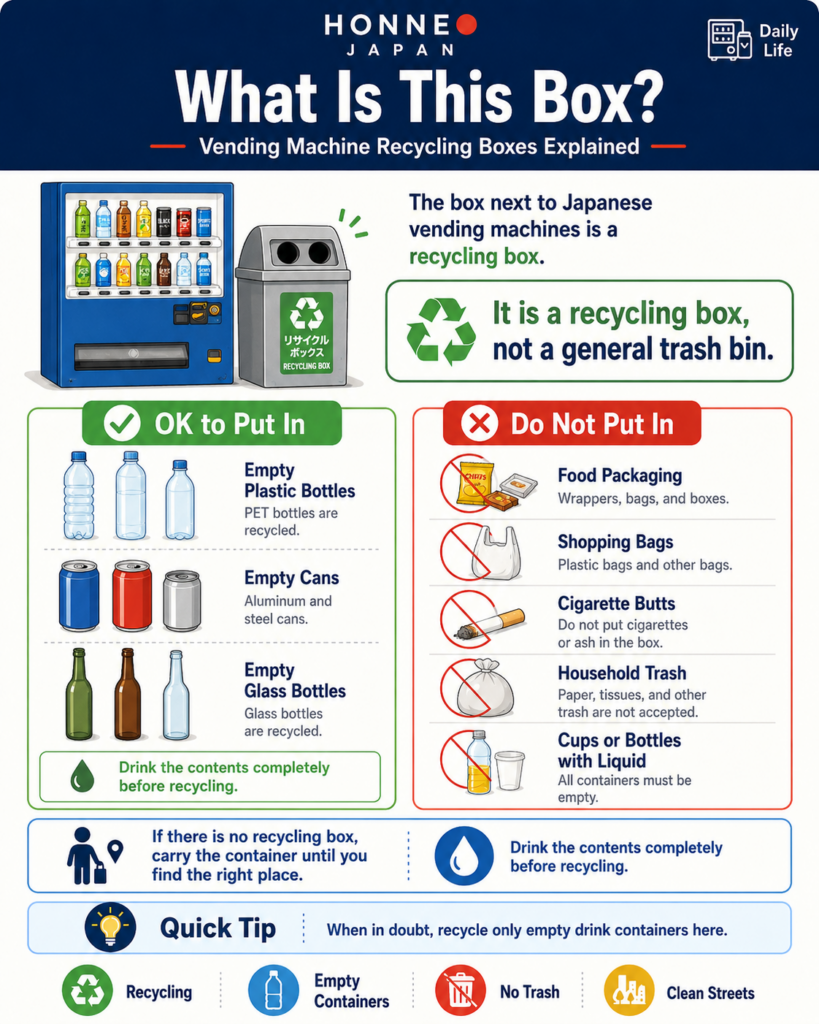
The box beside a drink machine is usually a recycling box, not a general rubbish bin.
It is intended for empty:
- Plastic drink bottles
- Cans
- Glass drink bottles
Do not put in:
- Food packaging
- Plastic cups
- Shopping bags
- Cigarettes
- Batteries
- Household rubbish
- Containers with liquid still inside
Japan’s soft-drink industry explicitly states that vending-machine recycling boxes are for empty beverage containers and that leftover liquid and unrelated waste interfere with recycling.
Drink the contents completely before placing the container inside.
A recycling box is normally installed where appropriate, but one may not be available at every vending-machine location.
What If There Is No Recycling Box?
Keep the empty bottle or can with you until you find an appropriate recycling point.
Possible locations include:
- Another vending-machine area
- A train station
- A convenience store
- Your hotel
- A public recycling station
Do not leave the container beside the machine.
Also avoid putting drink containers into a recycling box that is clearly labelled for another material.
What If the Machine Takes Your Money but Gives No Product?
Look on the front or side of the machine for a management sticker.
It should show information such as:
- Operator or management company
- Telephone number
- Address or machine identification
- QR code for support
The Japan Soft Drink Association advises customers to contact the manager using the details shown on the machine when money is taken but no product is dispensed.
Take a photo of:
- The whole vending machine
- The management sticker
- The product and price
- The location
- Any error message
This makes it easier to explain the problem.
Common Vending-Machine Mistakes
1. Buying a Hot Drink by Accident
Check whether the product label is red or blue.
2. Tapping an IC Card Where It Is Not Accepted
Look for the IC logo before tapping.
3. Using the Wrong Cashless Reader
Some machines have separate readers or QR instructions for different payment services.
4. Walking Away Without Your Change
Always check the change tray after paying with cash.
5. Treating the Recycling Box as a Rubbish Bin
It is intended for empty beverage containers only.
6. Leaving Liquid in the Bottle
Finish or empty the drink before recycling the container.
7. Assuming Every Machine Works the Same Way
Payment order, accepted methods and screen layouts differ.
Pause briefly and follow the illuminated buttons or display.
Vending-Machine Etiquette
Japanese vending machines do not require complicated etiquette, but a few simple habits help.
✅ Do
- Decide what you want before blocking the machine.
- Check whether the drink is hot or cold.
- Collect your drink and change promptly.
- Move aside after purchasing.
- Use the recycling box only for drink containers.
- Keep the area clean.
- Take your container with you when no box is available.
❌ Don’t
- Leave bottles beside the machine.
- Put food rubbish into the recycling box.
- Shake, hit or tilt the machine.
- Block a narrow pavement while choosing.
- Leave children to climb on or play with the machine.
- Force coins into an unsuitable slot.
🇯🇵 HONNE JAPAN PICK
For most first-time visitors, the simplest method is:
Choose a drink, check the red or blue temperature label, look for the Suica logo, tap your IC card and collect the product.
When Suica is not accepted, use cash or check the displayed payment logos.
The most important detail after drinking is also easy to remember:
The box beside the machine is for empty drink containers—not general rubbish.
FAQ
Are Japanese vending machines available 24 hours?
Outdoor machines are generally accessible whenever the surrounding area is open.
Machines located inside stations, malls, offices or attractions can only be used during the facility’s opening hours.
Are drinks expensive?
The price is clearly displayed beside every product.
Prices depend on the product, size, location and machine operator.
Can I use foreign credit cards?
Only when the machine supports the card or contactless wallet being used.
Check the logos on the payment panel.
Can I use Suica?
Yes, on machines displaying the compatible IC-card symbol.
How do I know whether a drink is hot?
Hot drinks normally have a red label. Cold drinks normally have a blue label.
Do vending machines give change?
Cash machines normally have a change tray or return mechanism. Check the lower part of the machine before leaving.
Can I throw other rubbish into the box beside the machine?
No. It is a recycling box for empty beverage containers.
What should I do if the machine does not dispense the product?
Photograph the machine and contact the operator using the telephone number or QR code on the management sticker.
Do all vending machines sell drinks?
No, but beverage machines are the most common. Specialist machines may sell food, ice cream and other goods.
Final Thoughts
Japanese vending machines are designed to make everyday purchases quick and convenient.
Although different machines support different payment systems, the basic process is simple:
- Check the product.
- Confirm whether it is hot or cold.
- Check the accepted payment methods.
- Pay.
- Select the product.
- Collect your drink and change.
Once visitors recognize the red and blue labels, IC-card logo and beverage recycling box, most Japanese vending machines become easy to use.
They are more than a travel novelty—they are a small but highly visible part of Japan’s everyday infrastructure.
Related Articles
- How to Use Suica and PASMO in Japan
- Cash or Credit Card? How to Pay in Japan
- Where Are the Trash Bins in Japan?
- How Japanese Convenience Stores Really Work
- How to Use Restaurant Ticket Machines in Japan
- How to Use Coin Lockers in Japan
- How to Stay Hydrated During a Japanese Summer