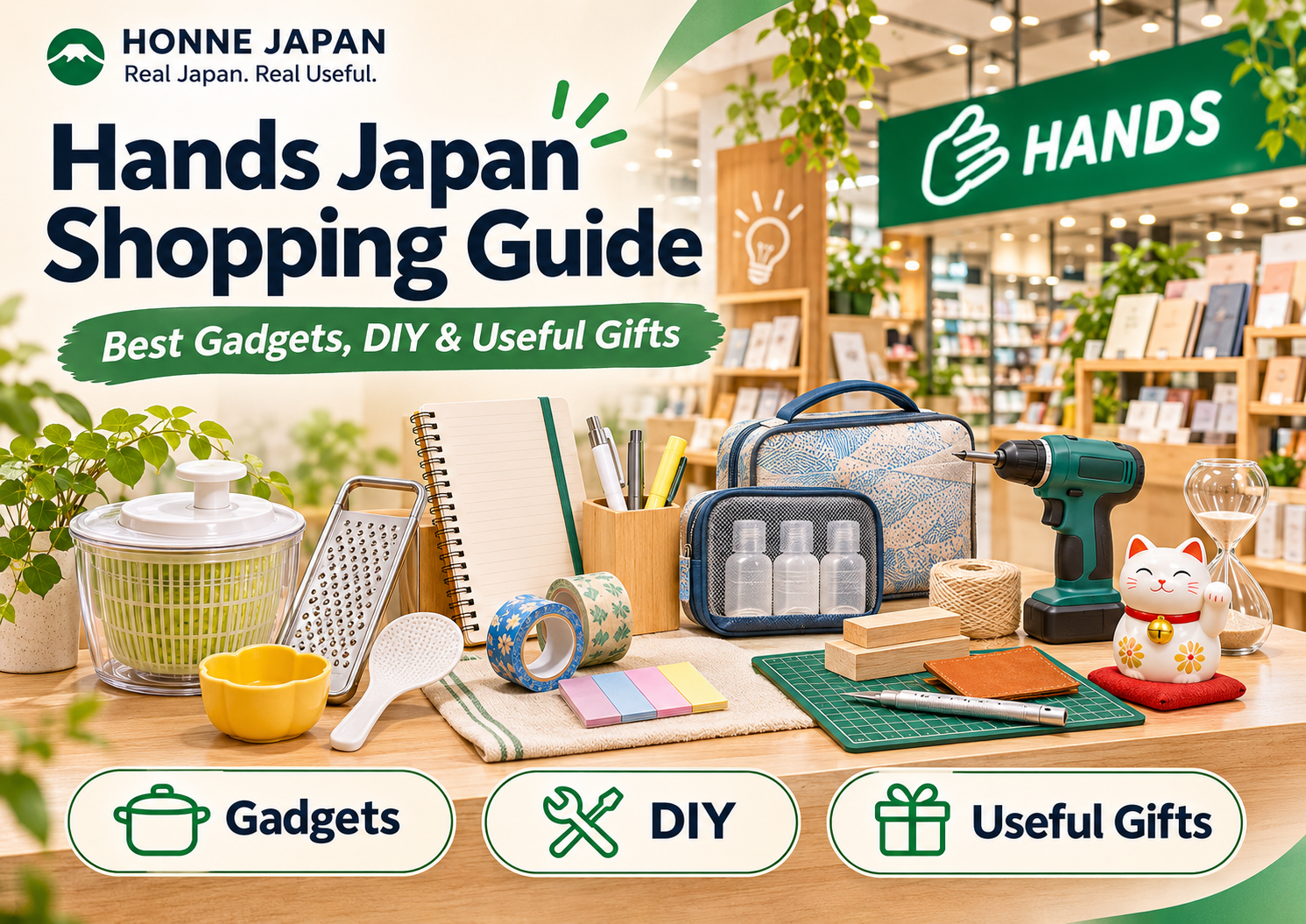
Ever walked into a store looking for one simple item and discovered a hundred things you never knew existed? That’s what shopping at Hands in Japan can feel like.
Formerly known as Tokyu Hands, Hands is one of Japan’s most fascinating lifestyle retailers.
You can find beautifully designed stationery, clever kitchen gadgets, unusual cleaning tools, craft materials, travel accessories and sometimes even specialized tools that would normally belong in a workshop.
Unlike a typical souvenir store, Hands isn’t only about buying something Japanese. It’s about discovering how Japanese products solve everyday problems.
And that’s what makes it worth visiting.
Whether you’re a DIY enthusiast, a stationery lover, a curious traveler or someone looking for a practical gift, this guide will help you discover what to buy at Hands in Japan.
Quick Facts: Hands Japan
| Item | Details |
|---|---|
| Japanese name | ハンズ |
| Former name | Tokyu Hands (東急ハンズ) |
| Founded | 1976 |
| Store type | Lifestyle goods, tools, DIY and specialty products |
| Best for | Creative gadgets, kitchenware, stationery, DIY |
| Suggested shopping budget | ¥500–¥3,000 for small gifts |
| Tax-free shopping | Available at participating stores |
| Store sizes | Large multi-floor stores and smaller locations |
| Recommended visit | 45–90 minutes for a larger store |
Honne Japan Pick: Start with the kitchen gadgets, stationery and household problem-solving products. These sections are especially enjoyable for first-time visitors.
1. What Is Hands Japan?
Hands is a Japanese specialty retail chain that started in 1976 under the name Tokyu Hands.
The company’s original focus was different from that of many modern lifestyle stores.
Instead of selling only finished products, it provided tools, materials and ideas to people who wanted to create, repair or improve things themselves.
That philosophy helped make Hands a distinctive destination in Japan.
It was a place for people who enjoyed making things, discovering unusual materials and exploring hobbies.
Today, Hands has expanded into stationery, beauty products, kitchen goods, travel accessories, gifts and much more.
But the original spirit of creativity and practical problem-solving remains an important part of its identity.
Is Tokyu Hands the Same as Hands?
Yes.
The company previously operated under the Tokyu Hands name, but it was renamed Hands following a change in ownership.
The familiar green hand-shaped logo was also replaced.
You may still encounter the old name in travel blogs, older guidebooks and online discussions.
If someone recommends visiting Tokyu Hands, they’re referring to the retail chain now called Hands.
2. Best Things to Buy at Hands Japan
What makes Hands interesting isn’t simply the number of products.
It’s the variety of ideas behind them.
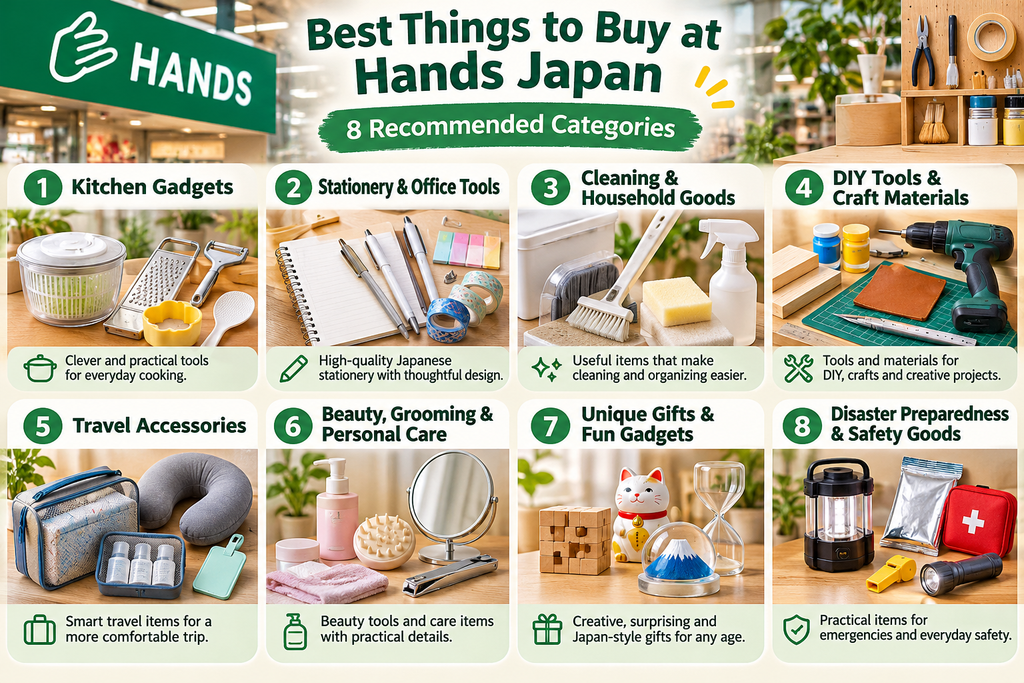
Here are eight categories we recommend exploring.
1. Clever Japanese Kitchen Gadgets
Best for: Home cooks, food lovers and practical gifts.
Japanese kitchen tools are among the most enjoyable things to discover at Hands.
You may encounter familiar products redesigned to make everyday tasks easier.
Look for:
- Compact vegetable peelers and slicers
- Rice preparation accessories
- Bento-making tools
- Food storage containers
- Precision measuring spoons
- Useful cooking utensils
- Coffee and tea preparation tools
- Space-saving kitchen accessories
Some products have specialized functions that might seem unusual at first.
But once you understand the problem they’re designed to solve, they can make perfect sense.
Honne Japan Tip: Look for small kitchen tools that fit easily into your suitcase. They often make better souvenirs than bulky cookware.
2. Japanese Stationery and Office Tools
Best for: Students, office workers and stationery enthusiasts.
Hands is an excellent destination for Japanese stationery.
You’ll find familiar brands alongside products with surprisingly thoughtful details.
Depending on the store, you might discover:
- Mechanical pencils
- Gel pens and refills
- Specialty erasers
- Notebooks and planners
- Scissors and paper cutters
- Desk organizers
- Stamps and labeling tools
- Art and design materials
Japanese stationery often focuses on precision, durability and ease of use.
A pen that writes smoothly, a compact stapler or a cleverly designed notebook can make an ordinary task more enjoyable.
Gift idea: A quality Japanese mechanical pencil combined with a notebook is a practical gift that appeals to many ages.
3. Cleaning and Household Problem-Solvers
Best for: People who enjoy useful everyday products.
This category represents something particularly interesting about Japanese product design.
There seems to be a specialized tool for almost every household inconvenience.
Hands may carry:
- Narrow cleaning brushes
- Specialized sponges
- Laundry accessories
- Compact storage products
- Shoe-care supplies
- Repair tapes and adhesives
- Hooks and organizing tools
- Seasonal household accessories
Some products are designed for very specific spaces or tasks.
A brush might fit an awkward corner. A storage tool might make better use of a small apartment. A repair accessory might extend the life of a favorite item.
These products help explain how everyday practicality influences Japanese design.
4. DIY Tools and Craft Materials
Best for: Makers, hobbyists and creative travelers.
This is where Hands has a character of its own.
Larger stores may offer products that are difficult to find in ordinary lifestyle shops.
Depending on the branch, categories can include:
- Woodworking materials
- Hand tools and measuring equipment
- Model-making supplies
- Paints and adhesives
- Leathercraft materials
- Resin and jewelry-making supplies
- Sewing and handicraft accessories
- Art and design supplies
Some larger locations also offer workshops, demonstrations or specialized services.
This is an especially enjoyable section if you like building, repairing or creating things.
Honne Japan Tip: Tools, blades, paints, adhesives and chemicals may be restricted in airline baggage. Check your airline’s rules before purchasing.
5. Travel Accessories
Best for: Tourists and frequent travelers.
Hands is worth visiting if you want to make your trip more comfortable.
Look for practical accessories such as:
- Packing organizers
- Travel pouches
- Compact umbrellas
- Luggage accessories
- Toiletry containers
- Portable organizers
- Travel-size personal-care items
- Useful everyday bags
Products designed for compact storage are particularly interesting, reflecting the importance of efficient organization in many Japanese homes.
6. Beauty, Grooming and Personal Care
Best for: Personal shopping and practical gifts.
Hands also carries a broad selection of beauty and personal-care products.
At larger stores, you may find:
- Skincare
- Hair brushes and grooming accessories
- Nail-care tools
- Bath products
- Oral-care accessories
- Beauty tools
- Men’s grooming products
- Wellness and relaxation goods
Hands is particularly worth exploring if you’re interested in beauty tools and accessories rather than cosmetics alone.
However, everyday skincare may be cheaper at drugstores.
If price is your main priority, compare products before purchasing.
7. Unique Japanese Gifts and Fun Gadgets
Best for: Friends, family and people who enjoy unusual products.
Hands can be a surprisingly good place for gifts.
The most interesting options aren’t always traditional Japanese souvenirs.
You might find:
- Clever desk accessories
- Small educational science kits
- Creative puzzles
- Unusual household gadgets
- Specialty stationery
- Hobby accessories
- Seasonal novelty products
A useful or amusing item can make a more personal gift than a conventional souvenir.
Gift idea: Choose something connected to the recipient’s interests. Hands is particularly good when shopping for someone who enjoys cooking, making things, organizing or trying new gadgets.
8. Disaster Preparedness and Safety Goods
Best for: Travelers interested in Japanese everyday preparedness.
Japan experiences earthquakes, typhoons and other natural hazards.
As a result, disaster preparedness is part of everyday life for many households.
Hands stores may sell practical emergency supplies such as:
- Emergency flashlights
- Portable emergency toilet kits
- Compact first-aid supplies
- Emergency whistles
- Battery-powered accessories
- Storage and preparedness products
These items offer an interesting glimpse into a part of Japanese daily life that tourists may not notice.
Not everything is suitable as a souvenir, especially products containing batteries, chemicals or restricted materials.
Still, browsing this section can be educational.
3. Why Hands Is More Than Just a Shopping Store
There was a time when Hands occupied a very different place in Japanese retail culture.
Before the rise of today’s familiar lifestyle chains, Tokyu Hands had already become a destination for people who wanted something more specialized than ordinary household merchandise.
The original concept was closely connected to DIY, creativity and the idea of making things with your own hands.
At a large Hands store, you could discover materials, tools and parts that weren’t easy to find elsewhere.
You didn’t necessarily need to know exactly what you wanted before visiting.
Sometimes the products themselves inspired a new idea.
The Legendary Shibuya Hands
One of the most famous examples was the Shibuya flagship store.
Opened in September 1978, it became a destination for hobbyists, designers, makers and curious shoppers.
The building’s unusual arrangement of interconnected floors was part of the experience.
You could move through sections dedicated to tools, woodworking, crafts, stationery, science supplies and everyday products.
For many visitors, exploring the store felt less like ordinary shopping and more like discovering a world of possibilities.
Shibuya Store Update: Closed November 15, 2026
The historic Hands Shibuya store closed on November 15, 2026, following the expiration of its property lease.
If an older guide recommends the original Tokyu Hands building in Shibuya, that location is no longer open.
This closure does not mean that all Hands stores in Shibuya have closed. Hands Shibuya Scramble Square is a separate location and remains an alternative for visitors shopping in the area.
For a wider selection of DIY and craft supplies, consider Hands Shinjuku. Check the official Hands store directory before planning your visit.
What Makes Hands Different Today?
The answer is still closely connected to its origins.
While other retailers specialize in minimalist design, fashion, cosmetics or gifts, Hands continues to offer a distinctive combination of practical products, creative materials and specialized tools.
It’s a place where an everyday inconvenience can become the starting point for an interesting product.
4. Hands vs LOFT vs MUJI vs Standard Products
All four retailers are worth visiting, but they offer different experiences.
| Store | Main Strength | Best For |
|---|---|---|
| Hands | Tools, problem-solving products, crafts and gadgets | Makers and curious shoppers |
| LOFT | Gifts, stationery, cosmetics and trendy accessories | Souvenir shopping |
| MUJI | Simple, functional everyday products | Minimalist essentials |
| Standard Products | Affordable, coordinated lifestyle goods | Stylish homeware and small gifts |
Hands vs LOFT
LOFT is particularly enjoyable when you’re looking for gifts, colorful stationery, cosmetics or lifestyle accessories.
Hands has a stronger identity around practical solutions, DIY, tools and creative projects.
Choose LOFT for fun gift shopping.
Choose Hands if you enjoy understanding how things work or discovering an unusual tool.
Hands vs MUJI
MUJI focuses on simplicity, consistency and practical design.
Hands offers a wider variety of specialty products and brands, including tools and materials for specific purposes.
Choose MUJI for straightforward, minimalist everyday goods.
Choose Hands for specialized items and unusual solutions.
Hands vs Standard Products
Standard Products is known for affordable lifestyle goods with understated design.
Hands is more varied in product purpose, brand selection and price.
Choose Standard Products for home accessories that look coordinated and attractive.
Choose Hands for practical tools, hobby materials and gadgets.
5. How Much Do Things Cost at Hands Japan?
Hands is not a discount chain.
Prices vary widely because it sells everything from everyday stationery to specialized tools and premium equipment.
Here are suggested shopping budgets for several common categories.
| Category | Suggested Budget |
|---|---|
| Pens and small stationery | ¥200–¥1,000 |
| Useful kitchen accessories | ¥500–¥3,000 |
| Cleaning and storage tools | ¥300–¥2,000 |
| Travel accessories | ¥500–¥3,000 |
| Personal-care accessories | ¥500–¥4,000 |
| Small gifts and gadgets | ¥500–¥3,000 |
| Specialty DIY tools and materials | Varies widely |
These are planning estimates, not verified prices for individual products.
Is Hands Expensive?
For simple household products, you may find cheaper alternatives at DAISO or other discount retailers.
However, Hands is valuable for its product variety and specialized selection.
You might find a tool that solves a very specific problem, or a product whose design and durability make it worth the higher price.
The most interesting question isn’t always whether an item is cheap.
It’s whether it does something useful that other products don’t.
6. Best Hands Gifts by Recipient
Hands can be an excellent gift-shopping destination if you know the recipient’s interests.
| Recipient | Gift Ideas |
|---|---|
| Students | Japanese pens, notebooks, desk accessories |
| Home cooks | Kitchen gadgets, precision tools |
| DIY enthusiasts | Compact tools, craft accessories |
| Artists and designers | Specialty stationery, drawing supplies |
| Frequent travelers | Packing accessories, organizers |
| Families | Educational kits, puzzles, everyday gadgets |
| Coworkers | Practical desk items, small accessories |
Honne Japan Pick: For someone who enjoys solving problems or making things, Hands may be more interesting than a traditional souvenir shop.
7. Where to Find Hands Stores in Japan
Hands operates stores across Japan, including large city-center locations and smaller stores inside commercial facilities.
The product selection varies significantly by store size.
Hands Shinjuku — Tokyo
Hands Shinjuku is a strong choice if you want to explore a large store with multiple product categories.
It’s located in the Takashimaya Times Square complex, near Shinjuku Station.
The store spans several floors and offers a broad selection of lifestyle products.
Hands Tokyo — Tokyo Station
Hands Tokyo is located in the Daimaru Tokyo building, close to Tokyo Station.
It’s convenient if you’re traveling by train or want to shop before leaving Tokyo.
The store includes stationery, travel products, kitchenware, beauty products and other practical goods.
Hands Shibuya Scramble Square — Shibuya
If you want to visit Hands while exploring Shibuya, consider the Shibuya Scramble Square location, on the 10th floor of the shopping complex directly connected to Shibuya Station.
This is a different store from the historic Hands Shibuya branch that closed in November 2026.
It is an option for beauty products and stationery. For DIY materials or specialized tools, check the store’s current departments before visiting.
Other Hands Stores
There are additional locations in Tokyo and cities throughout Japan.
Smaller stores may focus more heavily on stationery, cosmetics, gifts and popular household items.
If you’re interested in DIY tools or specialty materials, check the floor guide before visiting.
IImportant: The historic Hands Shibuya store closed on November 15, 2026. Hands Shibuya Scramble Square is a separate location.
Use the official Hands store directory to check current locations, opening hours and store services.
8. Is Hands Tax-Free for Tourists?
Tax-free shopping is available at participating Hands locations.
However, availability and procedures can differ by store.
Japan’s New Tax-Free Rules in 2026
From November 1, 2026, Japan uses a refund-based tax-free shopping system.
At a participating store, eligible visitors generally:
- Choose qualifying products meeting the minimum purchase requirements.
- Present their passport or other accepted identification.
- Pay the full price including Japanese consumption tax.
- Register the necessary refund details.
- Complete customs confirmation when leaving Japan.
- Receive the applicable refund after confirmation.
The general minimum purchase amount is ¥5,000 before tax at the same participating store on the same day.
Customs confirmation must be completed within 90 days of purchase.
The goods must be available for inspection if requested.
Honne Japan Tip: Ask the store about tax-free eligibility and refund procedures before paying, especially if you’re purchasing expensive items.
For detailed instructions, see our Tax-Free Shopping in Japan 2026 Guide.
9. Shopping Tips for First-Time Visitors
Don’t Rush Through the Store
Hands is a store that rewards curiosity.
You might discover something interesting in a category you weren’t planning to explore.
Check the Floor Guide
Larger stores can have many departments.
Use the store map to locate specialty tools, craft materials or particular product categories.
Look for Products That Solve Problems
Instead of searching only for famous Japanese souvenirs, think about everyday inconveniences you or someone you know would like to solve.
Hands is especially interesting when you shop with that mindset.
Don’t Assume Everything Is Made in Japan
Hands sells products from Japanese and international manufacturers.
Check the packaging for country-of-origin information if you specifically want Japanese-made goods.
Be Careful With Airline Restrictions
Scissors, craft blades, tools, paints, adhesives, aerosols and some batteries may be restricted in cabin or checked baggage.
Check the airline and destination country’s rules before purchasing unusual items.
Compare Prices When Buying Everyday Goods
For common stationery, cosmetics or household supplies, Hands may not always have the lowest price.
Its real advantage is the breadth of products and the possibility of discovering something unexpected.
10. Is Hands Worth Visiting?
Yes—especially if you enjoy discovering products that are useful, unusual or thoughtfully designed.
Hands offers a different shopping experience from LOFT, MUJI and ordinary Japanese souvenir stores.
It’s less about one particular design style and more about the countless ways products can make everyday life easier or more interesting.
You don’t need to be a DIY expert to enjoy visiting.
You might discover a brilliant kitchen accessory, a beautifully engineered pen, a compact travel organizer or an unexpected household solution.
And if you enjoy making things, some stores offer an even deeper world of specialized materials and tools.
That’s the enduring appeal of Hands.
Frequently Asked Questions
Is Hands the same as Tokyu Hands?
Yes. Tokyu Hands was renamed Hands following a change in ownership.
What is Hands Japan famous for?
Hands is known for its wide selection of stationery, DIY products, craft materials, kitchenware, household gadgets and specialty lifestyle goods.
Is Hands better than LOFT?
It depends on your interests. Hands is particularly interesting for tools, practical gadgets and crafts. LOFT is often more appealing for gifts, stationery and trendy lifestyle accessories.
Is Hands good for souvenirs?
Yes. Useful Japanese stationery, compact kitchen accessories, creative gadgets and hobby-related products can make excellent souvenirs.
Are all Hands products made in Japan?
No. Hands sells Japanese and international products. Check individual labels for country-of-origin information.
Is the Shibuya Hands store still open?
The historic Hands Shibuya store closed on November 15, 2026. However, Hands Shibuya Scramble Square is a separate location that continues to operate. Check the official store directory to make sure you are heading to the correct branch.
Can tourists shop tax-free at Hands?
Yes, at participating stores and subject to eligibility requirements. Japan’s refund-based system applies to purchases made from November 1, 2026.
Does Hands sell DIY materials?
Yes. Some larger stores sell woodworking, craft, repair and specialty materials, although the assortment varies by location.
Can I pay by credit card?
Major Hands locations generally accept credit cards and other cashless payment methods. Available methods vary by store.
Do Hands employees speak English?
English-language support depends on the location and staff. Some large stores provide multilingual information, but English-speaking assistance is not guaranteed.
Final Thoughts: Discover Japan’s Creative Side
Hands is more than a place to buy stationery or household accessories.
It’s a store that reflects an interesting part of Japanese everyday life: the desire to improve, repair, organize and create.
From specialized tools to clever kitchen accessories, many of its products reveal how much thought can go into solving a small problem.
If LOFT is a place to find a thoughtful gift, MUJI is a place to appreciate simplicity, and Standard Products is a place to discover affordable design, Hands is a place to discover ideas.
And sometimes, the best souvenir from Japan is something that makes you think:
“Why didn’t anyone invent this sooner?”
Continue Exploring Japan
- LOFT Japan Shopping Guide — Creative gifts, stationery and souvenirs.
- MUJI Japan Shopping Guide — Minimalist Japanese products for everyday life.
- Standard Products Japan Guide — Affordable tableware, fragrances and home accessories.
- 3COINS Japan Guide — Trendy gadgets and lifestyle products.
- How to Shop at DAISO in Japan — Japan’s famous discount store explained.
- Tax-Free Shopping in Japan 2026 — The new refund system and customs procedures.
Official Resources
- Hands Official Website
- Hands Store Directory (English)
- Hands Shinjuku
- Hands Tokyo
- Japan Tourism Agency — Tax-Free Shopping
- Hands Shibuya — Official Closure Notice (Japanese)
General guide information checked November 9, 2026. Shibuya store closure and alternative-location information updated November 16, 2026. Check official store pages for current opening hours, product availability and tax-free services.
1 thought on “Hands Japan Shopping Guide: Best Gadgets, DIY & Unique Gifts”
Comments are closed.