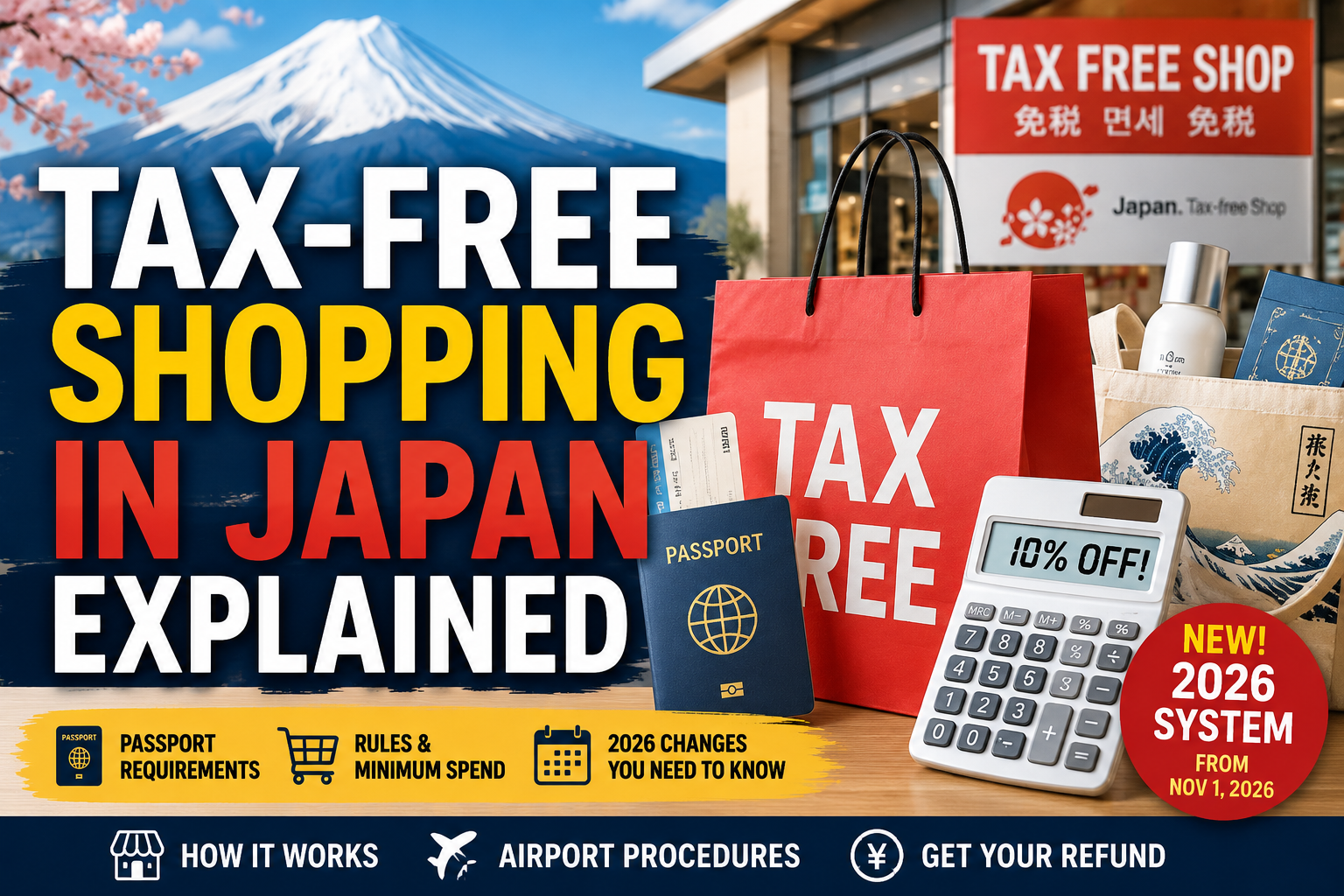
Rules, Passport Requirements and the New Refund System from November 2026
Tax-free shopping can make souvenirs, clothing, cosmetics, electronics and other purchases more affordable during your trip to Japan.
However, the rules are not always easy to understand.
You may wonder:
- Who is eligible for tax-free shopping?
- Do I need to carry my passport?
- How much do I need to spend?
- Can I open or use the items in Japan?
- Do I need to show the goods at the airport?
- Is the system changing in 2026?
The most important point is that Japan’s tax-free shopping system will change on November 1, 2026.
For purchases made up to October 31, 2026, eligible visitors generally receive the consumption-tax exemption at the store.
For purchases made on or after November 1, 2026, shoppers will initially pay the tax-inclusive price. The tax-equivalent amount will be refunded after customs confirms that the goods are being taken out of Japan.
This guide explains both systems so you know exactly what to expect.
Quick Answer: How Tax-Free Shopping Works
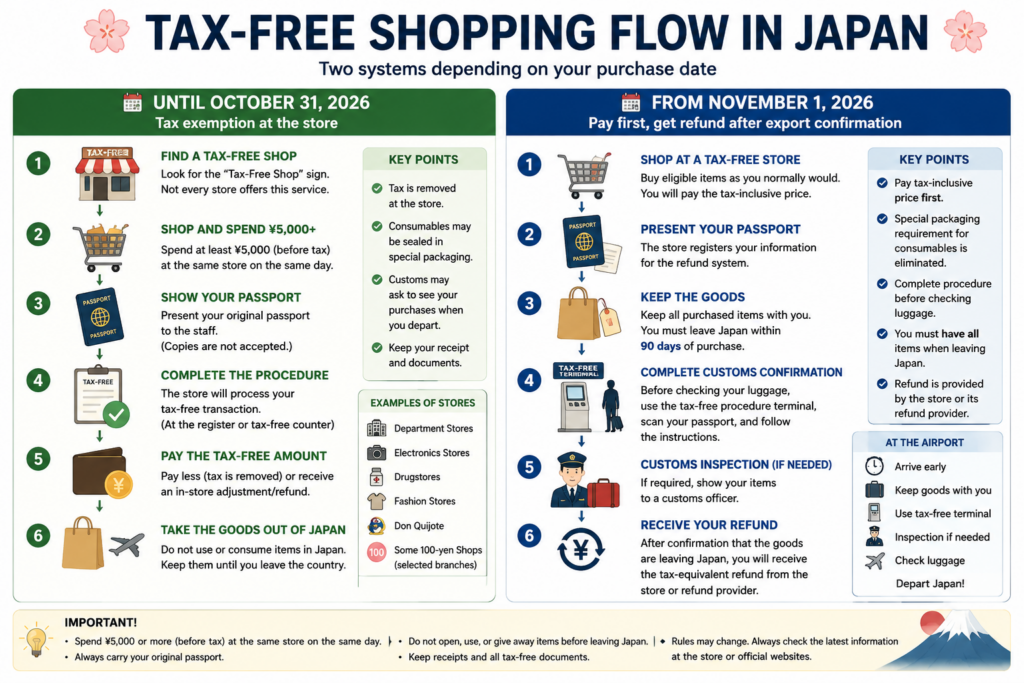
Until October 31, 2026
The typical process is:
- Shop at a registered tax-free store.
- Spend at least the required minimum.
- Present your original passport.
- Complete the tax-free procedure at the store.
- Receive the exemption or refund at the point of purchase.
- Take the goods out of Japan when you leave.
From November 1, 2026
The process will change:
- Buy the products at the tax-inclusive price.
- Present the required identification at the store.
- Keep all eligible goods with you.
- Leave Japan within 90 days of the purchase.
- Complete the required customs confirmation before departure.
- Receive the tax-equivalent refund from the store or its appointed refund provider.
What Is Tax-Free Shopping in Japan?
Japan imposes consumption tax on most goods and services.
Under the tax-free shopping system, eligible non-resident visitors can purchase qualifying goods without ultimately bearing that consumption tax, provided that the products are taken out of Japan and all applicable conditions are met.
Typical tax-free purchases include:
- Clothing
- Shoes
- Bags
- Watches
- Electronics
- Cosmetics
- Food
- Beverages
- Medicine
- Souvenirs
The system is available only at registered tax-free shops. Spending enough money at a normal store does not automatically make the purchase tax-free.
Tax-Free vs Duty-Free: What Is the Difference?
The expressions tax-free and duty-free are sometimes used interchangeably, but they can refer to different systems.
Tax-Free Shopping
Tax-free stores located in cities generally provide an exemption or refund related to Japanese consumption tax.
You may find them in:
- Department stores
- Electronics shops
- Drugstores
- Fashion stores
- Shopping malls
- Souvenir shops
- Selected branches of major retail chains
Duty-Free Shopping
Duty-free stores are often found in international airport departure areas.
Depending on the product, purchases may be exempt from consumption tax as well as certain customs duties or product-specific taxes.
For ordinary shopping in cities, visitors are usually using the tax-free shopping system, not an airport duty-free allowance.
Who Is Eligible for Tax-Free Shopping?
Tax-free shopping is principally designed for eligible non-residents temporarily visiting Japan.
Eligibility depends on factors such as:
- Your residency status
- Your immigration status
- The date you entered Japan
- The identification document you present
- Whether the purchase meets the tax-free requirements
Eligible foreign visitors generally need to present their passport at the tax-free store. Certain travelers arriving by cruise ship may use an applicable landing or tourist permit instead.
Japanese citizens who normally live abroad may also qualify in certain circumstances, but additional proof of overseas residence may be required.
Because eligibility is determined from official entry and identity information, do not assume that nationality alone determines whether you qualify.
Do You Need Your Passport?
Yes, in most cases you should carry your original passport when planning to shop tax-free.
A photograph, photocopy or ordinary ID card may not be sufficient because the store must verify the information required for the tax-free record.
Under the current system, the tax-free shop transmits purchase and passport-related information electronically to the relevant authorities. When leaving Japan, travelers may be required to present their passport to customs.
A practical rule is:
No original passport, no guaranteed tax-free procedure.
Do not leave your passport in the hotel if you intend to make a tax-free purchase that day.
How Much Do You Need to Spend?
Under the current rules, the commonly applied minimum is:
At least ¥5,000 before tax at the same tax-free shop on the same day.
Purchases from different stores usually cannot be combined.
Purchases made on separate days usually cannot be combined either.
For example:
| Purchase | Qualifies? |
|---|---|
| ¥5,500 before tax at one participating store | Usually yes |
| ¥3,000 at one store and ¥3,000 at another | Usually no |
| ¥3,000 today and ¥3,000 tomorrow at the same store | Usually no |
| ¥6,000 at a store that is not registered tax-free | No |
The ¥5,000 threshold and same-store, same-day principle are also stated in official visitor guidance for the new refund system.
How Can You Find a Tax-Free Store?
Look for signs such as:
- Tax-Free Shop
- Japan Tax-Free Shop
- 免税
- Tax Refund
- Duty Free
The sign may appear:
- Near the entrance
- At the register
- On a store directory
- Beside the customer-service counter
- On the store’s website
Do not assume that every location of a major chain provides tax-free shopping.
One branch may offer the service while another does not.
When unsure, ask:
Is tax-free shopping available here?
or:
Tax-free wa dekimasu ka?
What Can You Buy Tax-Free?
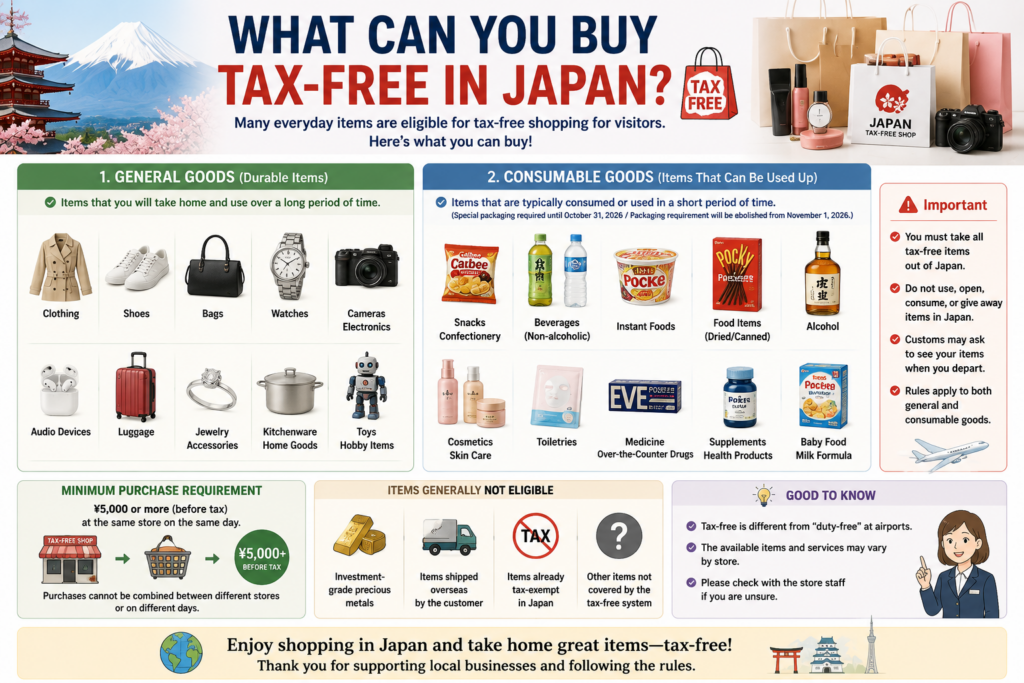
Many ordinary products purchased for personal use can qualify.
General Goods
Examples include:
- Clothing
- Shoes
- Bags
- Watches
- Jewelry
- Cameras
- Electronics
- Kitchenware
- Toys
- Souvenirs
Consumable Goods
Examples include:
- Food
- Drinks
- Alcohol
- Cosmetics
- Toiletries
- Medicine
- Supplements
Official visitor guidance confirms that both durable goods such as home appliances and watches and consumables such as food and cosmetics can fall within the tax-free system when the requirements are met.
Certain goods, including some investment-related precious-metal products and items already exempt from consumption tax, may be excluded.
General Goods vs Consumables
This distinction is especially important under the system in effect through October 31, 2026.
General Goods
General goods are durable items intended to remain usable over time.
Examples:
- Clothing
- Electronics
- Watches
- Bags
- Shoes
- Household items
Consumables
Consumables are items that can be used up relatively quickly.
Examples:
- Food
- Beverages
- Cosmetics
- Medicine
- Toiletries
- Alcohol
Under the current system, consumables may be placed in special sealed packaging because they are not supposed to be opened or consumed in Japan.
From November 1, 2026, the special packaging requirement will be abolished under the refund method. However, the goods must still be available for customs confirmation when you leave Japan. Items consumed or missing at departure may not qualify for the refund.
How the Current Tax-Free System Works
For Purchases Made Until October 31, 2026
The exact procedure varies by retailer, but the typical process is as follows.
Step 1: Shop at a Participating Store
Confirm that the store or shopping complex offers tax-free procedures.
Step 2: Meet the Minimum Purchase Requirement
Your eligible purchase usually needs to total at least ¥5,000 before tax at that store on that day.
Step 3: Present Your Passport
Show your original passport or other accepted document.
Step 4: Complete the Procedure
The process may take place:
- Directly at the register
- At a separate tax-free counter
- At a customer-service desk
- At a central counter inside a shopping mall
Step 5: Receive the Tax Benefit
Depending on the retailer, you may:
- Pay the tax-free amount directly
- Pay the tax-inclusive amount and receive an immediate store refund
- Receive a refund after a processing fee is deducted
Step 6: Keep the Goods and Records
Keep:
- The purchased products
- Your receipt
- Any store documents
- The sealed packaging, where applicable
Step 7: Take the Products Out of Japan
The goods must be exported from Japan.
Customs may request that you present your passport and tax-free purchases when you depart.
The New Refund System from November 1, 2026
Japan will switch to a refund-based tax-free shopping system for purchases made on or after November 1, 2026.
The fundamental change is:
You pay the tax-inclusive price first and receive the tax-equivalent amount later, after export confirmation.
The Japan Tourism Agency states that the refund will be provided by the tax-free shop or a refund provider appointed by that shop.
How the New Refund Method Will Work
Step 1: Buy the Goods at the Tax-Inclusive Price
You will pay the normal price including consumption tax.
Step 2: Present the Required Document
The store will verify your tax-free eligibility and register the transaction.
Step 3: Keep All the Purchased Goods
The products must remain available for export confirmation.
Step 4: Depart Within 90 Days
You must complete the departure confirmation within 90 days of the purchase date.
Step 5: Complete Customs Confirmation
Before departure, customs must confirm that the goods are being taken out of Japan.
You may need to:
- Scan your passport
- Use a designated tax-free terminal
- Present the purchased products
- Follow instructions for an additional inspection
Step 6: Receive the Refund
Once the export confirmation has been completed, the relevant store or refund provider will issue the tax-equivalent refund according to its procedure.
The payment method and timing may vary by retailer or refund provider.
Current System vs New Refund System
| Item | Until October 31, 2026 | From November 1, 2026 |
|---|---|---|
| Price paid at store | Usually tax-exempt or immediately adjusted | Tax-inclusive price |
| Main tax benefit | At the store | After customs export confirmation |
| Passport check | At the store | At the store and during departure procedure |
| Consumable packaging | Special packaging may apply | Special packaging abolished |
| Departure deadline | Goods must be exported as required | Customs confirmation within 90 days |
| Refund provider | Store procedure | Store or appointed refund provider |
| Key risk | Opening or using restricted goods | Missing goods at departure means no refund |
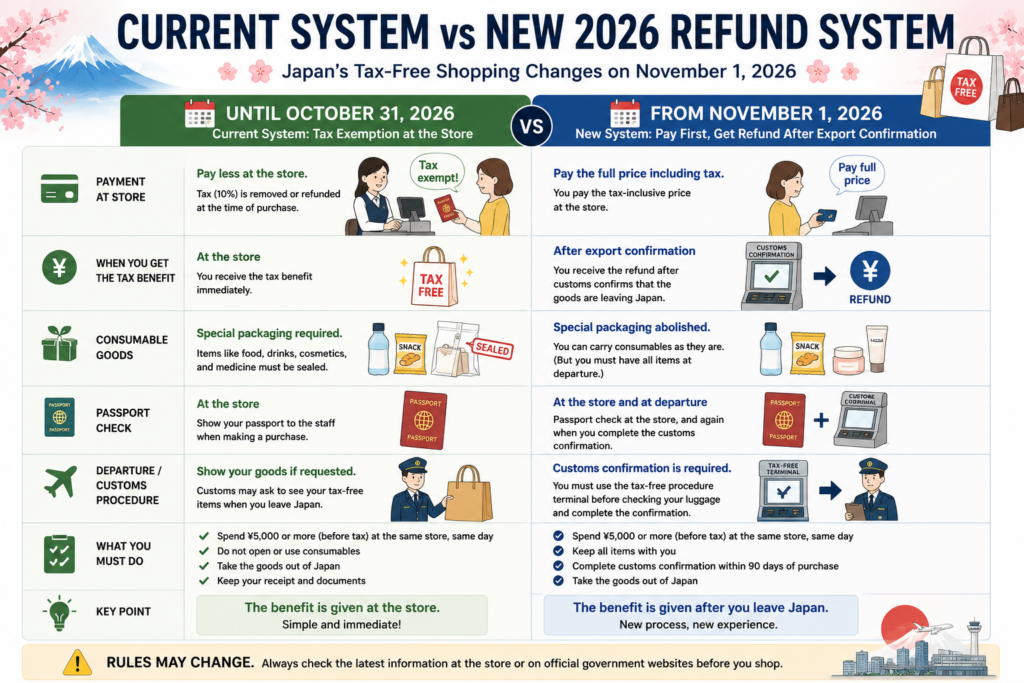
The new system is intended to verify more directly that tax-free purchases are actually leaving Japan.
What Should You Do at the Airport from November 2026?
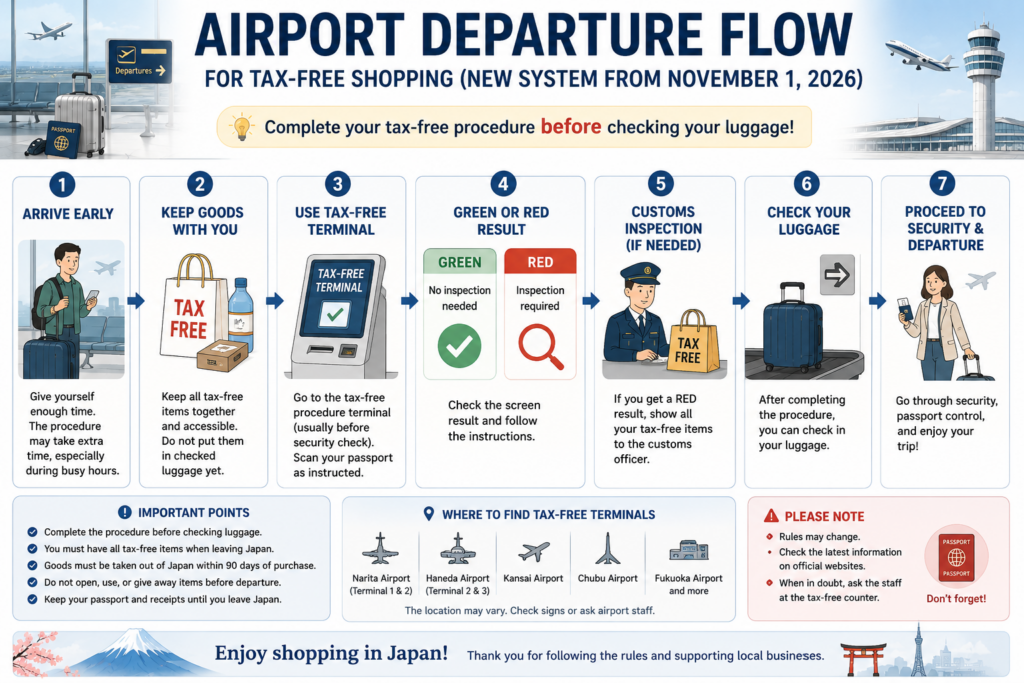
Under the new system, departure procedures will become much more important.
Arrive Earlier Than Usual
Allow extra time, especially if you have many tax-free purchases.
Keep the Products Accessible
Do not bury all tax-free goods at the bottom of inaccessible luggage.
Customs may ask to inspect them.
Complete the Procedure Before Checking Relevant Luggage
When tax-free goods will be placed in checked baggage, complete the required export confirmation before handing the luggage to the airline.
The official guidance specifically warns that travelers need the goods available for customs inspection.
Have Your Passport Ready
The passport is required to connect you with the recorded tax-free purchases.
Follow the Terminal Result
Depending on the system, you may receive:
- Confirmation that no additional inspection is needed
- Instructions to report to a customs-inspection area
Do Not Leave the Procedure Until the Last Minute
A large airport may require walking between:
- Tax-free terminals
- Customs areas
- Airline counters
- Security checkpoints
- Departure gates
Build enough time into your schedule.
Can You Put Tax-Free Goods in Checked Luggage?
Yes, but timing matters.
Under the current and future systems, customs may need to confirm that you possess the goods.
From November 1, 2026, travelers should complete the necessary customs procedure before checking luggage containing tax-free purchases, because the goods may need to be shown during confirmation.
A practical sequence is:
- Arrive at the airport.
- Keep the tax-free goods with you.
- Complete the tax-free customs procedure.
- Check the luggage.
- Continue through security and immigration.
Do not check the suitcase first and then discover that customs wants to inspect the products inside it.
Can You Open or Use Tax-Free Goods?
Until October 31, 2026
For consumable goods placed in special tax-free packaging, do not open the package or use the goods in Japan.
Examples include:
- Cosmetics
- Food
- Drinks
- Medicine
- Toiletries
General goods may be treated differently, but the products must still be taken out of Japan.
From November 1, 2026
Special consumable packaging will no longer be required.
However, all eligible goods must still be present when you leave Japan and complete the export-confirmation process.
Therefore:
- Do not eat tax-free food in Japan.
- Do not finish tax-free cosmetics before departure.
- Do not give the products to someone living in Japan.
- Do not leave the items at your hotel.
- Do not discard the items before customs confirmation.
If the goods cannot be confirmed as leaving Japan, you may not receive the refund.
Can You Mail Tax-Free Goods Home?
This rule has already changed.
From April 1, 2025, travelers generally cannot qualify for tax-free shopping by personally sending the purchased goods overseas through an international parcel service.
The goods normally need to accompany the traveler and be available for customs confirmation at departure.
There may be different treatment where the tax-free retailer itself arranges an eligible direct shipment, but not every store provides such a service.
Ask the retailer before purchasing.
Will You Always Save Exactly 10%?
Not necessarily.
Japan’s standard consumption-tax rate is commonly 10%, while a reduced rate applies to certain qualifying food and beverage transactions.
In addition, the amount you receive may differ from a simple “10% off” calculation because:
- The tax is calculated from the tax-exclusive price.
- A refund counter may charge a handling fee.
- A retailer may use an external refund provider.
- Different product categories may have different tax treatment.
- The displayed price may already include tax.
- Foreign-currency conversion or card fees may apply.
For example, if an item costs ¥11,000 including 10% tax, the tax-exclusive price is ¥10,000 and the tax component is ¥1,000—not ¥1,100.
Always check the store’s refund explanation before completing the purchase.
Tax-Free Counters in Department Stores and Malls
Some shopping complexes operate a centralized tax-free counter.
The process may be:
- Purchase products from participating stores.
- Pay the tax-inclusive price.
- Bring the products, receipts and passport to the tax-free counter.
- Complete the combined procedure.
- Receive the applicable refund after fees.
Important points:
- Not every store in the building may participate.
- There may be a same-day deadline.
- The counter may close earlier than the shops.
- A handling fee may be deducted.
- You may need the original payment card.
- Refunds may be returned to the same card used for the purchase.
Complete the procedure before leaving the shopping complex.
Can Purchases from Different Stores Be Combined?
Usually not.
The threshold is generally assessed per participating tax-free shop and per day.
Purchases from separate shops cannot ordinarily be combined merely because they are:
- In the same neighborhood
- In the same chain
- In the same shopping district
- Purchased with the same card
A department store or mall with a centralized tax-free counter may have its own combined procedure for participating tenants, but you should confirm the specific rules before shopping.
Can Purchases from Different Days Be Combined?
Usually not.
A ¥3,000 purchase today and another ¥3,000 purchase tomorrow will generally not satisfy a same-day ¥5,000 minimum.
Plan larger purchases together when practical.
Can You Return Tax-Free Products?
Returns may be possible, but they can be more complicated than ordinary returns because the tax-free purchase record may need to be corrected.
Bring:
- The product
- The receipt
- Your passport
- The payment card used
- Any tax-free documents
- The original packaging
Refund and exchange rules vary by retailer.
A store may refuse returns for:
- Opened cosmetics
- Food
- Used products
- Clearance items
- Missing receipts
- Damaged packaging
Check the store’s policy before buying expensive goods.
Common Tax-Free Shopping Mistakes
Leaving Your Passport at the Hotel
Without the original document, the store may not be able to complete the tax-free procedure.
Shopping at a Non-Participating Store
The minimum purchase amount alone is not enough.
Spending Less Than ¥5,000 Before Tax
Check whether the displayed price includes tax.
Combining Unrelated Stores
Purchases at different shops usually cannot be combined.
Opening Consumable Packaging
Under the current system, this may violate the conditions of the exemption.
Using or Consuming Goods in Japan
Under the new system, missing goods may prevent export confirmation and refund.
Losing the Receipt
The store or refund counter may require it.
Checking Your Luggage Too Early
From November 2026, customs may need to inspect the goods before the suitcase is checked.
Sending the Products Yourself by International Mail
Personal overseas shipment generally stopped qualifying from April 1, 2025.
Assuming Every Branch Is Tax-Free
Always check the individual location.
Useful Japanese Words and Phrases
| Japanese | Pronunciation | Meaning |
|---|---|---|
| 免税 | Menzei | Tax-free |
| 免税店 | Menzeiten | Tax-free shop |
| 消費税 | Shōhizei | Consumption tax |
| パスポート | Pasupōto | Passport |
| 免税できますか? | Menzei dekimasu ka? | Is tax-free shopping available? |
| 免税カウンター | Menzei kauntā | Tax-free counter |
| レシート | Reshīto | Receipt |
| 返金 | Henkin | Refund |
| 手数料 | Tesūryō | Handling fee |
| 税込 | Zeikomi | Tax included |
| 税抜 | Zeinuki | Before tax |
| 出国 | Shukkoku | Departure from Japan |
| 税関 | Zeikan | Customs |
A useful phrase is:
Menzei dekimasu ka?
This means:
“Can I shop tax-free?”
Frequently Asked Questions
Do I need my passport for tax-free shopping?
Yes. Eligible visitors generally need to present their original passport or another officially accepted document.
Can I use a photocopy of my passport?
Do not rely on a copy. Carry the original passport when planning a tax-free purchase.
Is every store tax-free?
No. Only registered participating stores can process tax-free purchases.
What is the minimum purchase amount?
The general minimum is ¥5,000 before tax at the same participating shop on the same day.
Can I combine purchases from different stores?
Usually not.
Can I combine purchases made on different days?
Usually not.
Can I use tax-free cosmetics while I am in Japan?
Under the current system, consumables in special packaging should not be opened or used in Japan. Under the new refund system, the products must still be present at departure to receive the refund.
Can I eat tax-free food in Japan?
You should not consume it before departure if the purchase depends on proving that the goods are exported.
Can I put tax-free goods in checked luggage?
Yes, but from November 2026, complete the customs confirmation before checking any luggage containing those goods.
Can I mail the products home?
A traveler’s personal international shipment generally does not qualify for tax-free treatment for purchases made from April 1, 2025 onward.
Do I receive exactly 10% back?
Not always. Tax calculation, reduced tax rates, handling fees and refund-provider charges can affect the amount.
What happens if I leave Japan without the products?
You may lose the exemption or refund and may be required to pay the applicable consumption tax.
What changes on November 1, 2026?
Visitors will pay the tax-inclusive price at the store and receive the tax-equivalent refund only after customs confirms that the products are leaving Japan.
Final Thoughts
Tax-free shopping in Japan can be valuable, but it is not simply an automatic discount for every tourist.
To avoid problems:
- Shop at a registered tax-free store.
- Carry your original passport.
- Meet the minimum purchase requirement.
- Keep your receipt.
- Do not consume or give away goods that must be exported.
- Keep the products available for customs inspection.
- Complete the procedure before checking relevant luggage.
- Understand which system applies to your purchase date.
The biggest change comes on November 1, 2026.
Before that date, tax-free procedures are generally completed at the store.
From that date onward, travelers will pay the tax-inclusive price first and receive the refund only after customs confirms that the goods are leaving Japan.
Knowing this difference before you shop will help you save money without creating stress at the airport.