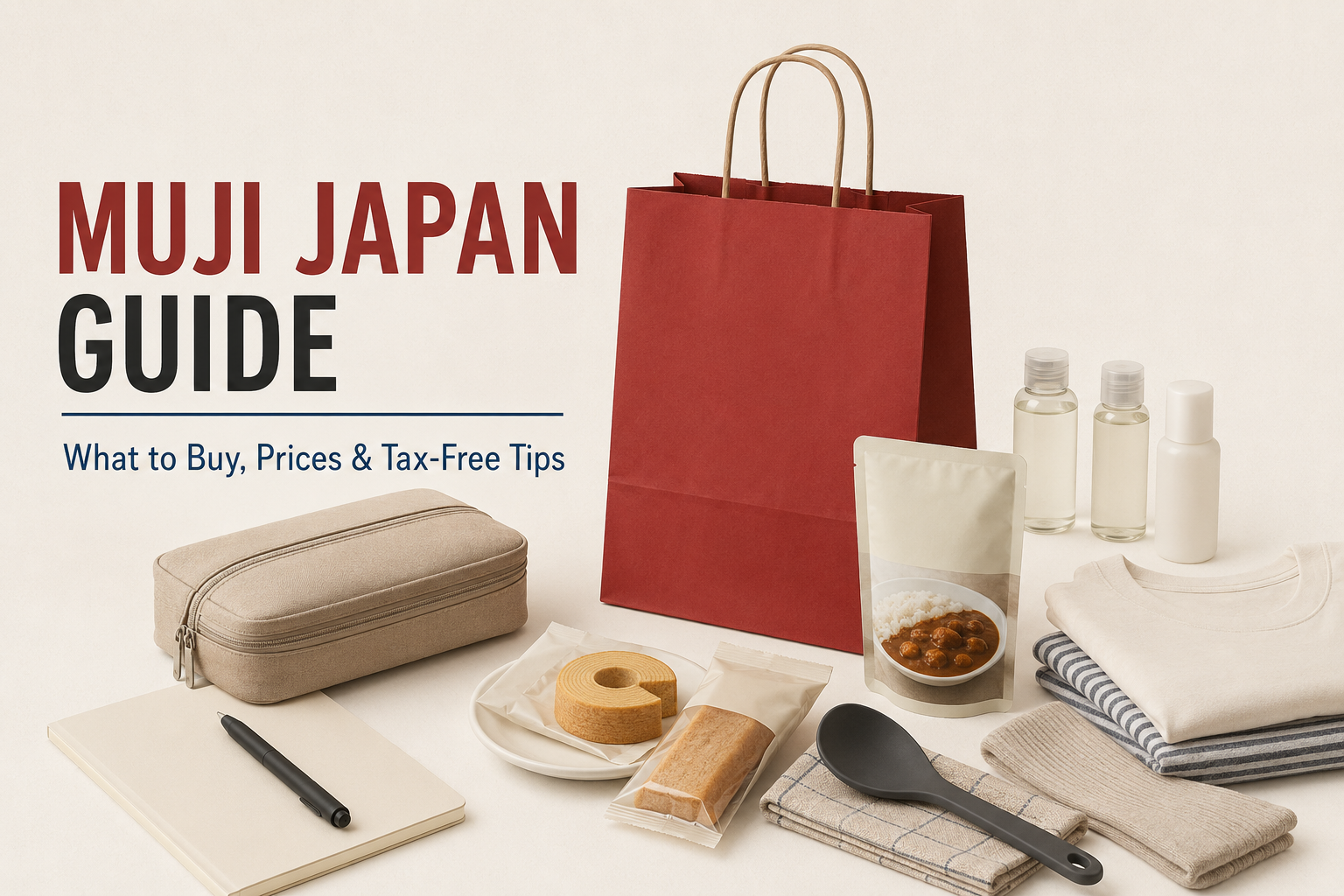
MUJI is one of Japan’s best-known lifestyle stores. Its calm, minimalist shops sell everything from pens and travel bottles to clothing, skincare, snacks, storage boxes and furniture.
For travelers, MUJI is an easy place to find practical souvenirs and useful items for the rest of a trip. You can buy a small notebook or packaged snack without spending much, while larger stores offer enough homeware and clothing to fill several floors.
Prices are generally higher than at DAISO or Seria, but MUJI is not a luxury brand. Its appeal lies in simple design, practical details and products made for everyday use.
This guide explains what MUJI is, what to buy in Japan, how prices compare, which payment methods you can use and how tax-free shopping works.
Quick Facts About MUJI in Japan
- MUJI’s Japanese name is Mujirushi Ryohin (無印良品), meaning “no-brand quality goods.”
- Stores sell stationery, travel goods, clothing, skincare, household items, food and more.
- Prices range from inexpensive pens and snacks to furniture and appliances.
- Cash and major credit cards are widely accepted, but other payment methods vary by store.
- Tax-free shopping is available at participating locations for eligible visitors.
- Product selection differs considerably between small and large stores.
- MUJI Ginza in Tokyo is the brand’s world flagship store.
What Is MUJI?
MUJI is a Japanese retail brand built around simple, functional products with restrained packaging. The name comes from Mujirushi Ryohin, which can be translated as “no-brand quality goods.”
Rather than placing a large logo on every item, MUJI usually lets the shape, material and function speak for themselves. Its designs often use neutral colors, clear containers and minimal decoration.
That does not mean every product is traditionally Japanese. MUJI is better understood as a modern Japanese lifestyle store: practical, organized and designed to fit quietly into daily life.
The range is much broader than many first-time visitors expect. Depending on the store, you may find:
- Pens, notebooks and office supplies
- Travel organizers, neck cushions and refillable bottles
- Skincare, toiletries and aroma products
- Socks, T-shirts, pajamas and other clothing
- Kitchen tools and tableware
- Storage boxes and cleaning supplies
- Packaged curry, snacks, tea and sweets
- Bedding, furniture and small appliances
Smaller branches may focus on daily essentials, while flagship stores can feel closer to a compact department store.
Is MUJI Cheaper in Japan?
MUJI prices differ by country, so an item sold in Japan may cost less than the same or a similar product overseas. However, exchange rates, local pricing and product specifications change, so it is better to compare the exact item rather than assume everything is cheaper.
Within Japan, MUJI sits above 100-yen shops in both price and positioning. A basic stationery item or snack can still be inexpensive, but clothing, skincare and household goods cost more than their DAISO equivalents.
You are mainly paying for a consistent design system, material choices and practical construction—not decoration or a visible brand logo.
Before buying a product you can also find at home, check your local MUJI website. Japan-only flavors, seasonal items, compact travel goods and products that are difficult to find overseas usually make more interesting purchases.
Best Things to Buy at MUJI Japan
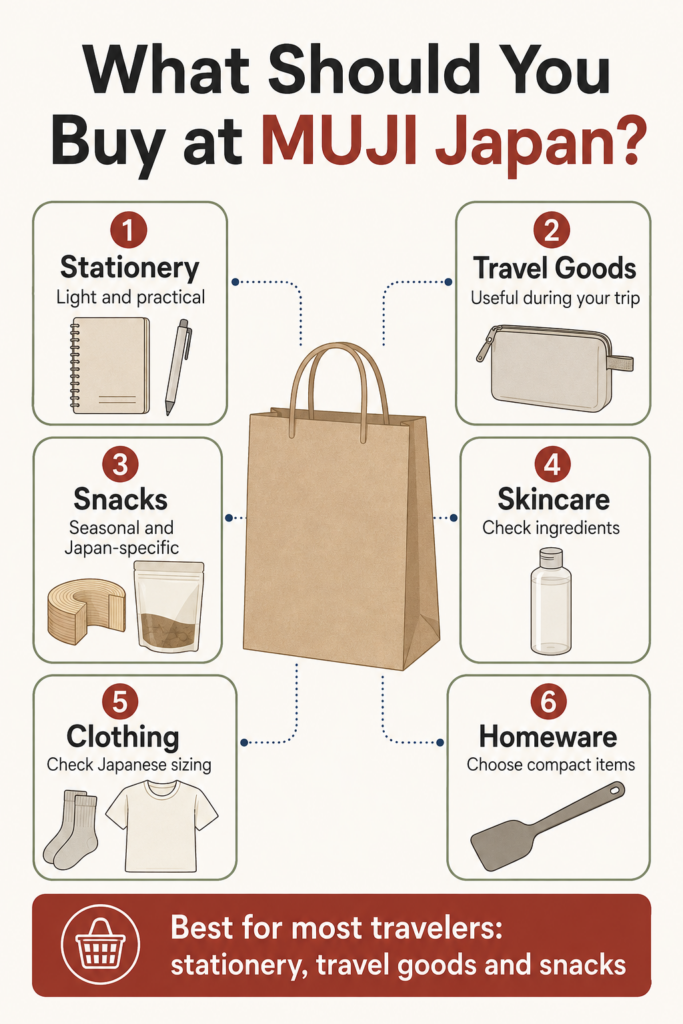
The best MUJI purchase is usually something light, useful and easy to pack. These categories are a good place to start.
1. Stationery
MUJI stationery is one of the easiest recommendations for travelers. Pens, mechanical pencils, notebooks, sticky notes, rulers and polypropylene pen cases take up little luggage space and make practical gifts.
The designs are deliberately plain, which also makes it easy to combine different items. Refill availability can vary outside Japan, so check the model number before buying several pens that require a specific refill.
2. Travel Accessories
MUJI sells products designed for organizing small spaces, including packing cubes, hanging cases, pouches, luggage tags, travel pillows and refillable containers.
These are useful during the trip rather than only after you return home. A small pouch or case can help organize coins, charging cables, medicine or toiletries in a hotel room.
When buying bottles or containers for carry-on luggage, confirm the capacity and your airline’s liquid rules.
3. Skincare and Toiletries
The skincare section often includes cleansing products, toners, moisturizers, sheet masks, cotton pads and small travel-size containers. The simple packaging is attractive, but choose products according to your own skin needs rather than design alone.
Ingredient lists may be primarily in Japanese, and formulas sold in Japan can differ from products with similar names overseas. Travelers with sensitive skin or allergies should check the label carefully.
4. Snacks and Packaged Food
MUJI’s food section is popular for packaged curry, baumkuchen, cookies, chocolate, tea and seasonal snacks. These products are easy to browse and often include flavors associated with Japan.
The irregularly shaped baumkuchen line, known as Fuzoroi Baum, is a familiar MUJI item and comes in changing flavors. Packaged curry is another popular category, although it is heavier and may be subject to food-import restrictions in your destination.
Check the expiration date, storage instructions and ingredient label before buying food as a souvenir.
5. Socks, T-Shirts and Pajamas
MUJI clothing is simple and easy to wear. Socks are compact souvenirs, while T-shirts, loungewear and pajamas can be useful if you prefer understated basics.
Japanese sizing may feel smaller or shorter than sizing in some other countries. Try clothing on when possible and use the garment measurements rather than relying only on S, M or L.
6. Kitchen and Household Items
Silicone cooking tools, cleaning accessories, small containers and storage products show MUJI’s practical design especially well. They can be excellent purchases if you already know how you will use them.
The main limitation is luggage space. Large storage boxes may look inexpensive in the shop but become inconvenient once you need to carry them home. Focus on compact items unless you have checked your baggage allowance.
7. Aroma Products
Aroma oils, diffusers and fragrance products are another recognizable MUJI category. Scents and seasonal stock vary by store.
Liquids need careful packing, and electrical aroma diffusers sold in Japan may be designed for Japan’s 100-volt power supply. Check voltage, plug type and warranty conditions before buying any appliance for use overseas.
Best MUJI Souvenirs from Japan
For a simple gift, choose something that is compact and does not require the recipient to know MUJI already.
Good options include:
- A pen and small notebook
- A polypropylene pen case
- Sticky notes or index tabs
- Socks in a neutral color
- A compact travel pouch
- Packaged tea or individually wrapped sweets
- A Japan-specific or seasonal snack
- A small aroma or self-care item, if you know the recipient’s preferences
Food can be memorable, but stationery is easier to transport and has fewer customs concerns. For several coworkers or friends, small items from the same series create a consistent set without looking overly formal.
MUJI vs DAISO and Seria
MUJI, DAISO and Seria all sell useful everyday items, but they are not direct substitutes.
| Store | Best for | General price level | Style |
|---|---|---|---|
| MUJI | Stationery, travel goods, clothing, skincare and coordinated homeware | Mid-range | Minimal and consistent |
| DAISO | Cheap essentials and a very broad product range | Low | Practical and varied |
| Seria | Small household goods, crafts and stylish 100-yen items | Low | Decorative and coordinated |
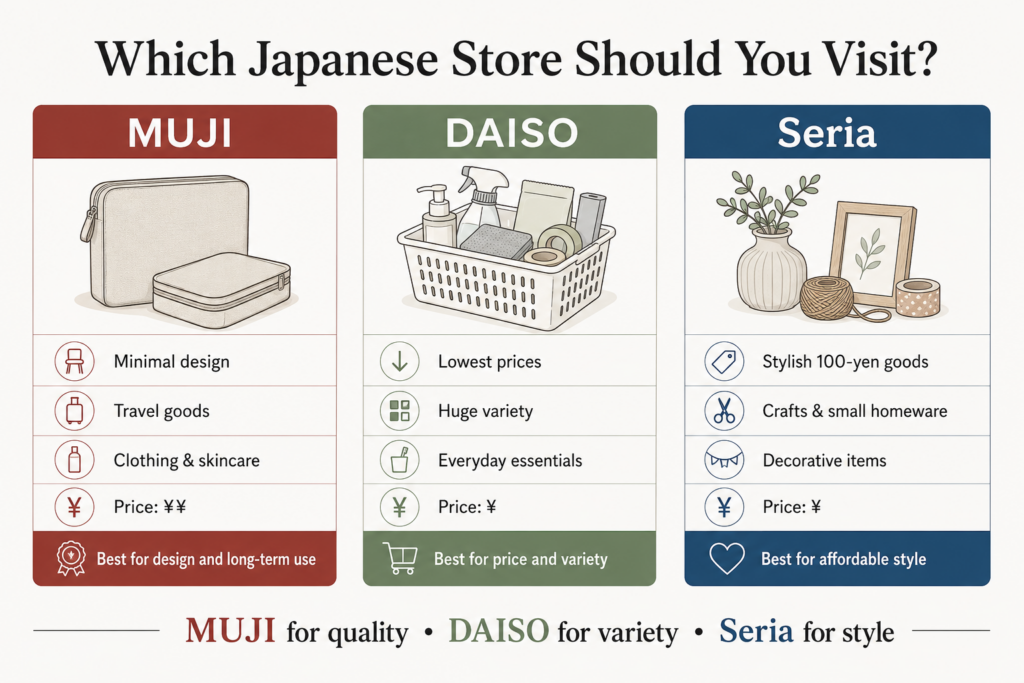
Choose DAISO when price and variety matter most. Choose Seria for inexpensive small items with a more decorative feel. Choose MUJI when you want a quieter design, a more coordinated range or something you expect to use for longer.
You can read our full guides to shopping at DAISO in Japan and Seria’s 100-yen shops for a closer comparison.
Can You Pay by Credit Card at MUJI Japan?
Most larger MUJI stores accept cash and major credit cards. Many locations also support some combination of transportation IC cards, debit cards and QR-code payments.
However, accepted payment methods vary because some MUJI branches follow the payment system of the department store, station building or shopping mall that contains them. Look for payment logos near the entrance or register, or check the individual store page before visiting.
If you plan to use Suica, PASMO or another IC card, do not assume every location accepts it. Keeping some yen available is the safest backup.
For more general advice, see our guide to using cash and credit cards in Japan.
Is MUJI Tax-Free in Japan?
Some MUJI stores offer tax-free shopping to eligible visitors, but not every branch participates. The official MUJI store locator shows “Tax-free” among the services for participating locations.
Under MUJI’s current rules, an eligible shopper generally needs to spend at least ¥5,000 before tax at the same store on the same day. You must present your passport or another accepted original document, and your entry status and date must meet Japan’s tax-free requirements.
Important points include:
- Tax-free service is only available at participating stores.
- The tax-free counter may have shorter hours than the store.
- Purchases must be for personal use and taken out of Japan.
- Processing must be completed on the day of purchase.
- A passport photo or photocopy is not a substitute for the required original document.
- Food and other consumable goods may be handled under specific tax-free rules.
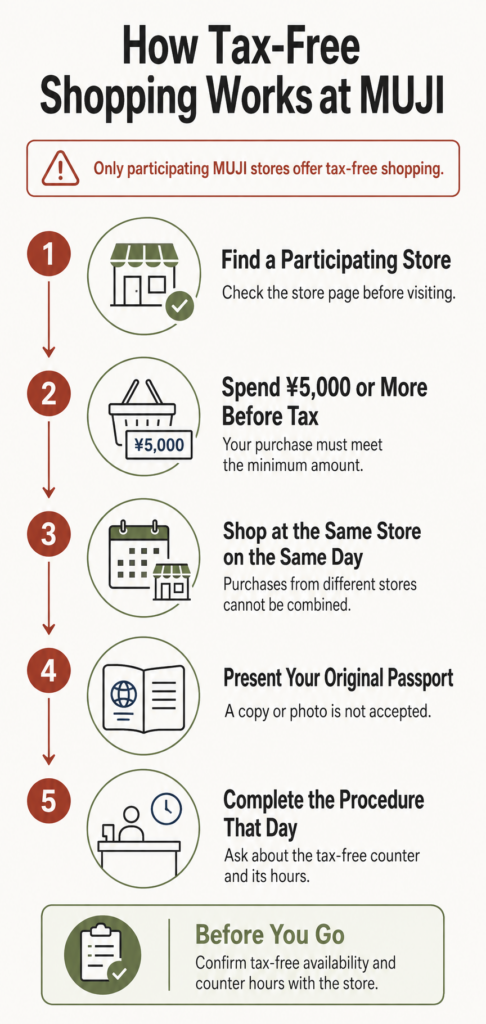
At large branches, the tax-free counter may be on a designated floor rather than beside every register. MUJI Ginza, for example, lists its duty-free register on the fourth floor.
Rules can change, so check MUJI’s official tax-free information and the store page shortly before shopping. Our tax-free shopping guide explains the wider Japanese system.
How to Find a MUJI Store in Japan
MUJI has locations in shopping malls, department stores, station buildings and standalone properties across Japan. Use the official store locator rather than relying only on a map listing, as the MUJI page shows store services and product categories.
Check the individual listing for:
- Opening hours and temporary closures
- Tax-free service
- Accepted payment methods
- Product departments
- Access from the nearest station
Not every branch carries the full range. A compact “MUJI 500” store is intended for affordable daily essentials and will not offer the same experience as a flagship location.
If you want one large store during a Tokyo trip, MUJI Ginza is the clearest choice.
Is MUJI Ginza Worth Visiting?
MUJI Ginza is the brand’s world flagship store, located a short walk from Ginza and Ginza-itchome stations and within walking distance of Yurakucho Station.
It carries a broad selection that includes clothing, travel and skincare products, storage, furniture, food, books and regional goods. The building also includes ATELIER MUJI GINZA and MUJI HOTEL GINZA, making it more of a brand experience than an ordinary neighborhood branch.
It is worth visiting if you already like MUJI, want to compare many product categories in one place or need a tax-free counter. If you only want pens, socks or snacks, a smaller branch may be quicker and more convenient.
Allow extra time at the flagship store, especially if you plan to browse several floors or complete tax-free paperwork.
Tips for Shopping at MUJI in Japan
Check the Store Size First
A nearby branch may not carry clothing, food or furniture. Open its official store page and check the product list before making a special trip.
Compare Exact Products
Do not assume every product is cheaper in Japan. Compare model numbers, sizes and materials, especially for skincare, clothing and appliances.
Keep Your Receipt
MUJI states that items bought in Japan cannot be returned or exchanged at stores outside Japan. Returns in Japan also require the original receipt and are subject to product and store conditions.
Think About Luggage Space
MUJI’s storage and homeware sections make large products tempting. Before buying, consider weight, shape and whether the item can survive a flight.
Check Electrical Specifications
Appliances sold in Japan are designed for Japan’s voltage and may not be suitable for use abroad. An adapter changes the plug shape but does not necessarily convert voltage.
Look for Seasonal Products
Food flavors, clothing colors and travel products change throughout the year. Seasonal items can make a purchase feel more specific to your visit, but stock differs by location.
Frequently Asked Questions
Is MUJI a Japanese brand?
Yes. MUJI originated in Japan, and its Japanese name is Mujirushi Ryohin, meaning “no-brand quality goods.”
Is MUJI expensive in Japan?
MUJI is generally more expensive than a 100-yen shop but less expensive than a luxury lifestyle brand. Small stationery and snacks can be affordable, while furniture, clothing and appliances cost considerably more.
What is the best thing to buy at MUJI Japan?
For most travelers, stationery, compact travel accessories, socks and packaged snacks offer the best balance of usefulness, price and luggage space.
Does MUJI Japan accept cash?
Yes, cash is accepted at MUJI stores. Credit cards are widely accepted, while electronic and QR-code payment options vary by location.
Can tourists shop tax-free at MUJI?
Eligible visitors can shop tax-free at participating MUJI stores if they meet the purchase and documentation requirements. Check the official store listing before visiting.
Are MUJI products in Japan different from those overseas?
Many core products are similar, but selection, sizing, formulas, flavors and seasonal ranges can differ. Japan may also have products that are unavailable in your home country.
Is MUJI Japan Worth Visiting?
MUJI is worth visiting if you like practical design or want souvenirs that can become part of everyday life. It is not the cheapest place to shop, and travelers looking only for low-cost necessities may be better served by DAISO or Seria.
MUJI’s strength is the way many ordinary products fit together: a pen, pouch, shirt or storage case feels simple on its own but belongs to the same calm, functional system.
For a quick visit, start with stationery, travel goods and food. For the full experience, visit a larger branch such as MUJI Ginza and leave enough time to explore beyond the first floor.
Editorial Sources
- MUJI official company materials: brand concept and history
- MUJI Japan official store locator: locations, services and store-specific payment methods
- MUJI Japan official FAQ: tax-free conditions, payments, returns and overseas use of Japanese appliances
- MUJI Ginza official store page: flagship status, access, departments, payments and duty-free counter
Product selection, prices, payment methods and tax-free procedures may change. Recheck official store information before publication and during future content reviews.