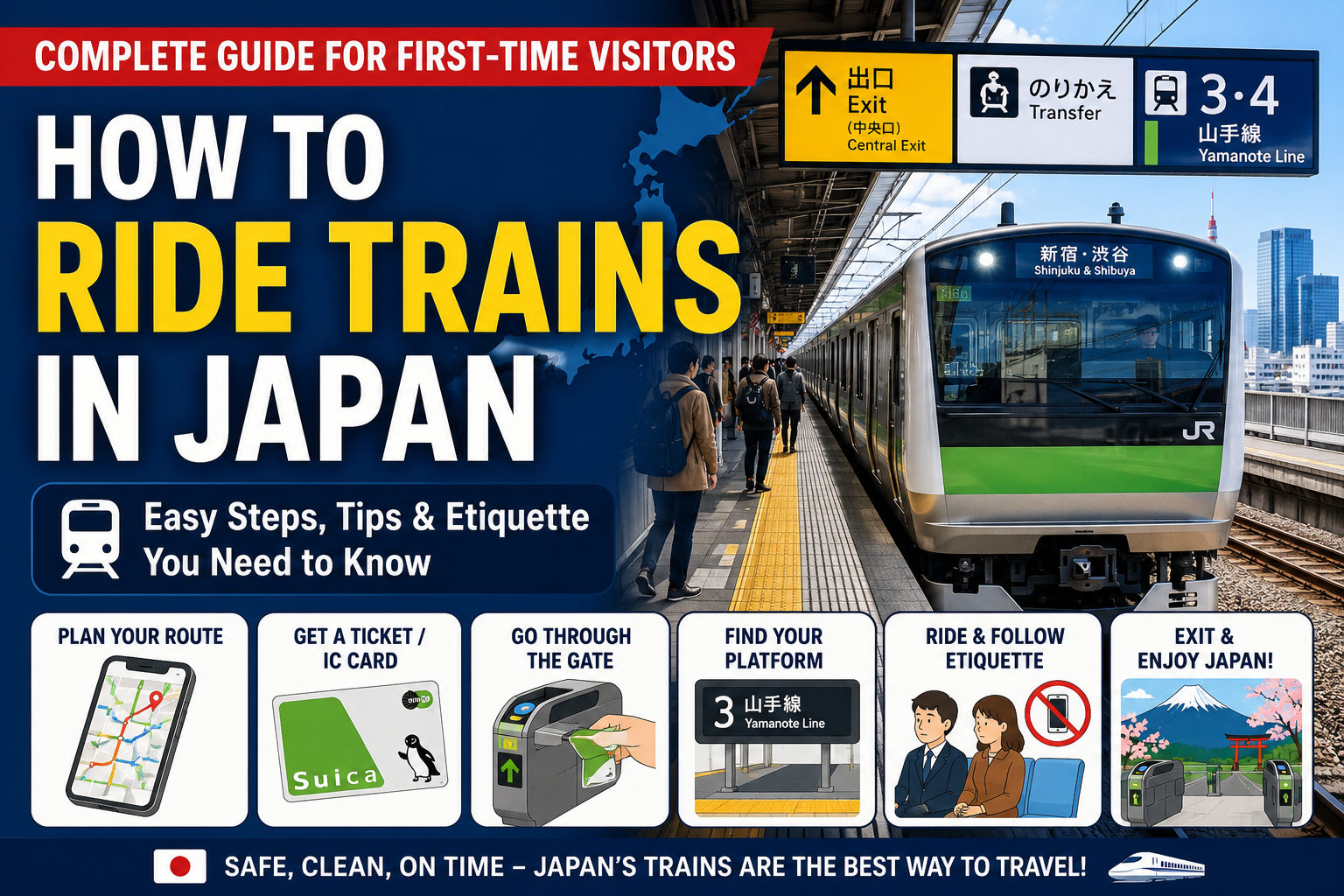
A Complete Guide for First-Time Visitors
If it’s your first time visiting Japan, the train system may look confusing.
You might wonder:
- Which train should I take?
- What’s the difference between JR and the subway?
- Do I need a ticket?
- Should I buy a Suica card?
- How do I know which platform to use?
The good news is that Japan’s railway network is one of the safest, cleanest and most reliable in the world.
Once you understand a few basic rules, it’s surprisingly easy to use.
This guide explains everything you need to know—from buying a ticket to finding the correct platform—so you can travel with confidence.
Why Does Japan’s Train System Look So Complicated?
Japan has one of the world’s largest railway networks.
Several different companies operate trains, including:
- JR (Japan Railways)
- Tokyo Metro
- Toei Subway
- Private railway companies such as Keio, Odakyu, Tokyu and Seibu
At first glance, the station map can look overwhelming.
However, you don’t need to understand every train company.
Modern route-planning apps such as Google Maps will usually tell you:
- Which train to take
- Which platform to use
- When the train leaves
- Where to transfer
- Which exit to use
Your job is simply to follow the directions.
Types of Trains in Japan
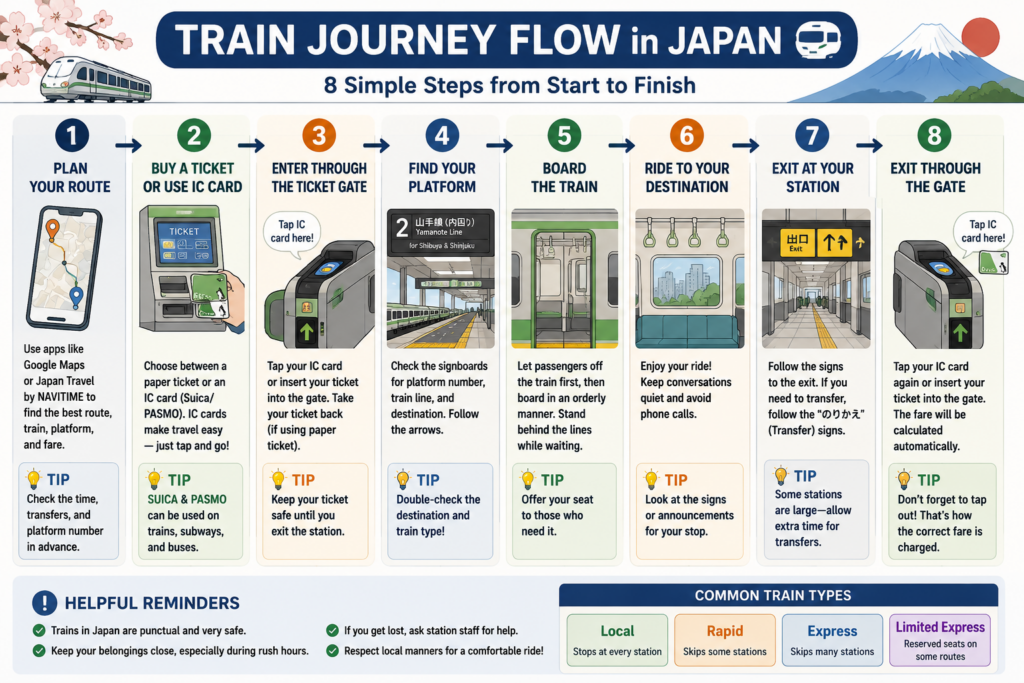
Not all trains are the same.
Understanding the differences makes traveling much easier.
JR (Japan Rail)
JR operates many of Japan’s major railway lines.
You’ll use JR for:
- Intercity travel
- Many Tokyo routes (such as the Yamanote Line)
- Airport access
- Shinkansen (through JR companies)
If you’re traveling around Japan, you’ll probably ride JR at least once.
Subway
Subways mainly serve large cities such as:
- Tokyo
- Osaka
- Kyoto
- Nagoya
- Fukuoka
They are ideal for getting around downtown areas.
Private Railways
Private railway companies connect neighborhoods, suburbs and nearby cities.
Examples include:
- Keio
- Odakyu
- Tokyu
- Seibu
- Hankyu
- Kintetsu
Many tourists ride private railways without even noticing.
Google Maps will tell you which company to use.
Shinkansen
The Shinkansen (bullet train) connects major cities across Japan.
It’s the fastest and most comfortable way to travel long distances.
Popular routes include:
- Tokyo → Kyoto
- Tokyo → Osaka
- Tokyo → Sendai
- Tokyo → Hiroshima
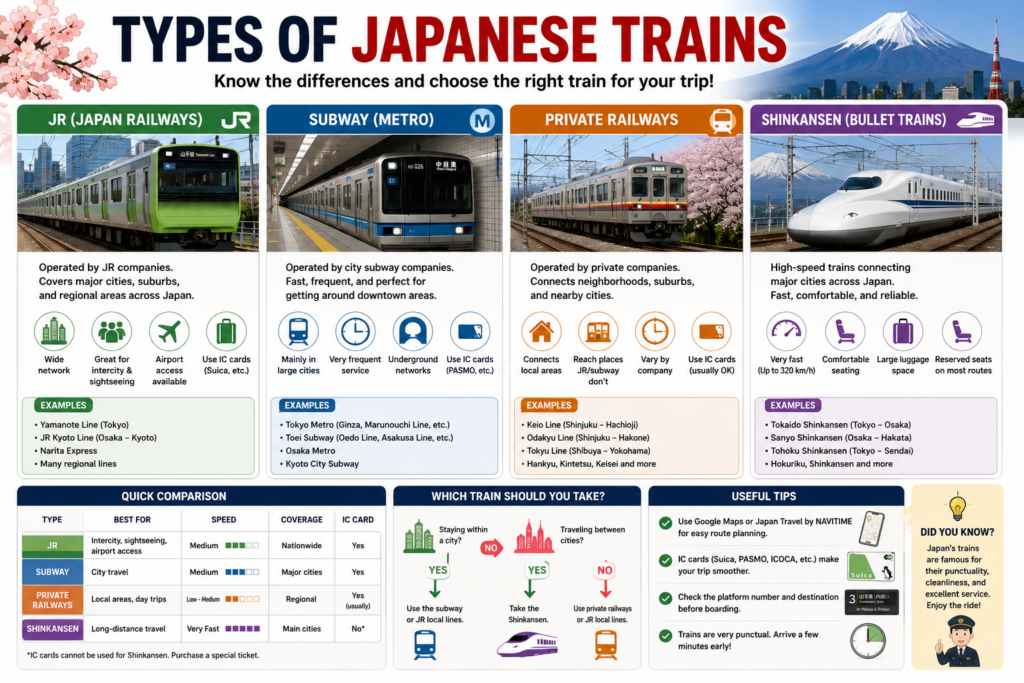
Step 1: Plan Your Route
Before heading to the station, use a navigation app.
Most travelers rely on:
- Google Maps
- Apple Maps
- Japan Travel by NAVITIME
Simply enter:
- Your starting point
- Your destination
The app will usually show:
- Departure time
- Platform number (sometimes)
- Transfer stations
- Arrival time
- Estimated fare
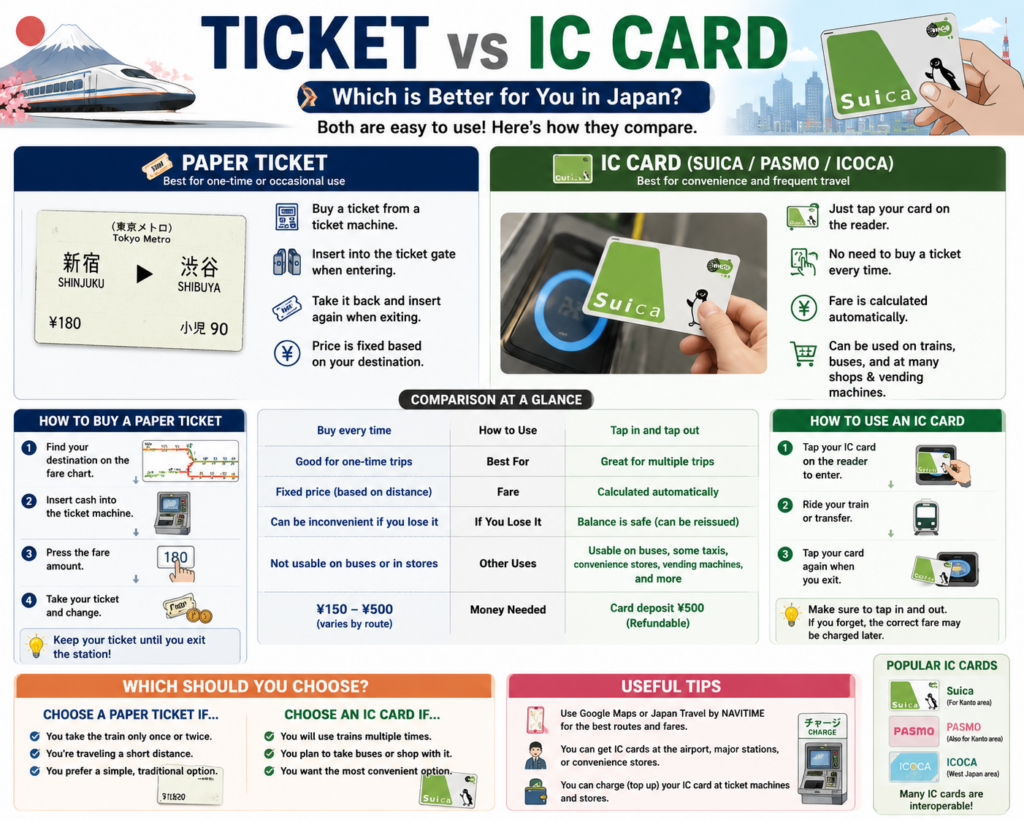
Step 2: Choose Your Ticket
There are two main ways to ride trains.
Option 1: Paper Ticket
Best for:
- One-time trips
- Visitors who rarely use trains
Buy your ticket from a ticket machine before entering the station.
Option 2: IC Card (Recommended)
Most visitors find an IC card much easier.
Examples include:
- Suica
- PASMO
- ICOCA
Simply tap the card at the ticket gate.
The fare is calculated automatically when you leave the station.
For most travelers, an IC card is the easiest choice.
👉 Read our complete guide:
Cash or Credit Card? How to Pay in Japan
Step 3: Enter Through the Ticket Gate
When you arrive at the station:
If using a paper ticket
Insert it into the ticket gate.
Take it back as it comes out.
Do not forget it—you’ll need it again when leaving the station.
If using an IC card
Simply tap the card on the blue reader.
The gate will open automatically.
If the gate closes, don’t panic.
A station attendant can help.
Step 4: Find the Correct Platform
Japanese stations are well signposted.
Look for:
- Platform Number
- Train Line
- Destination
For example:
Platform 3
JR Yamanote Line
For Shibuya & Shinjuku
Always check:
- Platform number
- Final destination
- Train type
before boarding.
Step 5: Check the Train Type
This is one of the most common mistakes made by visitors.
Different trains may stop at different stations.
Common train types include:
| Type | Stops |
|---|---|
| Local | Every station |
| Rapid | Skips some stations |
| Express | Skips many stations |
| Limited Express | Reserved seats on some routes |
If you’re unsure, choose a Local train.
It takes longer but stops everywhere.
Step 6: Ride the Train
Before boarding:
Allow passengers to leave first.
Stand behind the platform markings.
Board calmly.
Inside the train:
- Keep conversations quiet.
- Put your phone on silent.
- Wear headphones.
- Keep backpacks in front when crowded.
- Offer priority seats to those who need them.
Japanese trains are known for being quiet and orderly.
Following these simple customs helps everyone travel comfortably.
Step 7: Transfer Between Trains
Many journeys require one or more transfers.
Don’t worry.
Stations have clear signs showing:
- Transfer
- Line name
- Platform number
Follow the arrows.
Your navigation app will also tell you:
- Which platform to go to
- How many minutes you have
- Which exit to take after arrival
Some large stations, such as Shinjuku or Tokyo Station, can take 10–15 minutes to walk through.
Leave extra time when transferring.
Step 8: Leave the Station
At your destination:
Paper Ticket
Insert your ticket again.
The machine keeps it.
IC Card
Tap the card.
The correct fare is deducted automatically.
The gate opens.
Congratulations—you’ve completed your trip.
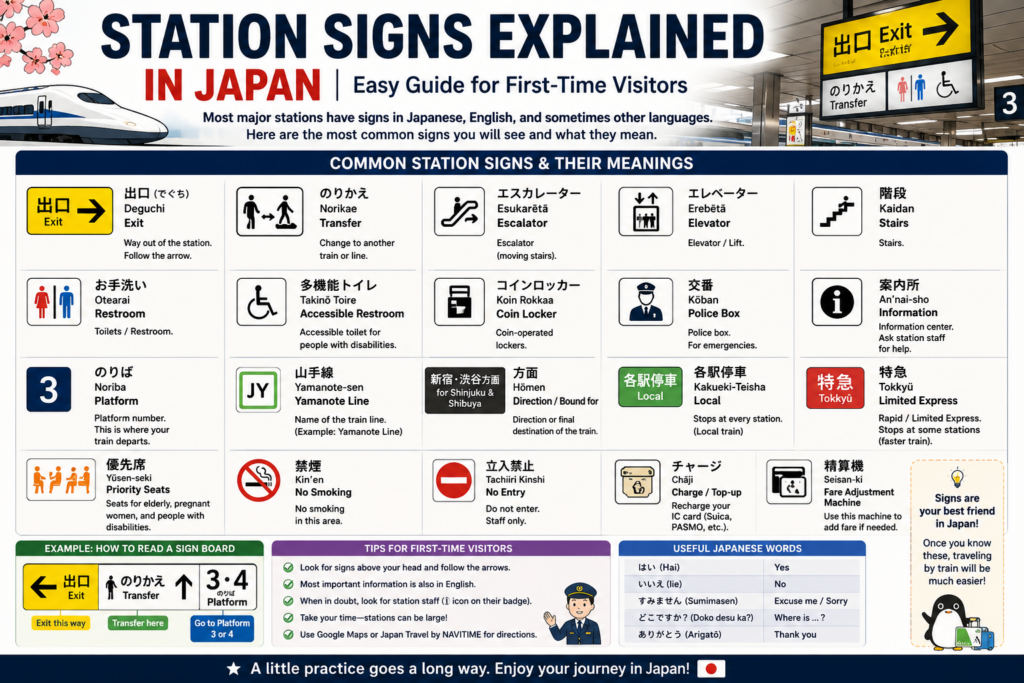
Understanding Station Signs
Most major stations display information in English.
You’ll often see:
| Sign | Meaning |
|---|---|
| Exit | Station exit |
| Transfer | Change trains |
| Platform | Boarding area |
| North Exit | North side of station |
| South Exit | South side |
| East Exit | East side |
| West Exit | West side |
| Elevator | Lift |
| Escalator | Moving stairs |
Learning these few words makes stations much easier to navigate.
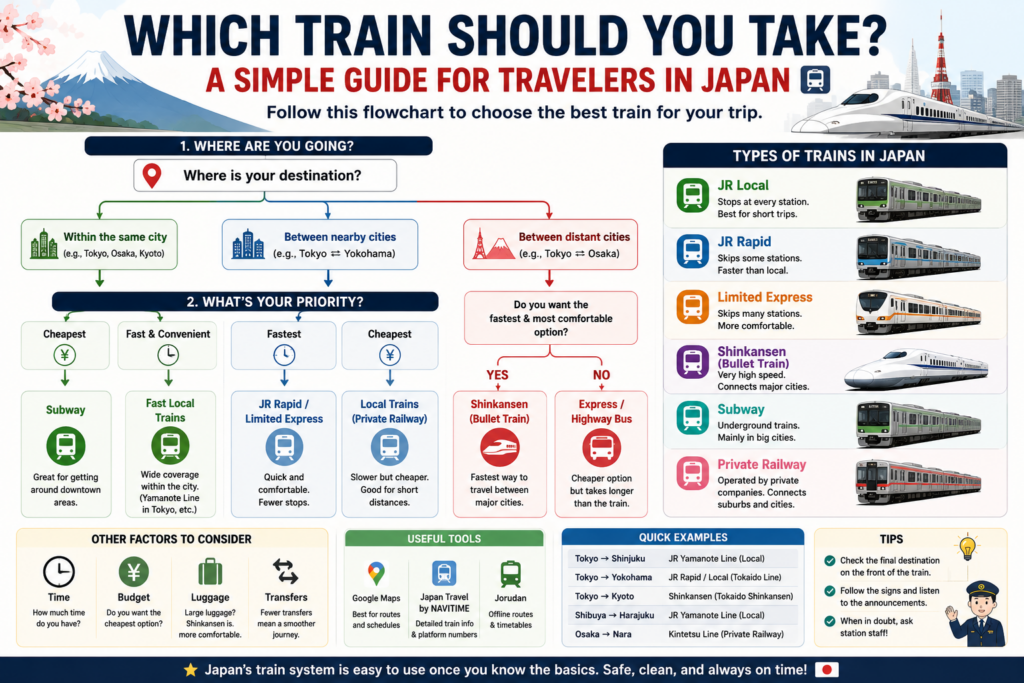
Which Train Should You Take?
Here’s a simple guide.
Traveling around Tokyo?
- JR
- Subway
- Private Railways
Traveling between cities?
- Shinkansen
Going to the airport?
Usually:
- JR
- Airport Express
- Keisei Skyliner
- Nankai Airport Express
Google Maps normally recommends the fastest option.
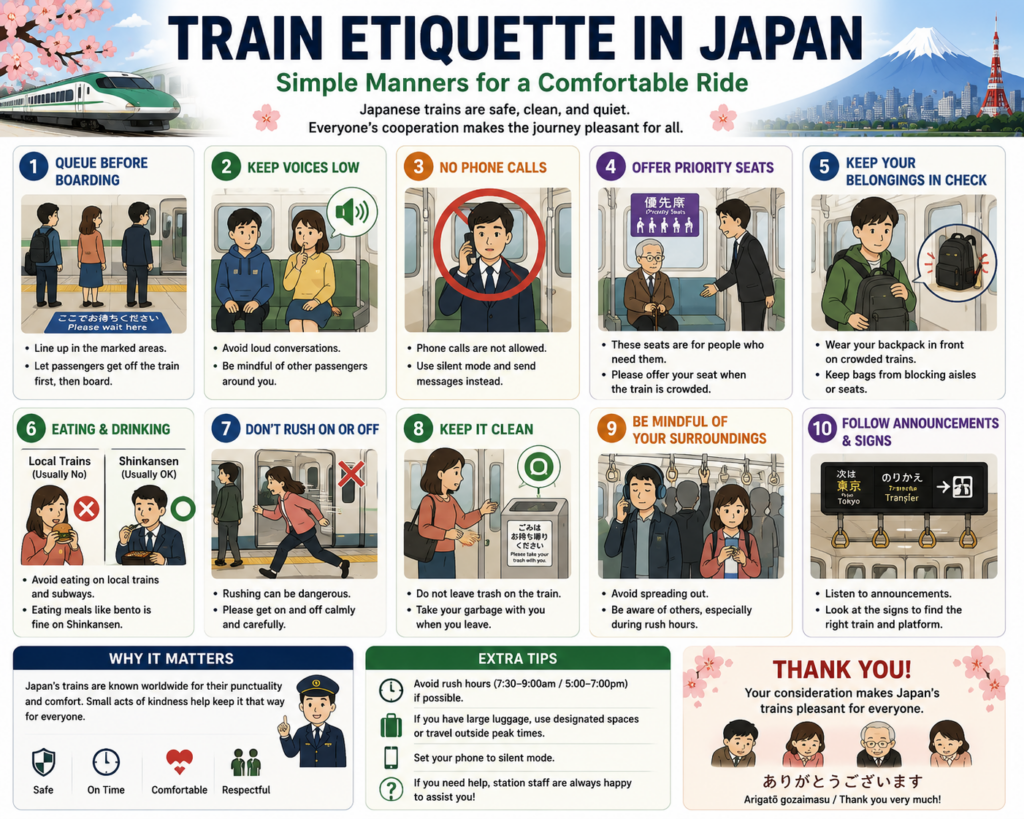
Train Etiquette in Japan
Japanese trains are famous for their polite atmosphere.
Here are a few simple rules.
Queue Before Boarding
Passengers line up in marked areas.
Wait until everyone has exited before getting on.
Keep Your Voice Down
Quiet conversations are fine.
Avoid speaking loudly.
Don’t Talk on the Phone
Phone calls inside train cars are generally discouraged.
Send messages instead.
Respect Priority Seats
Priority seats are for:
- Elderly passengers
- Pregnant women
- People with disabilities
- Injured passengers
If the train is crowded, offer your seat if someone needs it.
Eat Only When Appropriate
On local trains and subways, eating is uncommon.
On long-distance Shinkansen trains, eating a bento lunch is perfectly normal.
Common Mistakes First-Time Visitors Make
Boarding the Wrong Direction
Always check the train’s final destination.
Taking an Express Instead of a Local Train
An Express train may skip your station.
Forgetting to Tap an IC Card
If you forget to tap in or out, visit the station office.
Staff can correct the fare.
Losing a Paper Ticket
Don’t worry.
Go to the station office.
The staff will help you pay the correct fare.
Missing the Last Train
Unlike some cities, trains usually stop around midnight.
If you miss the final train, you may need to:
- Take a taxi
- Stay nearby
- Wait until morning
Always check the timetable if you’ll be out late.
Frequently Asked Questions
Is Google Maps enough?
For most visitors, yes.
It provides excellent train directions throughout Japan.
Do I need to speak Japanese?
No.
Most stations have English signs and announcements.
Can I bring large luggage?
Yes.
However, during busy hours it can be inconvenient.
Large luggage reservations are also required on some Shinkansen services.
Can I eat on trains?
Local trains:
Usually no.
Shinkansen:
Yes.
Many travelers enjoy an ekiben (station lunch box).
Can I use Suica everywhere?
Suica works on most trains, subways and buses in major regions.
It can also be used in many convenience stores, vending machines and shops.
What if I get lost?
Station staff are generally very helpful.
Show them:
- Your destination
- Your Google Maps route
- Your hotel address
Even if they don’t speak much English, they’ll usually help you find the right platform.
Final Thoughts
Japan’s train system may seem intimidating at first, but it’s designed to be efficient and reliable.
Remember these simple steps:
- Plan your route.
- Use an IC card if possible.
- Check the platform number.
- Confirm the train type.
- Follow station signs.
- Enjoy one of the world’s best railway systems.
After your first journey, you’ll likely find traveling by train much easier than you expected.