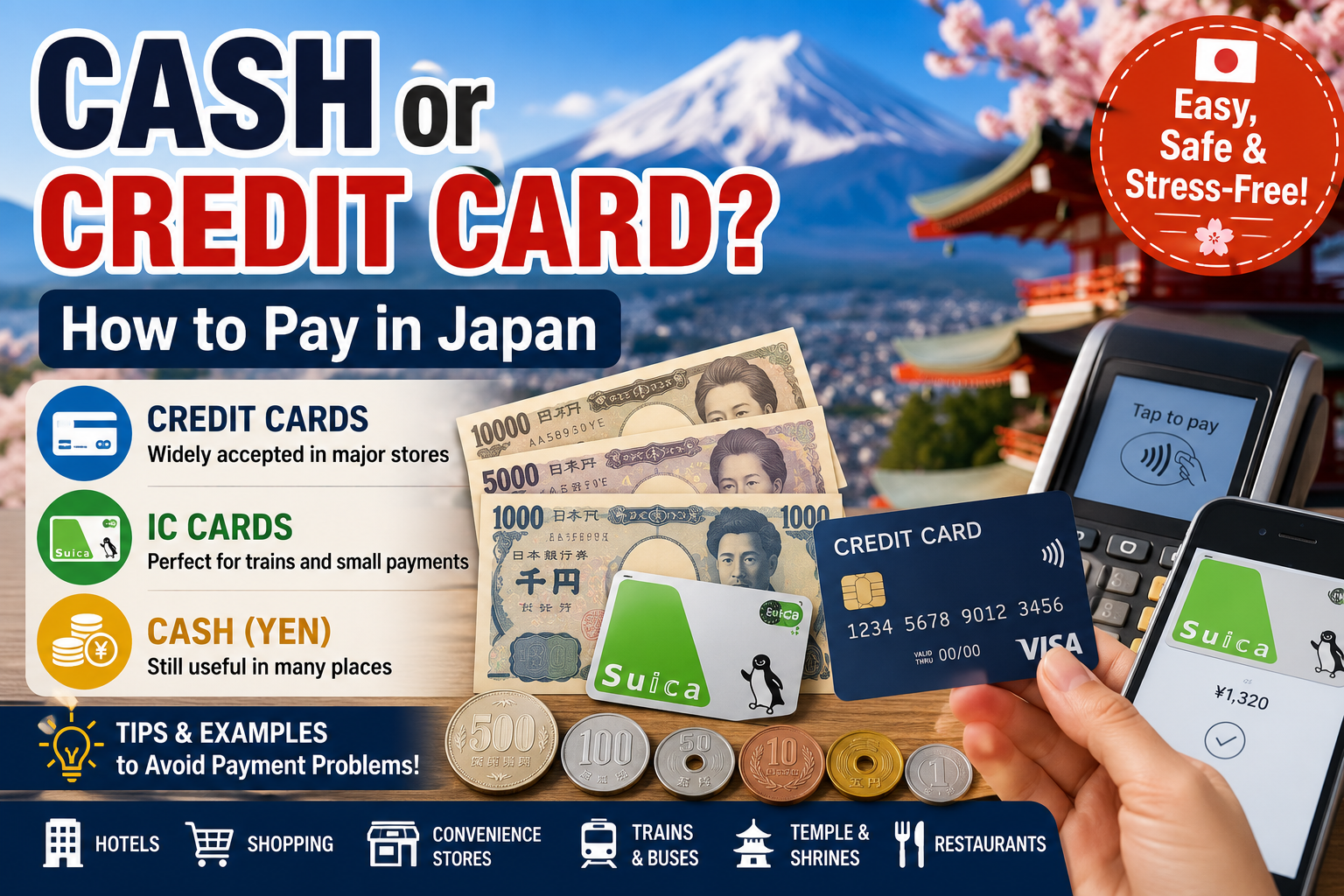
A Complete Guide to Cash, Cards, IC Cards and Mobile Payments
Japan is often described as a cash-based country.
That description is no longer entirely accurate.
Credit cards, contactless payments, transportation IC cards and QR-code payments are now widely used, especially in major cities. Japan’s cashless payment ratio reached 58.0% in 2025, with credit cards accounting for most cashless transactions.
However, cash has not disappeared.
Small restaurants, traditional shops, local attractions and some accommodation facilities may still accept only Japanese yen. Japan’s official tourism organization therefore recommends carrying cash even though credit cards are accepted at many stores and restaurants.
So, should you use cash or a credit card in Japan?
The practical answer is:
Use cards when they are accepted, but always keep some cash as a backup.
This guide explains the major payment methods available in Japan, where each one works, and how to avoid common payment problems.
The Best Payment Setup for Visiting Japan
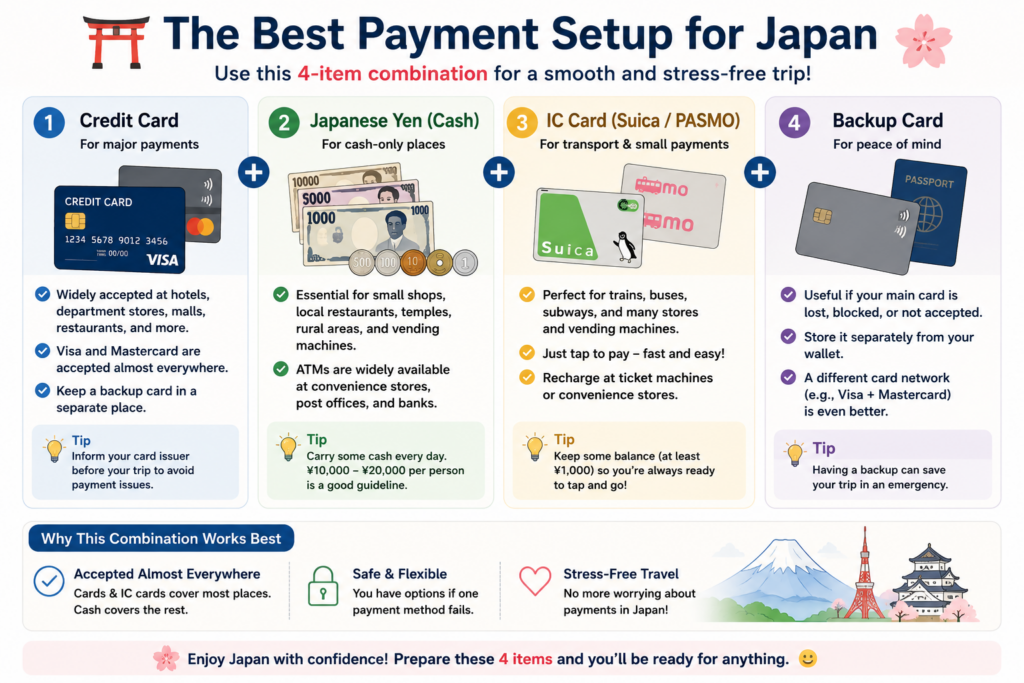
For most travelers, the safest combination is:
- One international credit or debit card
- Some Japanese yen in cash
- A Suica, PASMO or other transportation IC card
- A backup card stored separately
This combination covers most situations.
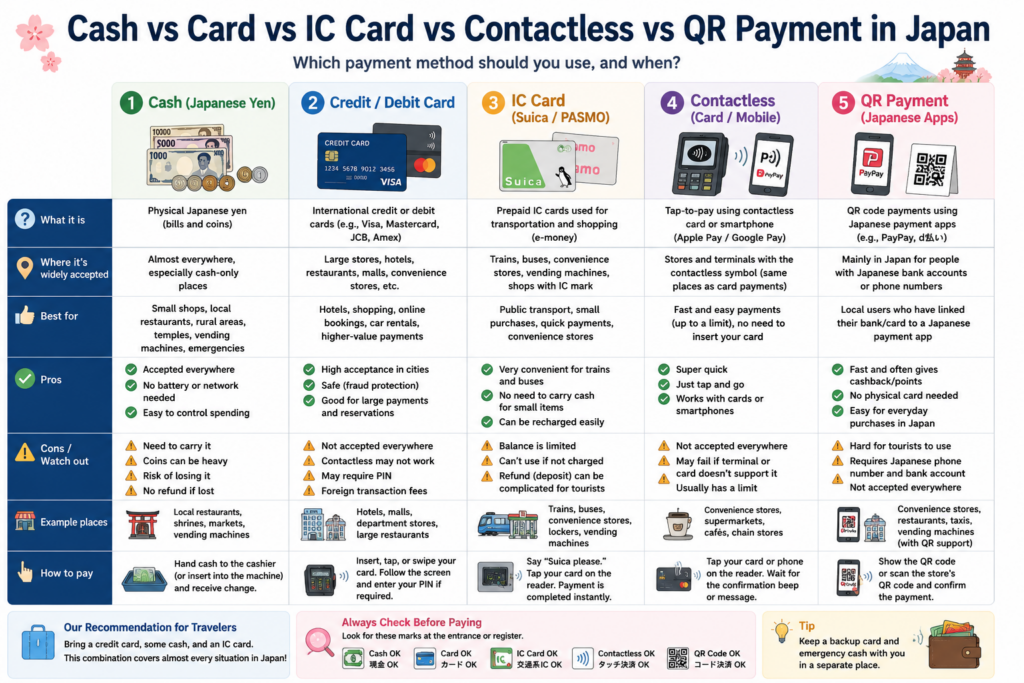
| Payment method | Best used for |
|---|---|
| Credit card | Hotels, department stores, shopping malls and major retailers |
| Cash | Small restaurants, temples, local shops and emergencies |
| IC card | Trains, buses, convenience stores, vending machines and small purchases |
| Contactless card | Fast payments at supported stores and some transit systems |
| QR payment | Mainly useful for people with compatible Japanese payment apps |
You do not need every payment method.
A card, some cash and an IC card are usually enough.
Is Japan Still a Cash-Based Country?
Japan is becoming significantly more cashless.
According to Japan’s Ministry of Economy, Trade and Industry, cashless payments represented 58.0% of consumer payments in 2025.
Of that cashless total:
- Credit cards accounted for 82.7%
- QR and code payments accounted for 10.2%
- Electronic money accounted for 3.7%
- Debit cards accounted for 3.4%
This means cards and digital payments are now part of everyday life.
However, averages do not tell the whole story.
Payment acceptance varies depending on:
- The type of business
- The location
- The size of the store
- The age of the payment terminal
- Whether the business is independently operated
- Temporary network or system conditions
In Tokyo, Osaka, Kyoto and other major destinations, you can often pay by card throughout most of the day.
In rural areas or at small independent establishments, cash may still be necessary.
Where Credit Cards Are Commonly Accepted
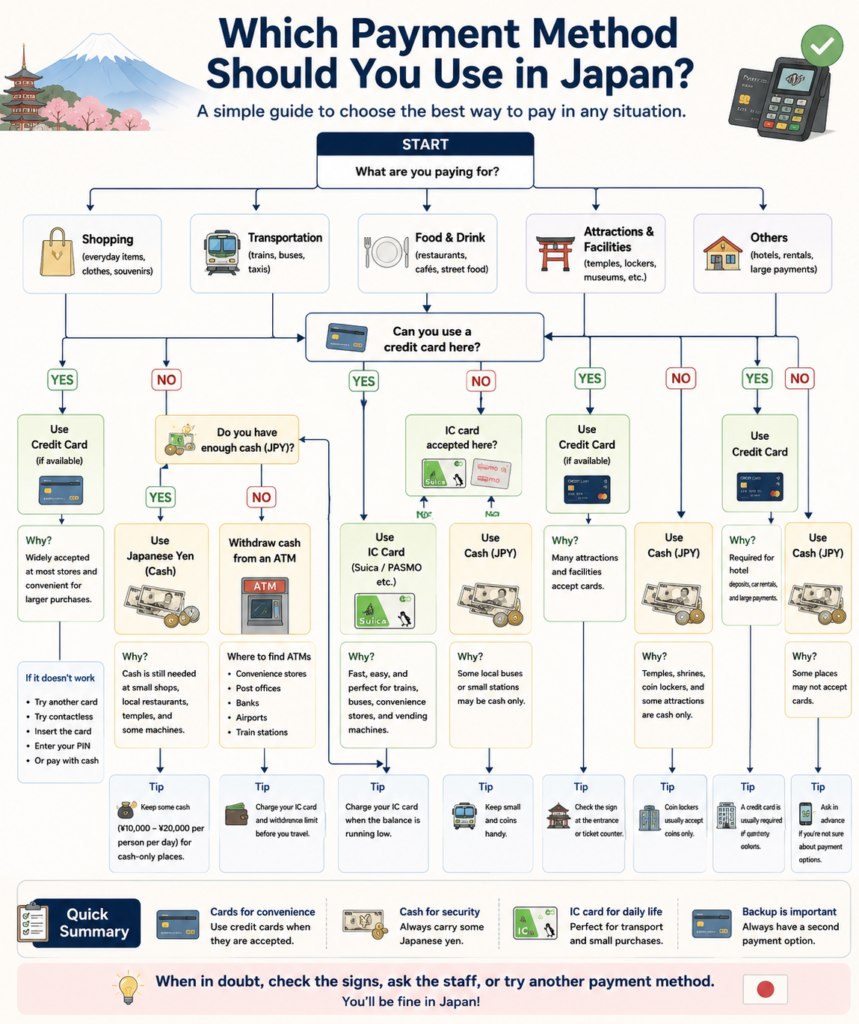
International credit cards are generally accepted at larger businesses.
You can usually expect card payment at:
- Hotels
- Department stores
- Shopping malls
- Major convenience stores
- Large supermarkets
- Chain restaurants
- Drugstores
- Electronics retailers
- Clothing chains
- Major tourist attractions
- Many taxis
- Car rental companies
Visa and Mastercard are usually the most widely recognized international brands.
JCB, American Express, UnionPay and other networks may also be accepted, depending on the merchant.
Look for card logos near:
- The entrance
- The cash register
- The payment terminal
- The self-checkout screen
Do not assume that every branch of the same chain accepts exactly the same methods.
Equipment and payment services can vary by location.
Where You May Still Need Cash
Cash remains useful in many everyday situations.
You may need Japanese yen at:
- Small family-run restaurants
- Traditional shops
- Rural businesses
- Food stalls
- Local markets
- Some temples and shrines
- Coin lockers
- Older vending machines
- Small clinics
- Local buses
- Guest houses
- Ticket machines
- Community festivals
- Cash-only parking facilities
A restaurant may display plastic food models, menus and modern signs yet still accept only cash.
Always check before ordering if you are unsure.
Useful signs include:
| Japanese | Meaning |
|---|---|
| 現金のみ | Cash only |
| 現金 | Cash |
| カード可 | Cards accepted |
| クレジットカード | Credit card |
| キャッシュレス | Cashless payment |
| お支払い | Payment |
How Much Cash Should You Carry?
There is no single amount that is right for every traveler.
For an ordinary day in a major city, carrying approximately ¥10,000 to ¥20,000 per person provides a useful backup without requiring you to carry a large amount.
You may want more cash when:
- Visiting rural areas
- Staying at small inns
- Attending a festival
- Visiting temples or shrines
- Eating at independent restaurants
- Traveling somewhere with limited ATM access
- Taking local buses
You may need less when:
- Staying in major cities
- Using large chain stores
- Paying hotels in advance
- Using an IC card for transportation
- Traveling mainly in commercial districts
Avoid keeping all your cards and cash in the same wallet.
Store one backup payment method separately.
How to Pay by Credit Card in Japan
Card payments in Japan are usually straightforward.
At a staffed register, the cashier may ask:
Oshiharai wa?
This means:
“How would you like to pay?”
You can answer:
Card, please.
or:
Kaado de onegaishimasu.
The terminal may then ask you to:
- Insert your card
- Tap your card
- Swipe your card
- Enter your PIN
- Confirm the amount
Wait until the terminal displays a confirmation before removing your card.
Insert or Tap?
Some terminals accept contactless payment, while others require the card to be inserted.
A card may support contactless payment but still need to be inserted when:
- The amount exceeds the terminal’s contactless limit
- The issuer requests PIN verification
- The contactless attempt fails
- The store’s terminal does not support your card’s contactless system
When tapping does not work, try inserting the card before assuming it has been declined.
Contactless Card Payments in Japan
Contactless card acceptance has expanded across Japan.
You may see symbols for:
- Visa contactless
- Mastercard Contactless
- JCB Contactless
- American Express contactless
- Apple Pay
- Google Pay
Visa states that its contactless service is available at participating convenience stores, supermarkets and other merchants displaying the contactless symbol.
At the register, you may need to select:
Credit Card
rather than:
Electronic Money
This is an important distinction.
Even though you are tapping the card or phone, the transaction may still be processed as a credit-card payment.
If you select the wrong category, the terminal may not respond.
Can Foreign Credit Cards Be Used in Japan?
Foreign-issued cards generally work at businesses that accept the relevant card network.
However, successful payment is never guaranteed.
A card may fail because:
- Overseas transactions are disabled
- Your bank blocks the transaction
- The terminal requires a PIN
- Contactless payment is unavailable
- The merchant does not accept that network
- The connection temporarily fails
- Your daily spending limit has been reached
- The card issuer identifies the transaction as unusual
Before traveling, check that:
- Overseas use is enabled
- You know your PIN
- Your bank has your current phone number
- You can access your banking application abroad
- Your credit limit is sufficient
- You have a second card
It is also wise to carry cards from two different networks.
For example:
- Visa plus Mastercard
- Mastercard plus American Express
This reduces the risk of losing access to card payments because of one network or issuer problem.
Credit Card, Debit Card or Prepaid Card?
All three can work, but they behave differently.
Credit Card
A credit card is usually the most convenient option for:
- Hotels
- Car rentals
- Large purchases
- Restaurants
- Shopping
Hotels and rental companies may require a credit card for a deposit or guarantee.
Debit Card
A debit card deducts money directly from your bank account.
It may work anywhere the corresponding network is accepted, but some hotels, rental services and unattended machines may handle debit cards differently.
Prepaid Travel Card
A prepaid travel card lets you load funds in advance.
It can help with budgeting, but you should confirm:
- Whether it works in Japan
- Which network it uses
- Foreign exchange fees
- ATM withdrawal fees
- Whether refunds can be returned to it
Do not rely on one prepaid card as your only source of money.
Paying with Cash in Japan
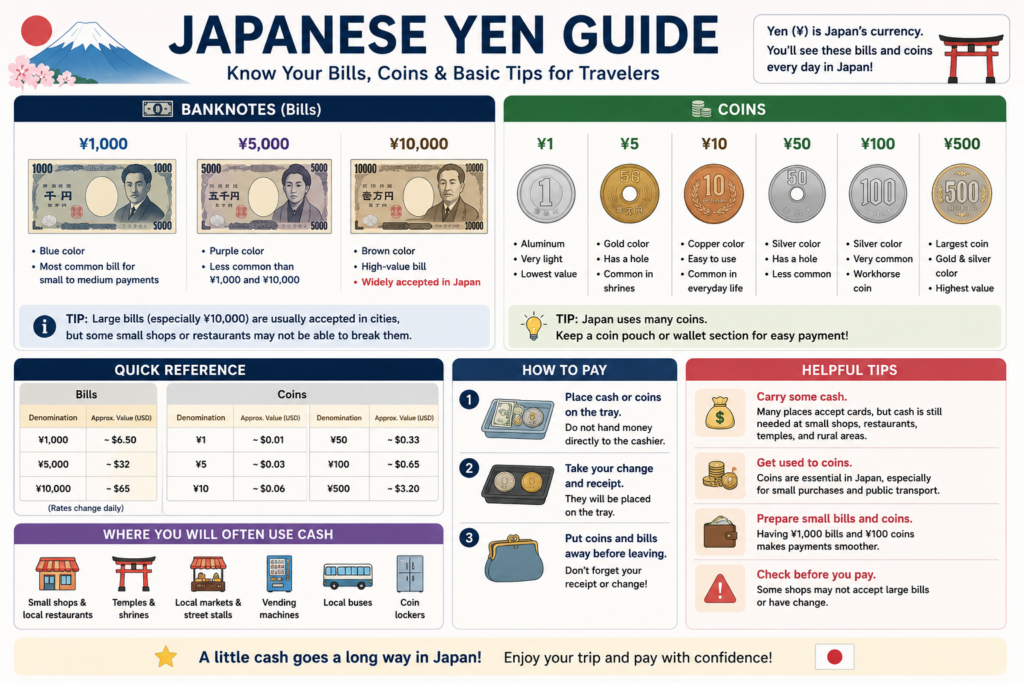
Japanese cash consists of banknotes and coins.
Common banknotes include:
- ¥1,000
- ¥5,000
- ¥10,000
Common coins include:
- ¥1
- ¥5
- ¥10
- ¥50
- ¥100
- ¥500
Cash is normally placed on a small tray rather than handed directly to the cashier.
The cashier may also place your change and receipt on the tray.
At automated registers, insert coins and notes into the marked slots.
The machine will calculate the change automatically.
Can You Use a ¥10,000 Note for a Small Purchase?
Usually, yes, especially at convenience stores, supermarkets and major retailers.
However, using a large note for a very small purchase at a small business may be inconvenient.
Keeping a few ¥1,000 notes and ¥100 coins is useful.
Transportation IC Cards
Transportation IC cards are among the most useful payment tools in Japan.
Examples include:
- Suica
- PASMO
- ICOCA
- Kitaca
- TOICA
- manaca
- SUGOCA
- nimoca
- Hayakaken
These cards were originally designed for trains and buses, but they can also be used as prepaid electronic money at many participating businesses.
JR East describes Suica as a prepaid electronic-money card that can be used for trains, subways, buses and shopping.
You may be able to use an IC card at:
- Convenience stores
- Vending machines
- Station shops
- Coin lockers
- Supermarkets
- Restaurants
- Cafés
- Drugstores
- Taxis
- Attractions
Look for an IC-card logo near the register.
How to Pay with an IC Card
At the register, say:
Suica de onegaishimasu.
This means:
“Suica, please.”
Then:
- Select the IC-card or electronic-money option.
- Check the amount.
- Hold the card over the reader.
- Wait for the confirmation sound.
- Check your remaining balance if displayed.
The amount is deducted immediately.
You do not normally need to enter a PIN.
How to Add Money to an IC Card
Physical IC cards can usually be recharged at:
- Railway ticket machines
- Fare adjustment machines
- Convenience stores
- Station service counters
- Some charging machines
JR East notes that Suica cards can be charged at ticket machines at railway stations.
Many physical charging machines require cash.
Do not wait until your balance is completely empty.
Maintaining a small balance helps avoid delays when entering a station or making a purchase.
Mobile Suica and Mobile IC Cards
Some travelers can add Suica or another supported transit card to a compatible smartphone wallet.
This can make it possible to:
- Pay for trains
- Pay at participating stores
- Check your balance
- Recharge digitally
However, availability depends on:
- Your phone model
- Your operating system
- Your country or region settings
- Your card issuer
- Wallet compatibility
JNTO notes that mobile IC cards may not work on every smartphone.
A physical card can therefore still be a useful backup.
What Are QR-Code Payments?
QR-code payments are widely used by residents of Japan.
Common domestic services include:
- PayPay
- Rakuten Pay
- d払い
- au PAY
- Merpay
At checkout, the customer either:
- Shows a barcode for the cashier to scan, or
- Scans the merchant’s QR code and enters the amount
However, many Japanese QR-payment applications require:
- A Japanese account
- A Japanese phone number
- A supported Japanese payment method
- Domestic identity or account verification
For most short-term international visitors, QR-code payments are less important than cards, cash and IC cards.
Do not assume that a familiar overseas QR wallet will work simply because the store displays a QR-payment symbol.
Apple Pay and Google Pay
Apple Pay and Google Pay can work in Japan when:
- Your card is supported
- The merchant accepts the relevant card network
- The terminal supports contactless payment
- Your device is configured correctly
At the register, it may be clearer to name the underlying payment method.
For example:
Credit card, please.
Then tap your phone when instructed.
Saying only “Apple Pay” may occasionally cause confusion because the phone wallet can contain different payment types, including:
- Credit cards
- Debit cards
- Suica
- Other electronic-money services
The terminal must be set to the correct payment category.
Credit Card or IC Card at the Register?
Both may involve tapping, but they are not the same.
When Paying with a Contactless Credit Card
Select or say:
Credit card
The payment is processed through the card network.
When Paying with Suica or PASMO
Select or say:
IC card
or:
Suica
The amount is deducted from the prepaid IC-card balance.
Choosing the wrong option is one of the most common reasons a contactless payment appears not to work.
Can You Split a Payment?
Split payments are not always available.
Some stores may allow:
- Cash plus points
- Gift card plus cash
- Store voucher plus card
However, many businesses will not allow:
- Two separate credit cards
- IC card plus credit card
- Partial IC-card balance plus card
- Multiple unrelated payment methods
If your IC-card balance is insufficient, you may need to:
- Recharge the card
- Pay the entire amount another way
- Ask whether the store permits the remaining balance to be paid in cash
Policies vary by store.
Choosing Yen or Your Home Currency
Some card terminals may ask whether you want to pay in:
- Japanese yen
- Your home currency
Paying in your home currency may involve a service called dynamic currency conversion.
The exchange rate and fees offered at the terminal may differ from the rate provided by your own card issuer.
Before selecting, compare:
- The displayed exchange rate
- The conversion fee
- Your card’s foreign transaction fee
- Your issuer’s exchange-rate policy
In many cases, travelers prefer to select Japanese yen and allow their card issuer to perform the conversion, but the best choice depends on the terms of your card.
Where Can You Withdraw Cash?
Foreign cards may work at compatible ATMs in locations such as:
- Airports
- Convenience stores
- Post offices
- Banks
- Railway stations
- Shopping centers
Not every ATM accepts every foreign card.
Before confirming a withdrawal, check:
- ATM fees
- Your bank’s withdrawal fees
- Exchange rates
- Daily limits
- Whether the ATM offers currency conversion
Keep your card, cash and receipt before leaving the machine.
It is safer to withdraw during the day and in a well-lit, busy location.
Common Payment Problems
Your Contactless Card Does Not Work
Try:
- Selecting “credit card” rather than “electronic money.”
- Holding the card still for another second.
- Inserting the card.
- Entering your PIN.
- Using another payment method.
Your Card Is Declined
Try:
- Checking your banking application.
- Confirming that overseas use is enabled.
- Using chip-and-PIN instead of contactless.
- Using another card.
- Paying in cash.
The Store Is Cash-Only
Pay in Japanese yen.
Do not argue with the cashier or expect them to make an exception.
Your IC-Card Balance Is Too Low
Recharge it or use another accepted payment method.
The Machine Is Only in Japanese
Look for:
- English
- Language
- 言語
- A globe icon
You can also ask:
Eigo wa arimasu ka?
This means:
“Is English available?”
You Selected the Wrong Payment Method
Press:
- Back
- Cancel
- 戻る
- 取消
- 店員を呼ぶ
If the screen cannot be reset, ask a staff member for help.
Useful Japanese Payment Phrases
| Japanese | Pronunciation | Meaning |
|---|---|---|
| 現金でお願いします | Genkin de onegaishimasu | Cash, please |
| カードでお願いします | Kaado de onegaishimasu | Card, please |
| Suicaでお願いします | Suica de onegaishimasu | Suica, please |
| タッチで | Tacchi de | Contactless, please |
| カードは使えますか? | Kaado wa tsukaemasu ka? | Can I use a card? |
| 現金だけですか? | Genkin dake desu ka? | Is it cash only? |
| 暗証番号 | Anshō bangō | PIN |
| 一括払い | Ikkatsu barai | One-time/full payment |
| レシート | Reshīto | Receipt |
| 領収書 | Ryōshūsho | Formal receipt |
| 支払い方法 | Shiharai hōhō | Payment method |
| 使えません | Tsukaemasen | Cannot be used |
What Does “One-Time Payment” Mean?
At some Japanese payment terminals, you may see:
一括払い
This means paying the full amount in one billing cycle.
For most international travelers, this is the normal selection.
Japanese cards may offer installment or revolving-payment options, but those features generally do not apply in the same way to foreign-issued cards.
When asked, select or say:
Ikkatsu
meaning:
“One-time payment.”
Payment Etiquette in Japan
Payment etiquette is simple.
Use the Cash Tray
Place cash or a card on the small tray when one is provided.
Wait for the Cashier
Do not tap your card or phone before the cashier activates the correct payment mode.
State Your Payment Method Clearly
Say:
- Cash
- Card
- Suica
before attempting payment.
Check Before Ordering
At a small restaurant, check whether cards are accepted before eating.
Do Not Leave Too Quickly
Remember to collect:
- Your card
- Change
- Receipt
- Phone
- Purchases
Ask for Help Calmly
Payment errors happen regularly.
A simple:
Sumimasen.
is usually enough to get assistance.
Frequently Asked Questions
Should I bring cash to Japan?
Yes.
Cards are widely accepted, but cash is still necessary at some small businesses and local facilities. JNTO recommends keeping Japanese yen available as a backup.
Is Visa accepted in Japan?
Visa is widely accepted at participating merchants, particularly hotels, major retailers, convenience stores and restaurants.
Acceptance still varies by merchant.
Is Mastercard accepted in Japan?
Mastercard is also widely accepted at businesses that take international credit cards.
Can I travel through Japan using only a credit card?
It may be possible in major cities, but it is not recommended.
You could encounter cash-only shops, ticket machines or local services.
How much cash should I carry each day?
Approximately ¥10,000 to ¥20,000 per person is a practical backup for many urban travelers, although your needs will depend on your itinerary and spending habits.
Can I use Suica to buy things?
Yes.
Suica can be used not only for transportation but also as prepaid electronic money at participating shops and services.
Can I use Apple Pay in Japan?
Yes, when your device, card and the merchant’s contactless terminal are compatible.
Do taxis accept cards?
Many taxis do, especially in cities, but acceptance varies.
Check the payment logos before the ride or ask the driver.
Do restaurants accept credit cards?
Many chain restaurants and larger establishments do.
Small independent restaurants may accept only cash.
Do temples and shrines accept cards?
Admission counters and larger shops may accept cards, but offerings, small purchases and some entrance fees may require cash.
Should I exchange all my money before arriving?
Not necessarily.
You can combine some yen obtained before arrival with withdrawals in Japan.
Check the fees and exchange rates offered by your bank and ATM provider.
Final Thoughts
Japan is no longer a cash-only destination.
Credit cards, contactless payments and transportation IC cards are now widely used, particularly in cities and major commercial areas.
However, cash remains an important backup.
The simplest payment strategy is:
- Use a credit card at major businesses.
- Use an IC card for transportation and small purchases.
- Keep Japanese yen for cash-only situations.
- Carry a second card separately.
- Check payment signs before ordering or shopping.
With these options prepared, you can pay confidently almost anywhere during your trip.