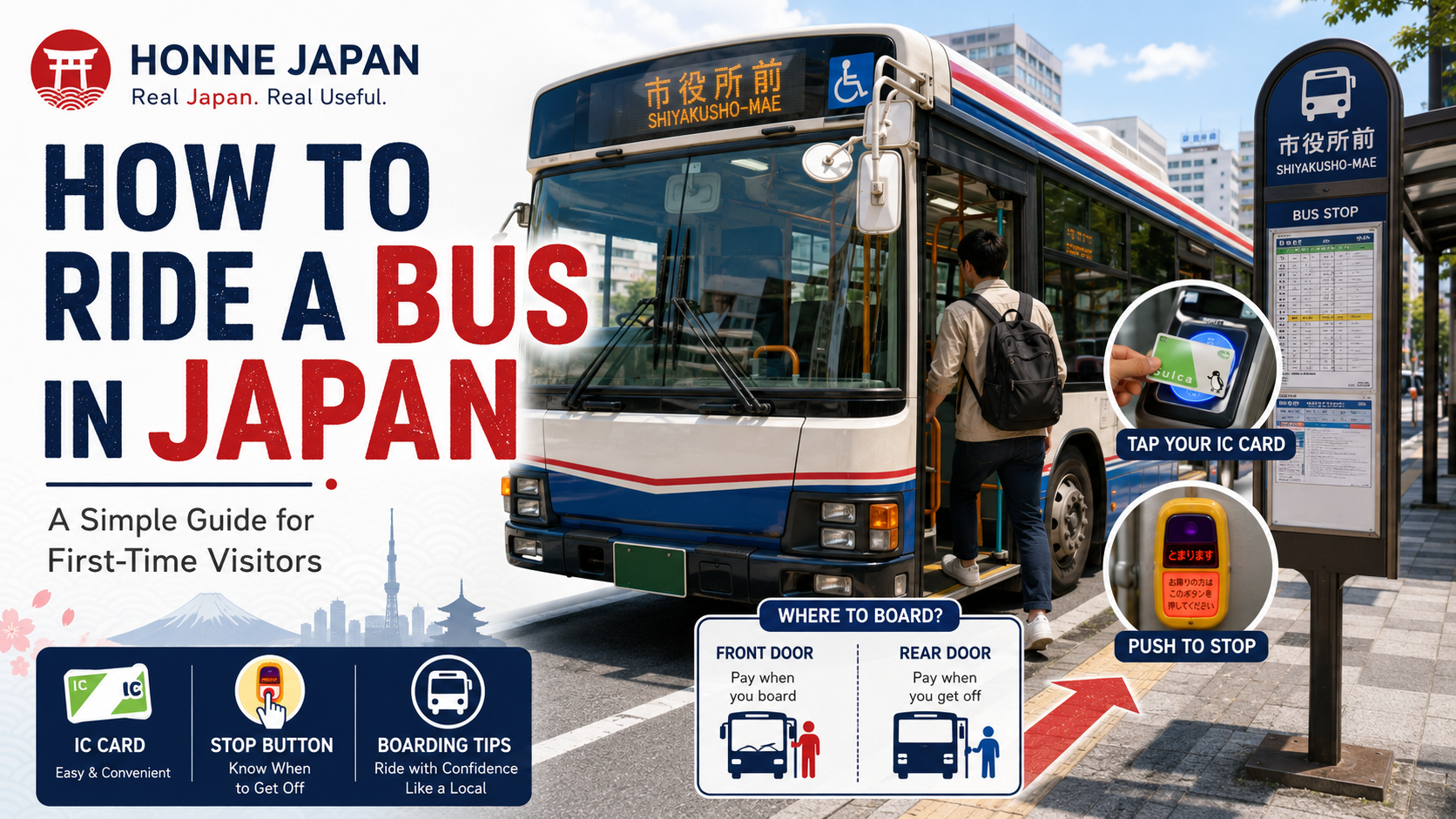
A Simple Guide for First-Time Visitors
Trains get most of the attention in Japan, but buses are often just as important.
They can take you to temples, residential neighborhoods, shopping areas, scenic spots, and places that trains do not reach easily.
The problem is that buses in Japan can feel confusing at first.
Unlike trains, the process is not always the same everywhere.
In some cities, you board from the front. In others, you board from the rear. Some buses use a flat fare, while others calculate the fare by distance. Sometimes you tap your IC card once. Sometimes you tap when boarding and again when getting off.
The good news is that once you understand the basic system, buses in Japan are not difficult.
This guide explains exactly how they work.
🇯🇵 Quick Facts
| Item | What to Expect |
|---|---|
| Difficulty | Moderate |
| Best Payment | IC card |
| Cash Accepted | Usually yes |
| Flat Fare or Distance Fare | Depends on the city |
| Boarding Style | Front or rear, depending on the route |
| Luggage Space | Usually limited on regular buses |
What Kind of Buses Are There in Japan?
When travelers say “bus in Japan,” they may actually mean several different things.
1. Local City Buses
These are the most common buses for everyday travel.
They are used for short trips within cities and towns.
Examples:
- Kyoto city buses
- Tokyo route buses
- Osaka local buses
- Residential and suburban buses
This article mainly focuses on these buses.
2. Airport Limousine Buses
These connect airports with major stations, hotels, and city centers.
They are easier to use than local buses because:
- They usually have luggage storage
- Seats are reserved or clearly assigned
- Payment is often handled in advance
3. Highway Buses
These travel between cities, such as Tokyo to Osaka or Kyoto to Nagoya.
They work more like coaches than local buses.
The Most Important Thing to Know
There is no single nationwide bus system.
However, most local buses in Japan follow one of these two patterns:
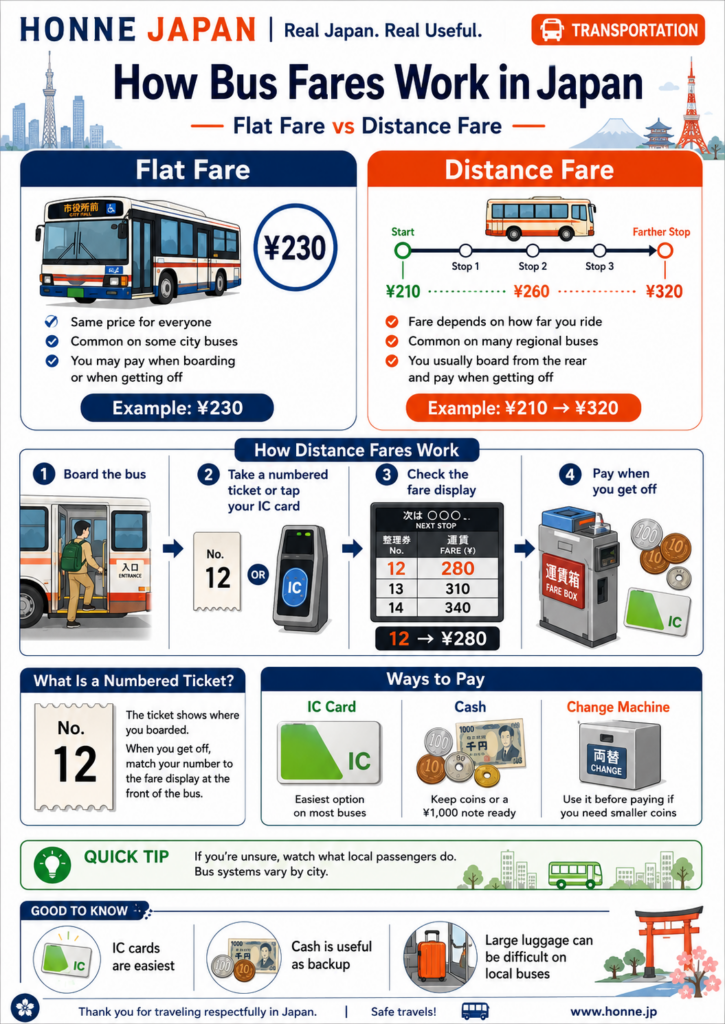
Pattern A: Flat Fare System
Common in some big cities.
- Fare is the same no matter how far you ride
- You often pay when boarding
- You may board from the front
Pattern B: Distance-Based Fare System
Common in many regional cities and suburban areas.
- Fare depends on how far you travel
- You usually board from the rear
- You may take a numbered ticket when boarding
- You usually pay when getting off at the front
If you keep these two patterns in mind, everything becomes much easier.
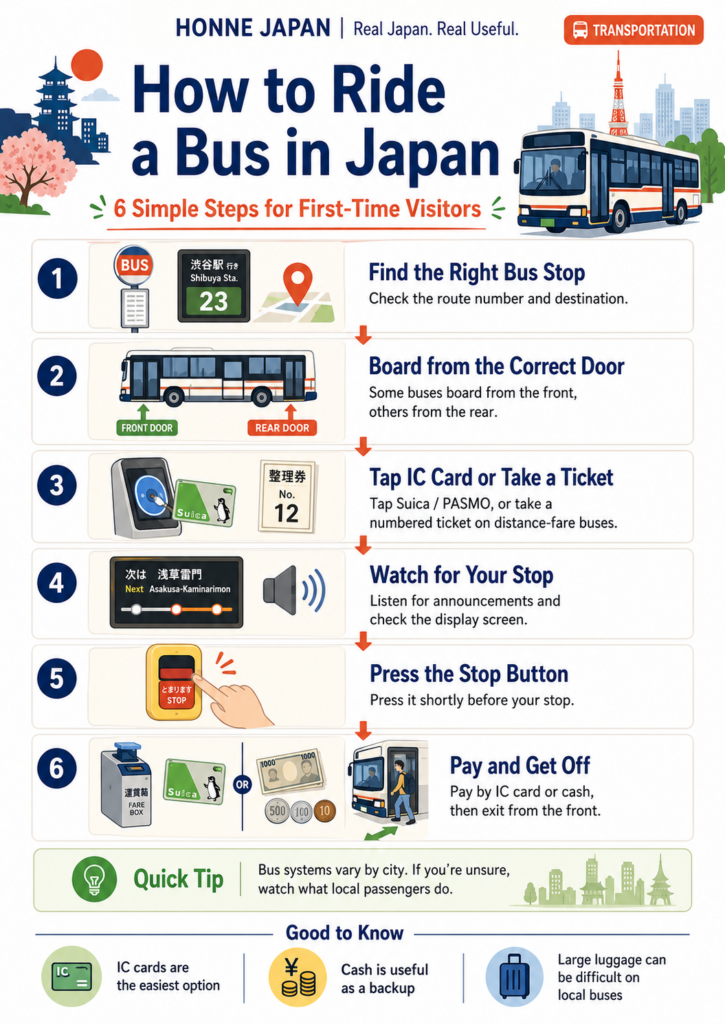
Step 1: Find the Right Bus Stop
Bus stops in Japan usually display:
- Route numbers
- Destination names
- Timetables
- Major stops along the route
Look for signs showing:
- The bus number
- The final destination
- Important places on the route
If you are using Google Maps or another navigation app, check:
- The bus stop name
- The route number
- The destination written on the front of the bus
This is important because multiple buses may stop at the same place.
Step 2: Line Up and Wait
Japanese bus stops are usually orderly.
People normally form a line rather than crowd around the door.
When the bus arrives:
- Let passengers get off first
- Wait until the line moves
- Board calmly
Do not rush.
Step 3: Check Where to Board
This is one of the biggest sources of confusion.
In some cities:
- You board from the front door
In many others:
- You board from the rear door
- You exit from the front door
Look at:
- Signs on the bus
- Arrows near the doors
- What local passengers are doing
If in doubt, simply follow the people ahead of you.
Step 4: If Needed, Take a Numbered Ticket
On many distance-based buses, there is a small machine near the boarding door that prints a numbered ticket.
This ticket is called a boarding ticket.
It shows where you got on the bus.
Later, the bus uses that number to determine your fare.
If you are paying with cash:
Take the ticket and keep it safe.
If you are using an IC card:
You usually do not need a paper ticket.
Instead, tap your IC card when boarding.
Important:
If you miss this step on a distance-based bus, it may be harder to calculate the correct fare later.
Step 5: Sit Down or Hold On
Once on the bus:
- Take an available seat
- If no seats are available, stand safely
- Hold a strap or rail
Priority seats are usually marked for:
- Elderly passengers
- People with disabilities
- Pregnant passengers
- Passengers with small children
Do not block the aisle with large luggage if possible.
Step 6: Watch or Listen for Your Stop
Inside the bus, you will usually find:
- A display screen
- Audio announcements
- Route maps
- Stop names in Japanese, and often English too
Announcements may be made in:
- Japanese
- English
- Sometimes Chinese or Korean in tourist areas
Pay attention, especially if the stop names are unfamiliar.
Using your phone map while riding is also very helpful.
Step 7: Press the Stop Button
When your stop is coming next, press one of the stop buttons located inside the bus.
You will usually see them on:
- Side walls
- Seat poles
- Window areas
After pressing the button:
- A light or sign will turn on
- The bus driver will know someone wants to get off
Do not wait until the bus has fully stopped.
Press it shortly before your stop.
Step 8: Pay Before Getting Off
This part depends on the fare system.
A. Flat Fare Bus
You may:
- Pay when boarding, or
- Sometimes pay when getting off
B. Distance-Based Bus
You usually pay when getting off.
Move toward the front door after the bus stops.
How to Pay
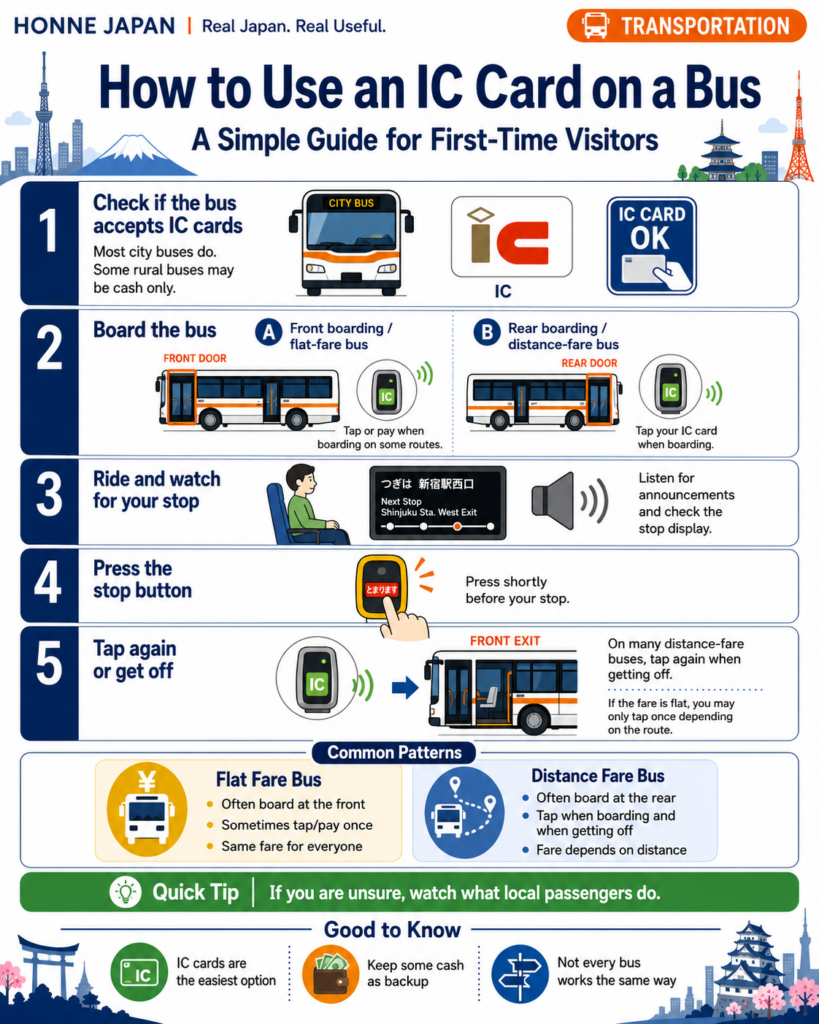
1. IC Card
The easiest option is an IC card such as:
- Suica
- PASMO
- ICOCA
- Other major Japanese transit IC cards
Depending on the bus:
- Tap once when boarding and once when getting off, or
- Tap only when paying/getting off
If you are unsure, look at what other passengers do.
IC cards are the easiest choice because you do not need exact coins.
2. Cash
Cash is still accepted on many buses.
If paying by cash on a distance-based bus:
- Check the fare display at the front
- Match your numbered ticket with the fare table
- Put both the fare and the ticket into the fare box
Some buses do not give change directly from the fare box.
Instead, they have a change machine near the driver.
You may need to insert a ¥1,000 note or coins and receive smaller change before paying.
It is a good idea to carry:
- ¥100 coins
- ¥50 coins
- ¥10 coins
- A few ¥1,000 notes
Large bills may not always be accepted.
How the Fare Display Works
On distance-based buses, there is often an electronic board at the front.
It shows:
- Numbers
- Corresponding fares
Your numbered ticket might say, for example, 7.
On the display board, you look for 7 and see the current fare next to it.
That is the amount you pay when getting off.
It may look confusing the first time, but the system is actually quite logical.
Common Bus Patterns in Japan
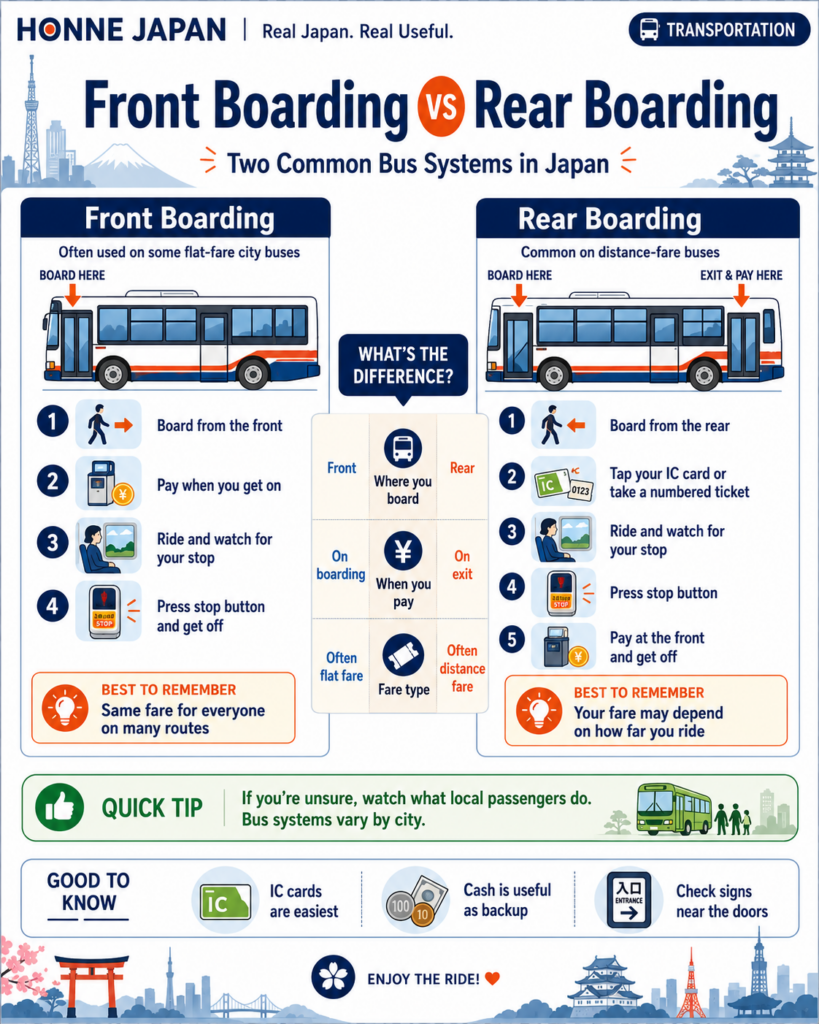
Front Boarding / Front Payment
Common with some flat-fare city buses.
Typical flow:
- Wait at the stop
- Board from the front
- Pay when you get on
- Sit down
- Press the stop button
- Exit from the front or middle, depending on the bus
Rear Boarding / Front Exit / Pay on Exit
Very common in regional and distance-based systems.
Typical flow:
- Wait at the stop
- Board from the rear
- Take a numbered ticket or tap IC card
- Ride the bus
- Press the stop button
- Check the fare
- Pay at the front
- Exit from the front
This is the pattern many visitors will encounter outside major central-city routes.
Can You Use Suica or PASMO on Buses?
Usually yes, but not always.
In many cities, major IC cards work on buses just like they do on trains.
However:
- Some rural buses may still be cash-only
- Some systems may use local IC cards
- Not every bus company supports every payment method
If you want the smoothest experience, keep some cash as backup.
What About Luggage?
On regular city buses
Space is often limited.
There may not be:
- Large luggage racks
- Dedicated suitcase storage
So try to:
- Keep luggage compact
- Avoid blocking the aisle
- Place bags on your lap or near your feet if possible
For airport buses
Large luggage is usually much easier because these buses often have underfloor luggage storage.
If you have a large suitcase, an airport limousine bus may be much more comfortable than a local route bus.
Bus Etiquette in Japan
Bus etiquette is simple but important.
Do
- Line up neatly
- Let others get off first
- Press the stop button once
- Prepare your payment before getting off
- Speak quietly
- Give priority seats to those who need them
- Keep bags out of the way
Don’t
- Block the doors
- Talk loudly on the phone
- Wait until the last second to prepare payment
- Open large amounts of luggage in the aisle
- Forget to press the stop button
- Assume all buses work exactly the same way
Helpful Japanese Phrases
Here are a few useful phrases:
Does this bus go to ___?
“Kono basu wa ___ ni ikimasu ka?”
How much is the fare?
“Unchin wa ikura desu ka?”
Can I use an IC card?
“IC kādo wa tsukaemasu ka?”
Which stop should I get off at?
“___ ni iku ni wa doko de orireba ii desu ka?”
Even if you do not pronounce them perfectly, staff usually understand simple place names and key words.
Best Option for Most Travelers
If you are only using buses occasionally, here is the easiest strategy:
Use Google Maps
It helps you identify:
- Route number
- Bus stop
- Destination
- Estimated travel time
Use an IC Card
This avoids coin confusion.
Watch What Other Passengers Do
In Japan, this works surprisingly well.
Keep Cash as Backup
Especially outside major tourist centers.
FAQ
Are buses in Japan difficult to use?
At first, they can feel confusing, especially because systems differ by city.
But after one or two rides, they usually become much easier.
Do buses in Japan accept credit cards?
Usually not directly for regular local bus fares.
IC cards and cash are more common.
What happens if I forget to take a numbered ticket?
If the bus uses distance-based fares, tell the driver when getting off.
They may help calculate your fare, but it is better not to forget.
Can I eat or drink on the bus?
On regular city buses, people usually do not eat.
Drinking water quietly is usually fine, but full meals are best avoided.
Are buses in Japan punctual?
Generally, yes.
However, traffic can cause delays, especially in cities or during bad weather.
Can I bring children on the bus?
Yes, of course.
Families regularly use buses in Japan.
Just try to keep strollers and bags as compact as possible when the bus is crowded.
HONNE JAPAN PICK
If it is your first time riding a bus in Japan, remember this:
Check where to board, prepare your IC card or cash, press the stop button before your stop, and pay attention to whether the bus uses a flat fare or a numbered ticket system.
That is really the whole experience.
Final Thoughts
Japanese buses may seem harder than trains at first, but they are often the key to reaching places trains cannot easily take you.
Once you understand the basic flow:
- Find the correct bus stop
- Board from the right door
- Take a ticket or tap your IC card
- Watch for your stop
- Press the button
- Pay and get off
—you will be able to use buses with much more confidence.
In fact, learning how to ride a bus in Japan opens up a quieter, more local side of travel that many visitors miss.
Related Articles
- How to Ride Trains in Japan
- How to Use Suica and PASMO in Japan
- How to Ride the Shinkansen in Japan
- Cash or Credit Card? How to Pay in Japan
- How to Use Coin Lockers in Japan