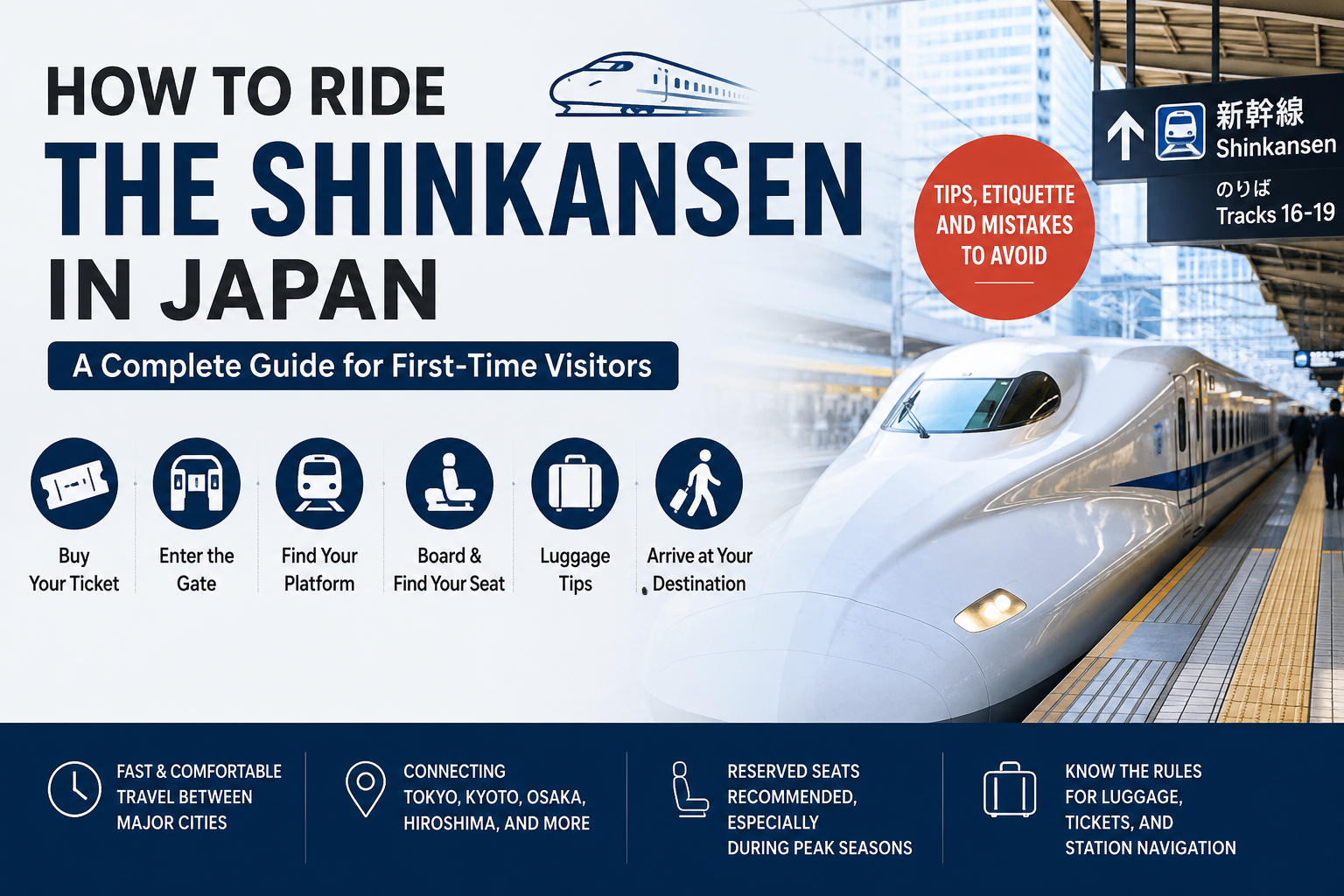
A Complete Guide for First-Time Visitors
Riding the Shinkansen is one of the easiest and most comfortable ways to travel between major cities in Japan.
These high-speed trains connect destinations such as Tokyo, Nagoya, Kyoto, Osaka, Hiroshima, Fukuoka, Sendai, Kanazawa, Nagano, and Hakodate.
However, first-time visitors are often confused by the ticket system, train names, seat types, station gates, and luggage rules.
The good news is that the actual boarding process is simple once you understand the basic steps.
This guide walks you through the entire journey—from choosing your train and buying a ticket to finding your seat and leaving the station.
🇯🇵 Quick Facts
| Item | Details |
|---|---|
| 🚅 Japanese Name | Shinkansen(新幹線) |
| 🎫 Reservation | Recommended, especially during busy periods |
| 💺 Seat Types | Non-reserved, reserved, Green Car |
| 🧳 Large Luggage | Reservation may be required |
| 🍱 Food | Eating is allowed |
| 🌍 English Support | Available at major stations and ticket machines |
| ⭐ Difficulty | Easy once you know the system |
What Is the Shinkansen?
The Shinkansen is Japan’s high-speed railway network, commonly known in English as the bullet train.
Different JR companies operate different parts of the network. The best-known route for international visitors is the Tokaido Shinkansen, which connects Tokyo, Nagoya, Kyoto, and Shin-Osaka.
The fastest Tokaido services travel from Tokyo to Kyoto in approximately 130 minutes and from Tokyo to Shin-Osaka in roughly two and a half hours.
Major Shinkansen lines include:
| Line | Main Destinations |
|---|---|
| Tokaido Shinkansen | Tokyo, Nagoya, Kyoto, Shin-Osaka |
| Sanyo Shinkansen | Shin-Osaka, Okayama, Hiroshima, Hakata |
| Kyushu Shinkansen | Hakata, Kumamoto, Kagoshima |
| Tohoku Shinkansen | Tokyo, Sendai, Morioka, Shin-Aomori |
| Hokuriku Shinkansen | Tokyo, Nagano, Toyama, Kanazawa, Tsuruga |
| Joetsu Shinkansen | Tokyo, Niigata |
| Hokkaido Shinkansen | Shin-Aomori, Shin-Hakodate-Hokuto |
You do not need to memorize all of these. Search for your departure and destination stations, and the reservation system will show the appropriate line and train.
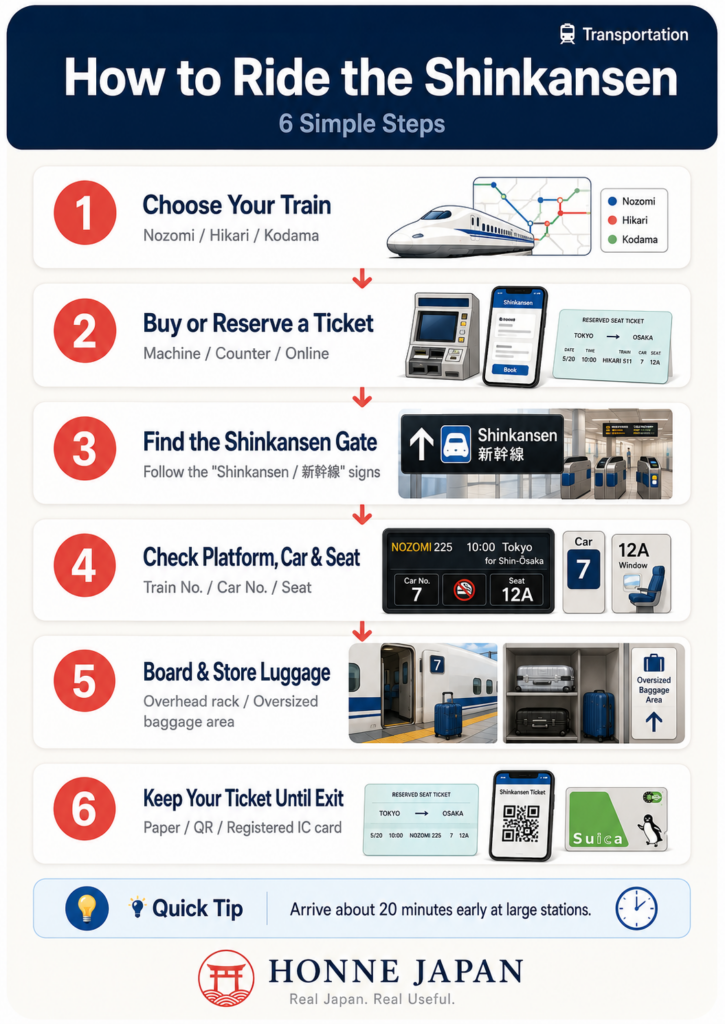
Step 1: Choose the Correct Train
Shinkansen trains on the same line may have different names and stopping patterns.
For example, the Tokaido Shinkansen has three main services.
Nozomi
Nozomi is the fastest option between Tokyo, Kyoto, and Osaka.
It stops only at major stations and is usually the best choice when you want to reach your destination as quickly as possible.
Hikari
Hikari makes more stops than Nozomi but is still relatively fast.
It is often useful for Japan Rail Pass holders because standard Japan Rail Pass coverage includes Hikari services.
Kodama
Kodama stops at every Shinkansen station along the route.
It takes longer but can be useful for smaller destinations such as Atami, Mishima, Shin-Fuji, Kakegawa, or Gifu-Hashima.
Simple Rule
| Your Priority | Recommended Train |
|---|---|
| Fastest journey | Nozomi |
| Using a standard Japan Rail Pass | Hikari |
| Traveling to a smaller station | Kodama |
Other Shinkansen lines use names such as Hayabusa, Komachi, Kagayaki, Sakura, Mizuho, and Tsubame.
Always check the destination, departure time, and train number—not just the train name.
Step 2: Choose Your Seat Type
There are three common seating options.
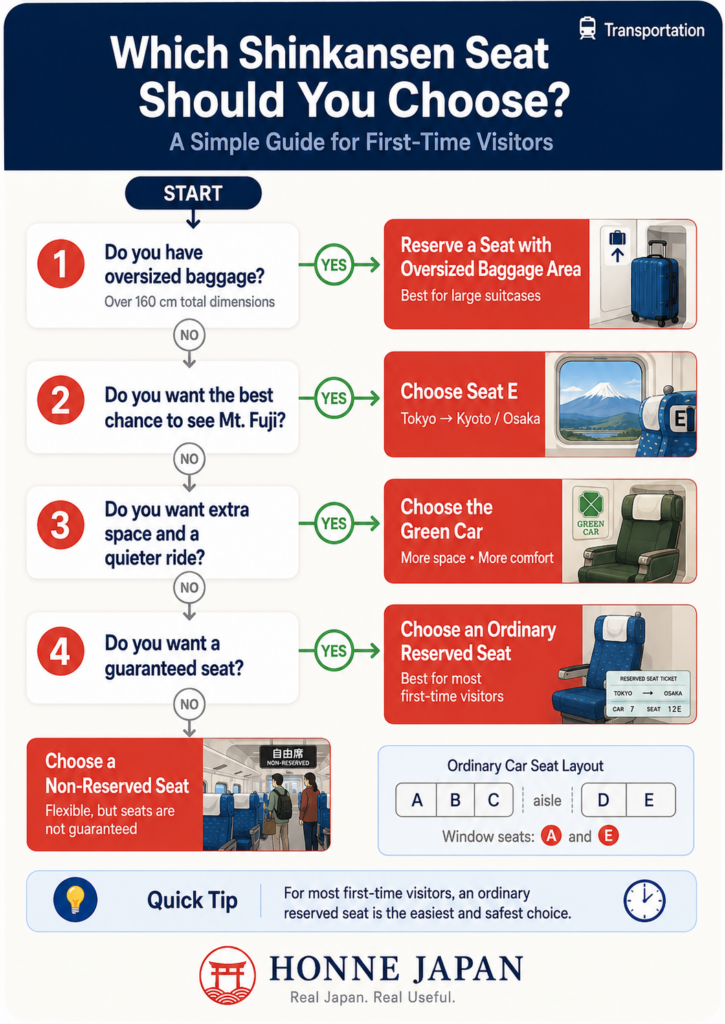
Non-Reserved Seat
A non-reserved ticket allows you to sit in a designated non-reserved car.
Seats are available on a first-come, first-served basis.
This option can work well when:
- Your travel schedule is flexible
- You are traveling outside busy periods
- You are boarding at the train’s starting station
- You do not mind waiting for another train
However, you may need to stand if all seats are occupied.
Reserved Seat
A reserved ticket gives you a specific:
- Train
- Car number
- Seat number
- Departure time
This is the easiest option for most first-time visitors.
It is particularly useful when traveling with children, as a group, with luggage, or during weekends and holidays.
Green Car
The Green Car is the Shinkansen equivalent of first class.
It usually provides:
- Wider seats
- More legroom
- A quieter environment
- Fewer passengers
The additional cost may be worthwhile for a long journey, but ordinary reserved seats are already comfortable for most travelers.
Step 3: Buy Your Shinkansen Ticket
There are several ways to purchase tickets.
Option 1: Buy at a Station Ticket Machine
Major JR stations have reserved-seat ticket machines with English-language menus.
You will usually need to select:
- Departure station
- Destination
- Travel date
- Departure time
- Train
- Reserved or non-reserved seat
- Ordinary or Green Car
- Number of passengers
JR Central states that its station ticket machines provide English menus, although not every machine offers every type of reserved ticket.
Option 2: Buy at a JR Ticket Office
Look for signs such as:
- JR Ticket Office
- Tickets
- Reserved Seat Tickets
- Midori-no-Madoguchi
Tell the staff:
Tokyo to Kyoto, tomorrow morning, reserved seat, please.
It also helps to show the destination and preferred departure time on your phone.
Option 3: Use SmartEX
SmartEX is the official online reservation service for the Tokaido, Sanyo, and Kyushu Shinkansen.
It covers routes connecting cities such as Tokyo, Nagoya, Kyoto, Osaka, Hiroshima, Hakata, Kumamoto, and Kagoshima.
You can reserve seats from outside Japan, select seats from a seat map, pay by credit card, and board using a QR ticket, registered IC card, or collected paper ticket.
Some SmartEX products can be booked up to one year ahead, while normal reserved seats are generally released at 10:00 a.m. one month before departure.
Option 4: Use JR-East Train Reservation
For the Tohoku, Joetsu, Hokuriku, and Hokkaido Shinkansen, use JR East’s official reservation system.
JR East also offers Shinkansen e-tickets that can be linked to a compatible transportation IC card.
Important: You Cannot Always Use Suica Like a Normal Train
A common mistake is assuming that you can simply tap a Suica or PASMO card and ride any Shinkansen.
Normally, you must first:
- Reserve and purchase the Shinkansen journey online.
- Register or assign your IC card to that reservation.
- Touch that registered card at the Shinkansen gate.
The Shinkansen fare is charged to the credit card used for the reservation—not deducted from the stored balance on the IC card.
Without a linked reservation or compatible Shinkansen e-ticket service, your ordinary Suica or PASMO card alone is not a valid Shinkansen ticket.
Step 4: Understand Your Paper Tickets
Depending on how you purchased your journey, you may receive:
- One combined ticket
- Two separate tickets
- A QR ticket
- An IC-card-linked reservation
Traditional paper journeys may include:
Basic Fare Ticket
This covers travel between your departure and destination areas.
Shinkansen Limited Express Ticket
This covers the Shinkansen service and your seat type.
When the gate gives you two paper tickets, place them together and insert them into the Shinkansen ticket gate at the same time.
Do not forget to take the returned tickets. You may need them during the journey and when exiting at your destination. JR Central specifically advises passengers to keep their tickets for onboard checks and the destination gate.
Step 5: Find the Shinkansen Gates
Large stations can have separate areas for:
- Local JR trains
- Private railways
- Subways
- Shinkansen trains
Follow signs showing:
Shinkansen
新幹線
The signs may also show a direction or line name, such as:
- Tokaido and Sanyo Shinkansen
- Tohoku Shinkansen
- Hokuriku Shinkansen
At Tokyo Station, for example, eastern and western Shinkansen services use different gate areas.
Allow at least 15 to 20 minutes to find the correct gate when using a large station for the first time.
Step 6: Pass Through the Ticket Gate
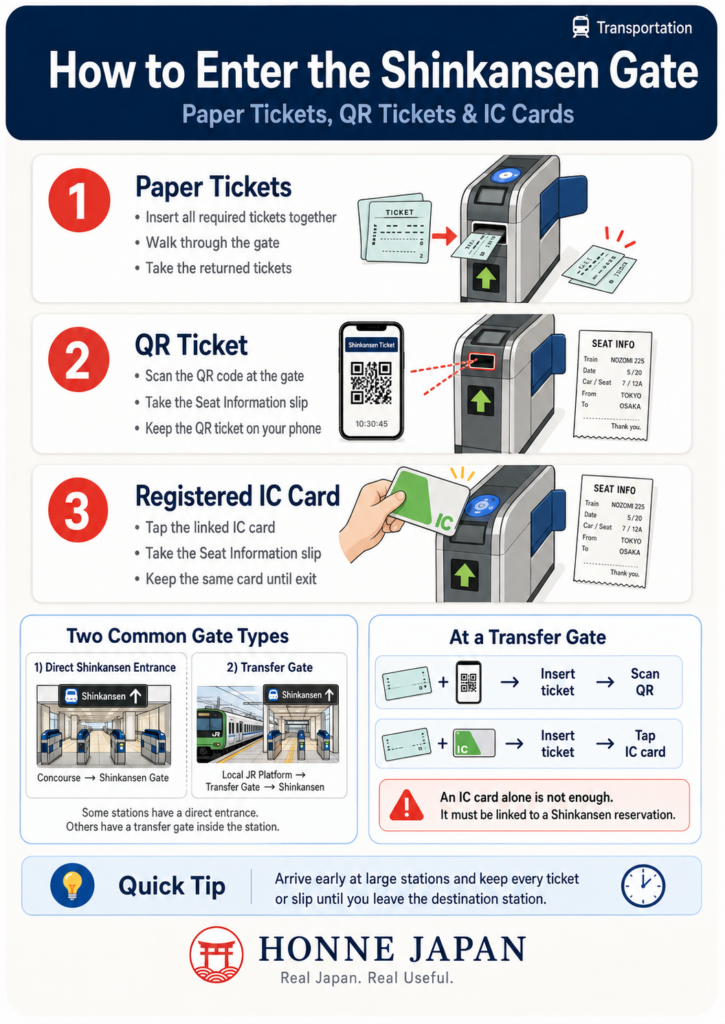
How you enter depends on your ticket type.
Paper Tickets
Insert all required paper tickets together.
Take the tickets that come out on the other side.
QR Ticket
Find a Shinkansen gate displaying the QR symbol and scan the QR ticket.
A small Seat Information slip may come out of the gate. Take it with you, but do not use that slip to exit—the QR ticket remains your gate credential.
Registered IC Card
Touch the IC card linked to your reservation.
A Seat Information slip may also be issued. Keep it during the journey.
Transferring from a Local Train
When transferring through an internal Shinkansen gate, the order matters.
For example, when using a conventional paper ticket and a Shinkansen QR ticket:
- Insert the conventional ticket.
- Scan the QR ticket.
When using a paper ticket with a registered IC card:
- Insert the ticket.
- Touch the IC card.
Follow the illustrations displayed on the gate, or ask the nearby station staff.
Step 7: Check Your Platform, Car and Seat
Your ticket or Seat Information will show details such as:
Train: Nozomi 25
Departure: 10:00
Platform: 16
Car: 12
Seat: 8-E
Check the electronic departure board for:
- Departure time
- Train name and number
- Destination
- Platform
Do not rely only on the destination. Several trains may leave for the same city within a short period.
Once you reach the platform, look for car-number signs on the floor or above the platform.
For example:
Car 12
Nozomi
Stand in the marked line corresponding to your train and car.
The platform is long, so finding the correct car before the train arrives is much easier than walking through multiple cars after boarding.
Step 8: Board the Train
Let passengers leave before you enter.
Shinkansen doors may remain open for only a short time, particularly at intermediate stations, so be ready to board when the train arrives.
Once inside:
- Check the car number.
- Find your seat row.
- Match the seat letter.
- Store your luggage safely.
- Sit in the seat printed on your ticket.
On many Tokaido Shinkansen ordinary cars, the seating layout is:
A B C aisle D EWindow seats are usually A and E.
Where Should You Put Your Luggage?
Small and medium-sized luggage can usually be stored:
- In the overhead rack
- In front of your legs
- In designated storage areas
Do not leave suitcases in the aisle or near the doors.
Oversized Baggage Rule
On the Tokaido, Sanyo, Kyushu, and Nishi-Kyushu Shinkansen, baggage measuring more than 160 cm and up to 250 cm when its three dimensions are added together requires an appropriate oversized-baggage seat reservation.
The reservation does not add an extra charge to the normal reserved-seat price. However, passengers who bring qualifying oversized baggage without the required reservation may be charged ¥1,000 and instructed where to place it. Items exceeding 250 cm in total dimensions cannot be brought aboard.
When booking, select:
Seat with an oversized baggage area
These are often seats in the final row of a car, with baggage space located behind them.
Do not place your suitcase behind the last row unless your reservation permits you to use that space.
Can You Eat on the Shinkansen?
Yes.
Eating and drinking are normal on long-distance Shinkansen journeys.
Popular choices include:
- Ekiben train bento
- Onigiri
- Sandwiches
- Coffee
- Tea
- Snacks
Buy your food before boarding, especially when using the Tokaido Shinkansen. Standard-class onboard food and drink sales are not available there, although selected Green Car passengers on Nozomi and Hikari services can use mobile ordering.
Avoid foods with an unusually strong smell, keep your area clean, and take your belongings and rubbish with you when leaving.
Can You See Mount Fuji?
When traveling from Tokyo toward Nagoya, Kyoto, or Osaka, Mount Fuji may be visible on the right side of the train.
For the best chance of seeing it on the Tokaido Shinkansen, choose:
- Seat E in an ordinary car
- Seat D in a Green Car
Visibility depends on clouds and weather, but the view usually appears after passing the Shin-Yokohama area and approaching Shizuoka Prefecture.
From Kyoto or Osaka toward Tokyo, Mount Fuji will be on the left side.
Shinkansen Etiquette
The atmosphere is generally quiet and relaxed.
Follow these simple rules:
- Speak quietly.
- Use headphones.
- Put your phone on silent mode.
- Avoid making calls at your seat.
- Keep luggage out of the aisle.
- Do not occupy another person’s reserved seat.
- Recline your seat carefully.
- Take your rubbish with you.
- Prepare to leave before reaching your station.
Eating is accepted on the Shinkansen, unlike on many short-distance commuter trains.
Traveling with the Japan Rail Pass
The nationwide Japan Rail Pass covers many JR Shinkansen services.
However, standard pass usage does not include Nozomi or Mizuho trains.
Pass holders can use those trains only after purchasing a special additional Nozomi/Mizuho ticket before boarding.
Without the additional ticket, choose services such as:
- Hikari
- Kodama
- Sakura
- Tsubame
- Hayabusa
- Kagayaki
Reserved seats can be booked through the official Japan Rail Pass reservation website when the pass was purchased through the eligible official channel, or at a JR station.
Before buying a nationwide pass, compare its price with the individual journeys you actually plan to take. A pass is not automatically cheaper for every itinerary.
Busy Travel Periods
Seat reservations are strongly recommended during:
- Golden Week
- Obon
- Year-end and New Year holidays
- Long weekends
- Major festivals and events
During designated peak periods, all seats on Tokaido and Sanyo Shinkansen Nozomi trains are operated as reserved seats. Hikari and Kodama continue to offer non-reserved seating, although those cars may also become crowded.
Reserve as soon as your itinerary is confirmed.
How to Get Off the Shinkansen
Listen for the English announcement before your destination.
Prepare early by:
- Returning your seat to an upright position.
- Checking the seat pocket.
- Collecting your luggage.
- Checking the overhead rack.
- Moving toward the door when appropriate.
Be careful with stations beginning with Shin, meaning “new.”
For example:
| Shinkansen Station | Main City Station |
|---|---|
| Shin-Osaka | Osaka |
| Shin-Kobe | Kobe / Sannomiya |
| Shin-Yokohama | Yokohama |
| Shin-Hakodate-Hokuto | Hakodate |
You may need to transfer to a local train or subway to reach the city center.
At the destination gate:
- Insert your paper tickets
- Scan your QR ticket
- Touch your registered IC card
Some paper tickets will be collected by the gate when your journey is complete.
Common Shinkansen Mistakes
1. Going to the Wrong Station
Osaka Station and Shin-Osaka Station are not the same place.
Check the exact Shinkansen station before leaving your hotel.
2. Boarding the Wrong Train
A train with the same destination may depart only a few minutes earlier or later.
Check the train number and departure time.
3. Entering the Wrong Car
Reserved-seat and non-reserved cars are separate.
Check your car number before boarding.
4. Assuming Suica Alone Is Enough
An ordinary IC card must normally be linked to a valid Shinkansen reservation before it can be used at the gate.
5. Forgetting Large-Luggage Rules
Measure large suitcases before traveling and reserve an oversized-baggage seat when required.
6. Throwing Away the Seat Information Slip
Keep all tickets and slips until you have completed the journey.
7. Arriving Too Late
Large stations can take longer to navigate than expected.
Arriving 20 minutes early is a sensible target for your first Shinkansen trip.
🇯🇵 HONNE JAPAN PICK
For a first journey between Tokyo and Kyoto or Osaka, the easiest option is:
Reserve an ordinary-class Nozomi seat online, arrive 20 minutes early, buy an ekiben, and choose Seat E for a possible Mount Fuji view.
A reserved seat removes most of the uncertainty, and the online QR-ticket option means you may not need to collect a paper ticket.
Travelers carrying a large suitcase should reserve a seat with an oversized baggage area at the same time.
FAQ
Do I need to reserve a Shinkansen seat?
Not always.
Some trains have non-reserved cars, but a reservation is recommended for first-time visitors, families, groups, busy periods, and anyone traveling with large luggage.
Can I buy a ticket on the same day?
Yes.
You can usually buy a ticket from a station machine or ticket office on the day of travel, subject to seat availability.
Can I use a credit card?
Credit cards are accepted by many reservation services, ticket offices, and ticket machines. Compatibility can vary, so carrying an alternative card or enough cash is sensible.
Can I use Suica or PASMO?
Only when the IC card has been correctly linked to a compatible Shinkansen reservation or e-ticket service.
You normally cannot board a long-distance Shinkansen simply by tapping an unregistered IC card.
Is there Wi-Fi?
Free Wi-Fi is available on Tokaido Shinkansen trains. Availability and performance on other lines may differ.
Are there toilets?
Yes.
Shinkansen trains have toilets and accessible facilities. Their exact locations depend on the train type, so check the signs inside your car.
Can I bring food?
Yes.
Eating bento, sandwiches, snacks, and drinks is normal on the Shinkansen.
Can I change my reservation?
Rules depend on the ticket product.
Standard online reservations can often be changed before departure, but discounted tickets may have stricter conditions.
What happens if I miss my train?
The answer depends on your ticket.
Some standard reserved-seat tickets may allow you to use a non-reserved car on a later eligible train that day, while discounted or train-specific products may become invalid. Ask station staff before entering another train.
Final Thoughts
The Shinkansen may look complicated because Japan has several railway companies, ticket types, train names, and boarding methods.
In practice, the journey can be reduced to six steps:
- Choose your route and train.
- Reserve your seat.
- Confirm your boarding method.
- Find the Shinkansen gate.
- Check the platform and car number.
- Keep your ticket until you exit.
Once you understand those steps, riding the Shinkansen is usually easier than navigating a major airport.
It is not only a way to travel between Japanese cities—it is also one of the most memorable everyday experiences Japan has to offer.
Related Articles
- How to Ride Trains in Japan
- How to Use Suica and PASMO in Japan
- How to Buy Train Tickets in Japan
- How to Transfer Trains in Japan
- Japanese Train Etiquette Explained
- How to Use Coin Lockers in Japan