
Don Quijote—usually called Donki by people in Japan—is one of the country’s most unusual and entertaining stores.
At first glance, it may look like a discount supermarket. But step inside, and you will find cosmetics, Japanese snacks, electronics, medicine, clothes, suitcases, souvenirs, toys and sometimes even luxury-brand products packed into the same building.
The narrow aisles, handwritten signs and shelves filled from floor to ceiling can feel overwhelming. However, once you understand how Don Quijote works, it becomes one of the most convenient places to shop during a trip to Japan.
This guide explains what you can buy, whether Don Quijote is really cheap, how tax-free shopping works and what you should know before visiting.
What Is Don Quijote?
Don Quijote is a Japanese discount-store chain known for selling an enormous variety of products in one place.
Its Japanese name is written as:
ドン・キホーテ
Most people in Japan shorten this to:
ドンキ — Donki
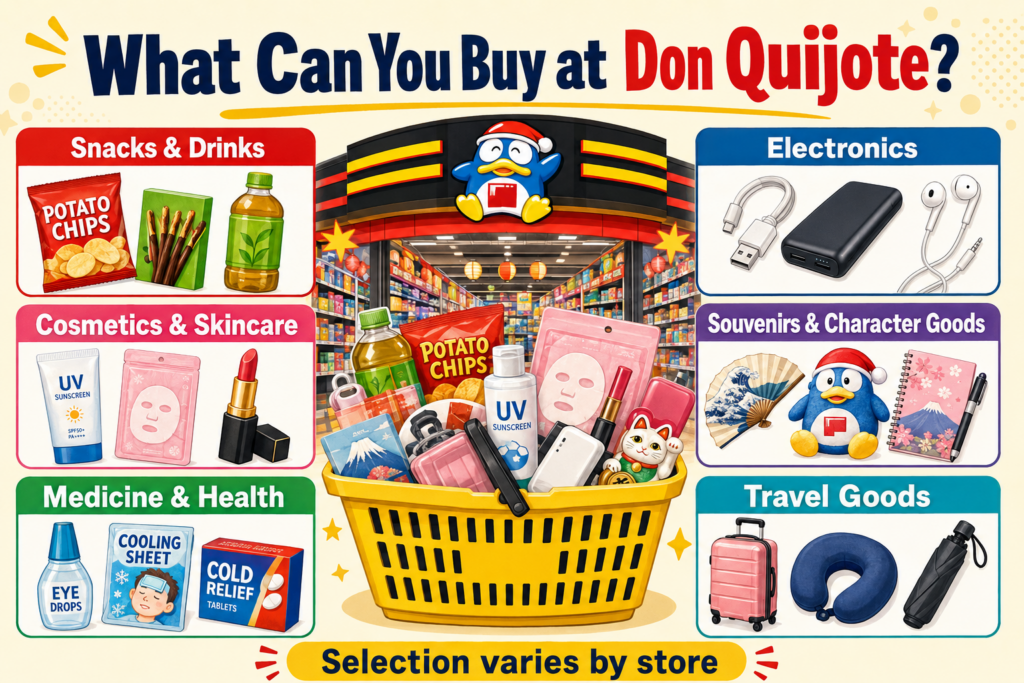
Unlike a normal supermarket or department store, Don Quijote does not specialize in one particular category. The product selection varies by store, but you can usually find everything from everyday necessities to unusual souvenirs.
Many large branches in major cities stay open until late at night, while some operate 24 hours. However, opening hours differ by location, so check the individual store before visiting.
What Can You Buy at Don Quijote?
The exact selection depends on the branch, but most Don Quijote stores carry several of the following categories.
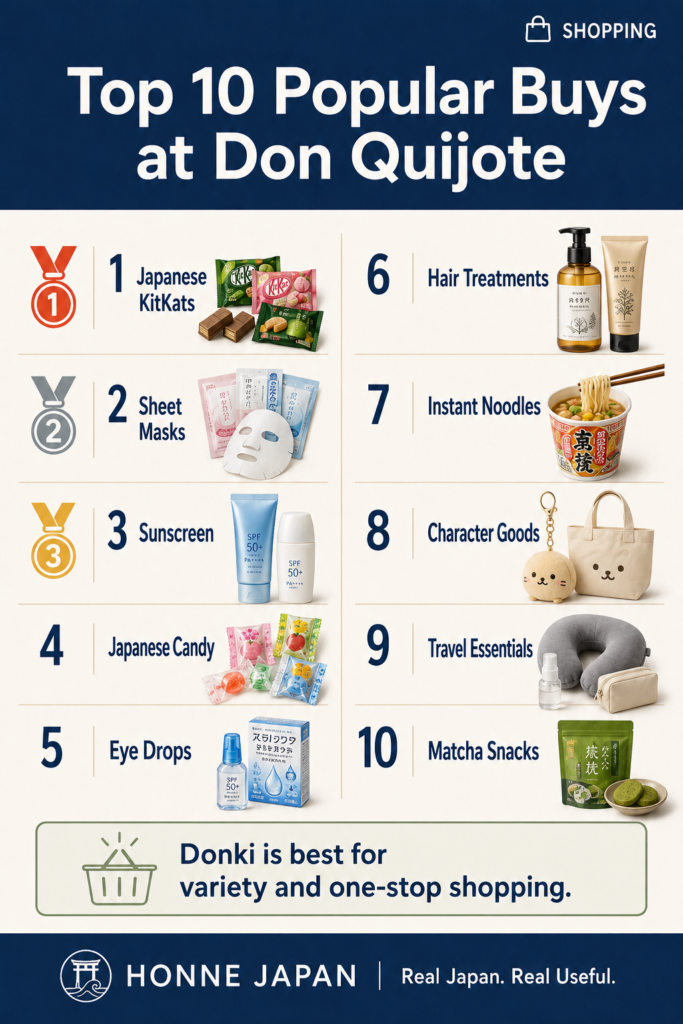
Japanese Snacks and Drinks
Don Quijote is a convenient place to buy popular Japanese snacks, including:
- KitKat flavors
- Pocky
- Hi-Chew
- Gummies
- Rice crackers
- Instant noodles
- Matcha sweets
- Regional souvenir boxes
- Japanese tea
- Soft drinks
- Alcohol
The selection is often larger than at a convenience store, especially at branches in tourist areas.
However, Don Quijote is not always the cheapest place for ordinary groceries. A local supermarket may offer lower prices on everyday food and drinks.
Cosmetics and Skincare
Cosmetics are among the most popular Don Quijote purchases for international visitors.
You may find:
- Japanese sunscreen
- Face masks
- Cleansing oil
- Facial cleansers
- Hair treatments
- Makeup
- Nail products
- Beauty tools
- Contact lens products
Large stores often have entire floors dedicated to beauty products.
Popular items can sell out, particularly at branches in Shibuya, Shinjuku, Dotonbori and other busy tourist areas.
Medicine and Health Products
Many branches sell over-the-counter medicines and health products, such as:
- Pain relievers
- Cold medicine
- Eye drops
- Stomach medicine
- Heat patches
- Cooling sheets
- Vitamins and supplements
Some medicines can only be sold when a qualified pharmacist or registered sales clerk is present. Therefore, even if the store itself is open 24 hours, the medicine counter may have shorter operating hours.
Packaging and dosage instructions are usually written mainly in Japanese. Ask a staff member or pharmacist if you are unsure which product to choose.
Electronics and Travel Accessories
Depending on the store, you may also find:
- Charging cables
- USB adapters
- Mobile batteries
- Earphones
- Travel plugs
- Small appliances
- Luggage scales
- Suitcases
- Travel pillows
- Compression bags
- Umbrellas
Check the voltage before buying electrical appliances.
Japan uses 100V electricity, so some products may not work correctly in another country. Products with a voltage range such as 100–240V are usually more suitable for international use, but you should still confirm the plug type and specifications.
Souvenirs and Character Goods
Don Quijote carries many easy-to-buy Japanese souvenirs, including:
- Anime merchandise
- Sanrio products
- Pokémon goods
- Japanese stationery
- Traditional-style gifts
- Novelty T-shirts
- Keychains
- Chopsticks
- Magnets
The selection is convenient, but it can vary significantly between branches.
For more specialized anime merchandise, stores in Akihabara, Ikebukuro or Nakano may offer a better selection.
Clothing, Bags and Luxury Products
Some large branches sell:
- Casual clothing
- Underwear
- Shoes
- Watches
- Bags
- Fragrances
- Designer-brand products
Luxury products are typically displayed in secured showcases. Selection, condition and pricing vary, so compare the item carefully before making an expensive purchase.
Is Don Quijote Really Cheap?
Sometimes—but not everything at Don Quijote is the cheapest available.
Don Quijote uses bright signs, discount labels and crowded displays that create a strong bargain-hunting atmosphere. Some products are genuinely inexpensive, while others may cost about the same as they do elsewhere.
A useful rule is:
| Product | Don Quijote | Possible Alternative |
|---|---|---|
| Japanese snacks | Good selection | Supermarkets may be cheaper |
| Cosmetics | Convenient and competitive | Drugstores may have special offers |
| Souvenirs | Easy one-stop option | Tourist shops may have regional items |
| Travel accessories | Very convenient | 100-yen shops may be cheaper |
| Electronics | Varies by product | Electronics stores offer more specialist support |
| Daily groceries | Convenient | Local supermarkets are often better |
Don Quijote’s main advantage is not always the absolute lowest price. It is the ability to buy many different things in one place, often late at night.
Don Quijote vs MEGA Don Quijote
You may see both Don Quijote and MEGA Don Quijote during your trip.
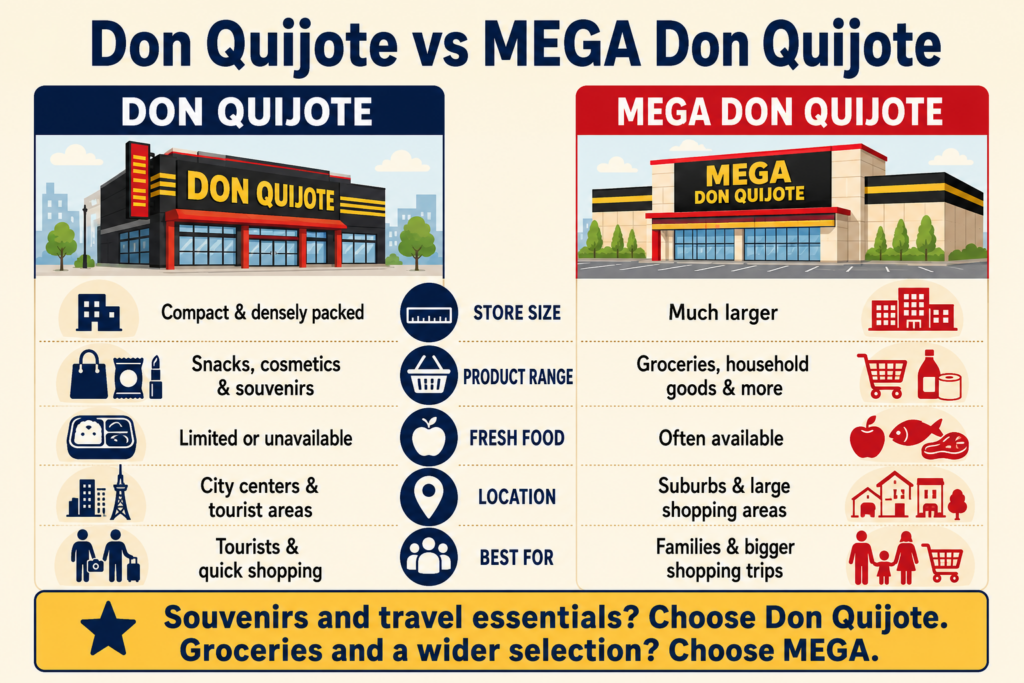
| Don Quijote | MEGA Don Quijote |
|---|---|
| Often located in central urban areas | Usually a much larger store |
| Compact and densely packed | Wider selection of daily necessities |
| Strong focus on cosmetics, snacks and novelty products | May include fresh food and supermarket sections |
| Convenient for tourists and late-night shopping | Better for families and larger shopping trips |
A regular Don Quijote is usually enough for souvenirs and travel essentials.
MEGA Don Quijote is better if you want groceries, household products, children’s items or a broader supermarket-style selection.
Why Does the Store Feel So Chaotic?
The crowded layout is intentional.
Don Quijote stores are designed to feel like a treasure hunt. Products are displayed closely together, promotional signs compete for attention and unexpected items appear around almost every corner.
This makes shopping entertaining, but it can also make specific products difficult to find.
Look for hanging category signs above the aisles or show a product name or photo to a staff member. At large branches, it is also worth checking the floor guide before walking through the entire store.
How to Shop at Don Quijote
Shopping itself is straightforward.
- Take a basket or cart near the entrance.
- Check the floor guide if the store has multiple levels.
- Look for price labels carefully.
- Bring your purchases to the checkout or tax-free counter.
- Choose whether you need a shopping bag.
- Keep your receipt, especially for expensive or tax-free purchases.
Some stores have separate checkout areas on different floors. Others require tax-free customers to use a dedicated counter.
Follow the signs or ask:
“Tax-free counter?”
Most employees at tourist-area branches will understand this phrase.
How Tax-Free Shopping Works in 2026
Japan’s tax-free system changes on November 1, 2026, so travelers need to check which rules apply on the date of purchase.
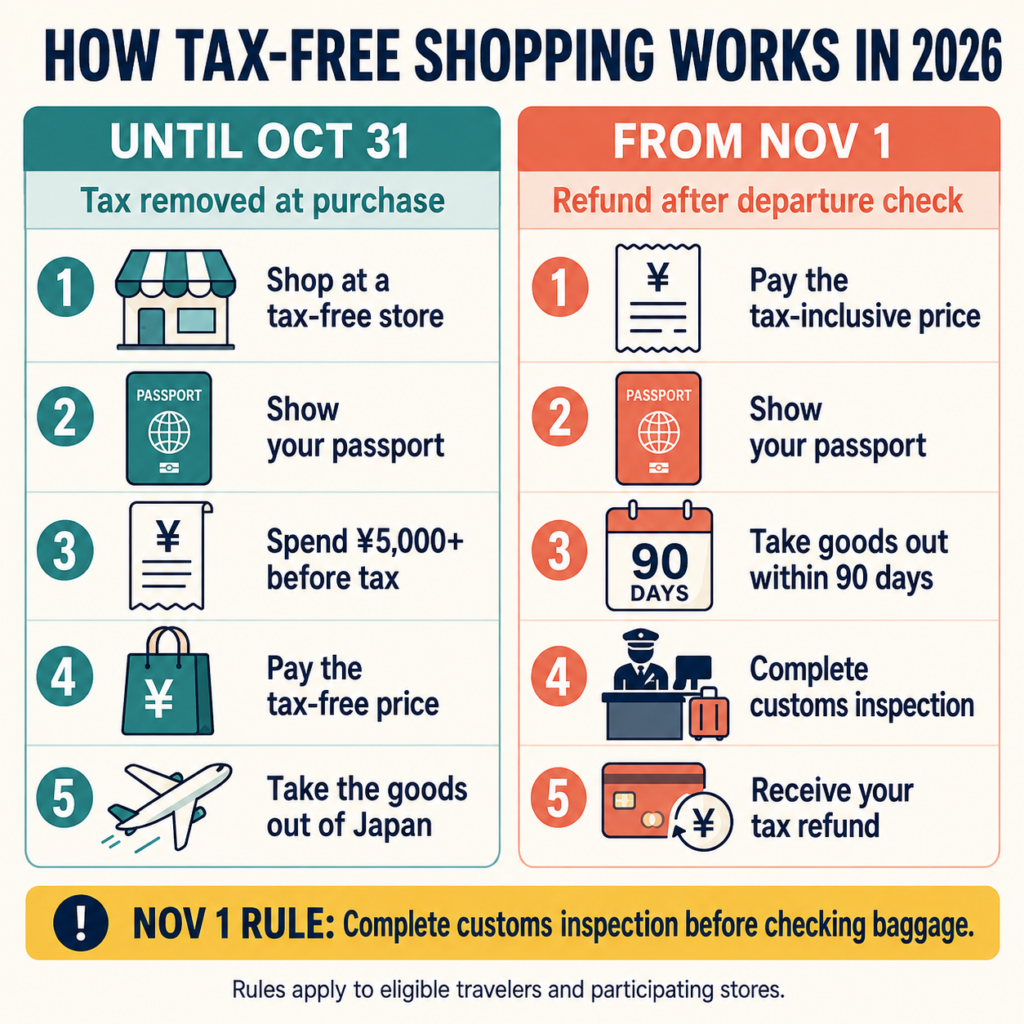
Purchases Until October 31, 2026
Under the current system, eligible visitors can generally receive the tax exemption during the purchase procedure at the store.
You normally need:
- Your physical passport
- Eligible temporary visitor status
- A qualifying purchase of at least ¥5,000 before tax at the same store on the same day
A passport photo or photocopy is generally not a substitute for the original passport.
Consumable products may be placed in sealed packaging and should not be opened or used while you are still in Japan.
Purchases From November 1, 2026
From November 1, Japan moves to a refund-based system.
Travelers will:
- Pay the tax-inclusive price at the store.
- Have the purchase registered as tax-free.
- Take the purchased items out of Japan.
- Complete the required departure inspection.
- Receive the consumption-tax refund through the retailer or its refund provider.
The qualifying minimum remains ¥5,000 before tax per store per day. Travelers must complete the customs procedure within 90 days of purchase and keep the goods available before checking their baggage.
The Japanese government warns that the inspection must be completed while the traveler still has the purchased items. Therefore, you should complete the procedure before handing over a checked suitcase containing tax-free goods. Japan Tourism Agency: Refund Method
Because refund arrangements can differ between retailers, check the latest instructions displayed at the Don Quijote tax-free counter.
Can You Use a Credit Card at Don Quijote?
Major Don Quijote branches generally accept international credit cards, including brands such as Visa, Mastercard, JCB and American Express. The company’s tourist information also notes that card acceptance and services can differ by location. Don Quijote tourist guide
Many branches also support Japanese electronic payment methods and QR-code payments.
However, not every payment method is available at every store or checkout. Carrying another card or some Japanese yen is a useful backup.
If the payment terminal asks whether you want to pay in Japanese yen or your home currency, paying in Japanese yen will often avoid an unfavorable dynamic currency conversion rate from the terminal provider. Your card issuer’s foreign transaction fees may still apply.
Best Time to Visit
Tourist-area branches can become extremely crowded in the evening.
For a calmer experience, try visiting:
- In the morning
- On a weekday
- Before the evening shopping rush
- At a branch outside the busiest tourist district
Late-night shopping can be fun, but stores near major stations may remain busy until surprisingly late.
If you need tax-free service, do not assume the tax-free counter operates for the store’s entire opening period. Check the counter hours in advance, especially when visiting after midnight.
Useful Don Quijote Shopping Tips
Photograph the Entrance or Store Name
Large cities may have several Don Quijote branches. Taking a photo makes it easier to return to the correct store if you leave and want to come back.
Check the Product Size
Japanese cosmetics, medicine and household products may look inexpensive because the package is smaller than an equivalent product in your country.
Compare the volume or number of items, not just the total price.
Check Food Expiration Dates
Discounted food may have a relatively short expiration or best-before period.
This is usually not a problem if you plan to eat it soon, but it matters if you are buying gifts to take home.
Confirm Luggage Space Before Shopping
Don Quijote makes impulse buying dangerously easy.
Suitcases, large snack boxes, bottled drinks and bulk cosmetics can take up much more space than expected. Check your airline’s baggage allowance before buying heavy or oversized items.
Do Not Assume Every Souvenir Is Made in Japan
Don Quijote sells Japanese brands alongside imported and private-label products.
If the country of manufacture matters to you, look for:
- Made in Japan
- 日本製 — Nihon-sei
- 原産国 — Country of origin
Compare Expensive Purchases
Don Quijote is convenient, but you should compare prices and warranty conditions before buying costly electronics, watches or designer products.
International warranty coverage is not always included.
Is Don Quijote Worth Visiting?
Yes—especially if it is your first trip to Japan.
Don Quijote is useful for buying cosmetics, snacks, souvenirs, medicine and last-minute travel items in one place. The unusual layout also makes the store itself feel like a small part of the Japan experience.
However, you do not need to buy everything there.
Use supermarkets for ordinary food, drugstores for additional cosmetics and medicine choices, 100-yen shops for inexpensive everyday items and specialist stores for major electronics or anime merchandise.
The best way to enjoy Don Quijote is to treat it as a treasure hunt—while still checking prices, product sizes and your remaining luggage space.
Frequently Asked Questions
What does “Donki” mean?
“Donki” is the common shortened name for Don Quijote in Japan.
Is Don Quijote open 24 hours?
Some branches are open 24 hours, but many are not. Opening hours vary by location.
Is everything at Don Quijote cheap?
No. Many products are competitively priced, but supermarkets, drugstores, 100-yen shops or specialist retailers may be cheaper for certain items.
Can tourists shop tax-free at Don Quijote?
Eligible international visitors can use tax-free services at participating locations when they meet the purchase and immigration-status requirements. Japan’s procedure changes to a refund-based system on November 1, 2026.
Do I need my passport?
You need your physical passport when completing a tax-free purchase. A photo stored on your phone is generally insufficient.
Can I buy medicine at night?
It depends. The store may be open, but certain medicines can only be sold while qualified staff are present.
Can I use a foreign credit card?
Most major branches accept common international card brands, but payment options can vary by store.