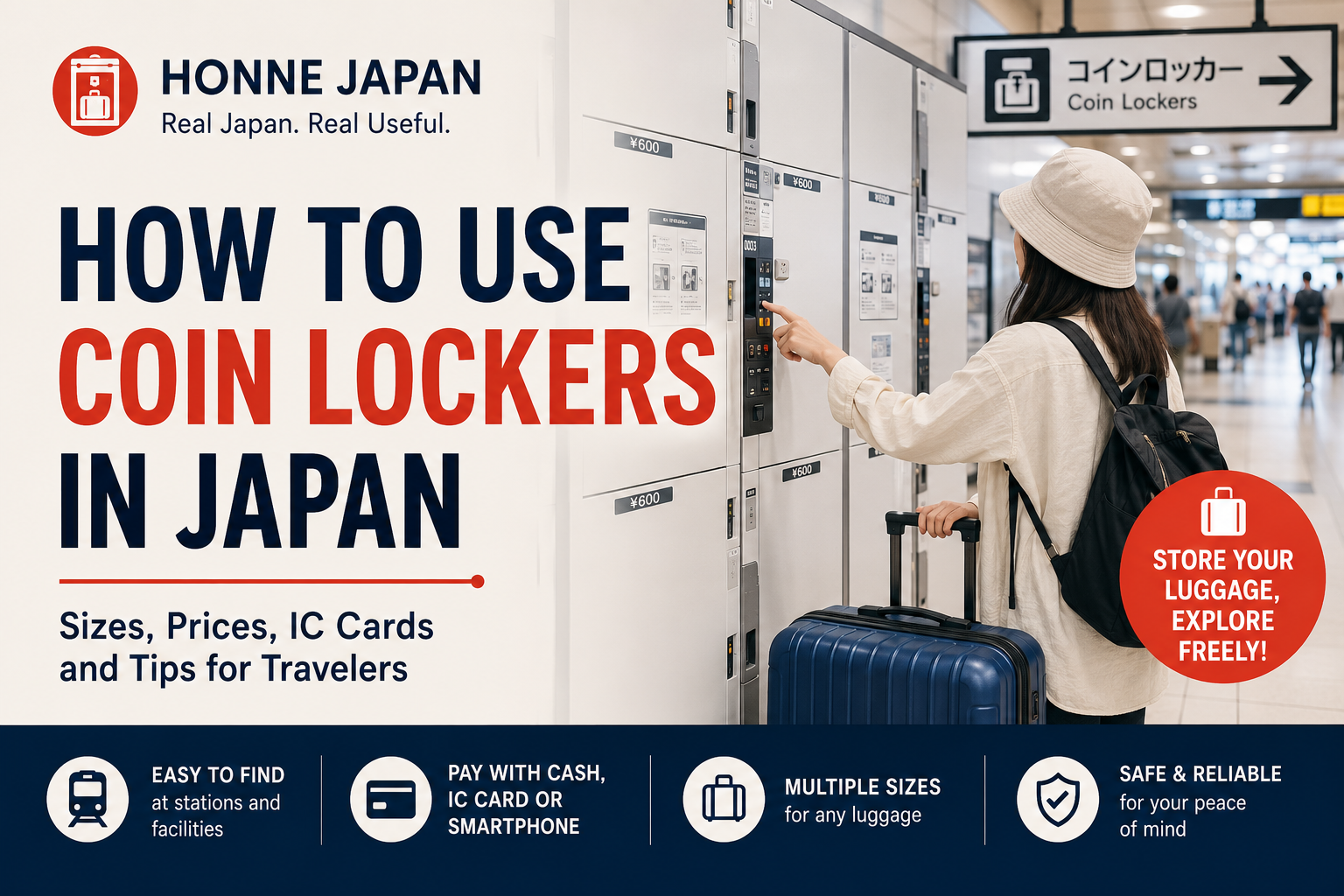
Sizes, Prices and IC Card Guide for First-Time Visitors
Leave your luggage, explore freely, and return when you are ready.
Dragging a suitcase through a crowded station, narrow shop, temple grounds, or busy sightseeing area can quickly make a day in Japan exhausting.
Fortunately, Japan has a practical solution almost everywhere travelers need it:
Coin lockers.
You can commonly find luggage lockers at major train and subway stations, airports, shopping centers, tourist facilities, and some bus terminals.
Despite the name, modern “coin lockers” do not always require coins. Depending on the machine, you may pay with cash, use a transportation IC card such as Suica, or operate the locker through a smartphone.
Some newer lockers can even be searched and reserved online before arrival. JR East’s Multi-Ecube system and services such as SPACER now offer functions including locker searches, reservations and cashless operation.
This guide explains how Japanese coin lockers work, what they cost, which size to choose, and what to do when every locker appears to be full.
Quick Facts
| Item | What to Expect |
|---|---|
| Best For | Backpacks, shopping bags and suitcases |
| Common Locations | Train stations, airports and shopping facilities |
| Payment | Coins, IC cards or smartphone payment |
| Typical Cost | Several hundred yen to ¥1,000 or more |
| Charging Period | Usually calculated by day |
| Availability | Can be limited at busy stations |
| Maximum Use | Depends on the locker operator |
| Safety | Useful for luggage, but not recommended for valuables |
Why Coin Lockers Are So Useful in Japan
Coin lockers allow you to use the time between:
- Hotel checkout and an evening train
- Morning arrival and afternoon check-in
- Two train journeys
- Shopping and sightseeing
- A day trip and your return journey
Instead of carrying your suitcase all day, you can leave it near the station you will use later.
This works particularly well in Japan because many sightseeing trips begin and end at railway stations.
Tokyo Metro includes a dedicated coin-locker symbol in its station guidance, and JR station maps often identify locker locations.
Where Can You Find Coin Lockers?
The most common places are:
Train and Subway Stations
Look near:
- Ticket gates
- Station exits
- Underground passageways
- Restrooms
- Station shopping areas
- Transfer corridors
Large stations may have several separate locker areas.
Airports
Airport lockers are useful when:
- You have a long layover
- You want to visit the city before a late flight
- You need to store seasonal clothing
- You are transferring between hotels
Shopping Centers
Lockers may be located near:
- Information counters
- Food courts
- Restrooms
- Supermarket entrances
- Main exits
Tourist Attractions and Bus Terminals
Some museums, temples, theme parks, visitor centers and bus terminals also provide lockers or staffed baggage storage.
Check Whether the Locker Is Inside the Ticket Gates
This is one of the most important details.
A locker may be:
- Inside the ticket gates
- Outside the ticket gates
- Inside a shopping facility connected to the station
If you store luggage inside the gates and later return from outside the station, you may need to enter the paid area again.
Before choosing a locker, check:
- Which side of the gates it is on
- Which exit it is near
- Whether the station area closes at night
- Whether you will return to the same part of the station
At a large station such as Tokyo, Shinjuku or Osaka, remembering only the station name is not enough.
Record the exact location.
Three Main Types of Coin Lockers
1. Key Lockers
These are traditional lockers with a physical key.
You usually:
- Put your luggage inside
- Insert the required coins
- Close the door
- Turn the key
- Remove and keep the key
The locker number is normally printed on the key tag.
Best For
- Travelers paying with cash
- Simple, short-term storage
- Stations without newer touchscreen lockers
Important
Do not lose the key.
Replacing a lost key may require staff assistance and an additional fee.
2. IC Card Lockers
These lockers use a transportation IC card as both:
- The payment method
- The locker key
JR East officially explains that Welcome Suica can be used to pay for compatible lockers and unlock them later. Cash and the IC card generally cannot be combined for one payment.
Compatible cards may include:
- Suica
- PASMO
- ICOCA
- Other mutually compatible transportation IC cards
Acceptance depends on the locker.
Best For
- Travelers already using an IC card
- People who do not want to carry coins
- Busy stations where a physical key would be easy to lose
3. Smartphone and Reservable Lockers
Some newer lockers use:
- QR codes
- Reservation numbers
- Mobile applications
- Online payment
- Smartphone-based keys
SPACER lockers can be located and operated using a smartphone, and selected lockers can be reserved in advance. JR East’s Multi-Ecube service also allows travelers to search for available lockers and reserve selected units online.
Some advanced lockers offer additional services, including sending luggage to a hotel or another address from selected locations.
Best For
- Busy travel days
- Large stations
- Travelers worried about finding an empty locker
- People comfortable using smartphone services
How to Use a Key Coin Locker
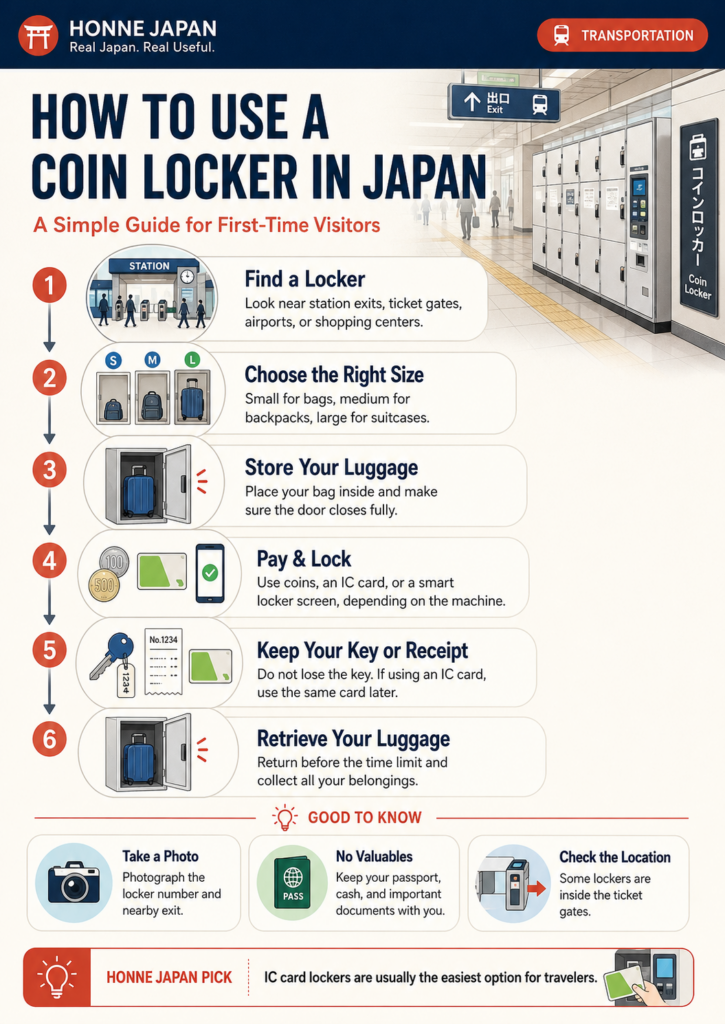
Step 1: Find an Empty Locker
An unused locker normally has:
- An open door
- A key in the lock
- An available indicator
Check that your luggage fits without forcing the door.
Step 2: Put Your Luggage Inside
Make sure:
- No straps are hanging outside
- The door can close completely
- You have removed anything you will need soon
Step 3: Check the Price
The price should be displayed on:
- The locker door
- The key area
- A nearby sign
- The main payment panel
Step 4: Insert the Required Coins
Many traditional lockers accept ¥100 coins.
Some may accept:
- ¥500 coins
- ¥1,000 notes through a central payment machine
- Other payment methods
Do not assume every machine gives change.
Step 5: Lock the Door
Close the door firmly, turn the key and remove it.
Test the door gently to confirm that it is locked.
Step 6: Photograph the Location
Take pictures of:
- The locker number
- The locker area
- Nearby signs
- The closest station exit
Then keep the key somewhere secure.
How to Use an IC Card Locker
Step 1: Choose an Empty Locker
Place your luggage inside and close the door.
Step 2: Follow the Screen
Select the storage or deposit option.
English may be available on the touchscreen.
Step 3: Select IC Card Payment
The machine will display the price.
Step 4: Tap Your IC Card
Hold the same card against the reader until the machine confirms payment.
Your card now functions as the key.
Step 5: Take the Receipt
JR East advises users to keep the printed receipt because it may contain the locker location and contact information for assistance.
Step 6: Use the Same Card to Retrieve Your Luggage
When you return:
- Select Remove or Retrieve
- Tap the same IC card
- Wait for the locker to unlock
- Remove all your belongings
- Check the locker before leaving
Do not use a different IC card, even if it belongs to the same person.
How to Use a Smartphone Locker
The exact process varies by operator, but it may look like this:
- Find or reserve a locker online
- Create an account or download the required app
- Pay by smartphone
- Receive a QR code or reservation number
- Go to the specified locker
- Scan the code or enter the number
- Store your luggage and lock the door
- Use the same service to retrieve it later
Multi-Ecube reservations provide the assigned locker information, reservation number and QR code on the day of use.
Read the instructions before reserving because:
- An additional reservation fee may apply
- Cancellation rules may apply
- The locker may have limited opening hours
- The service may require internet access
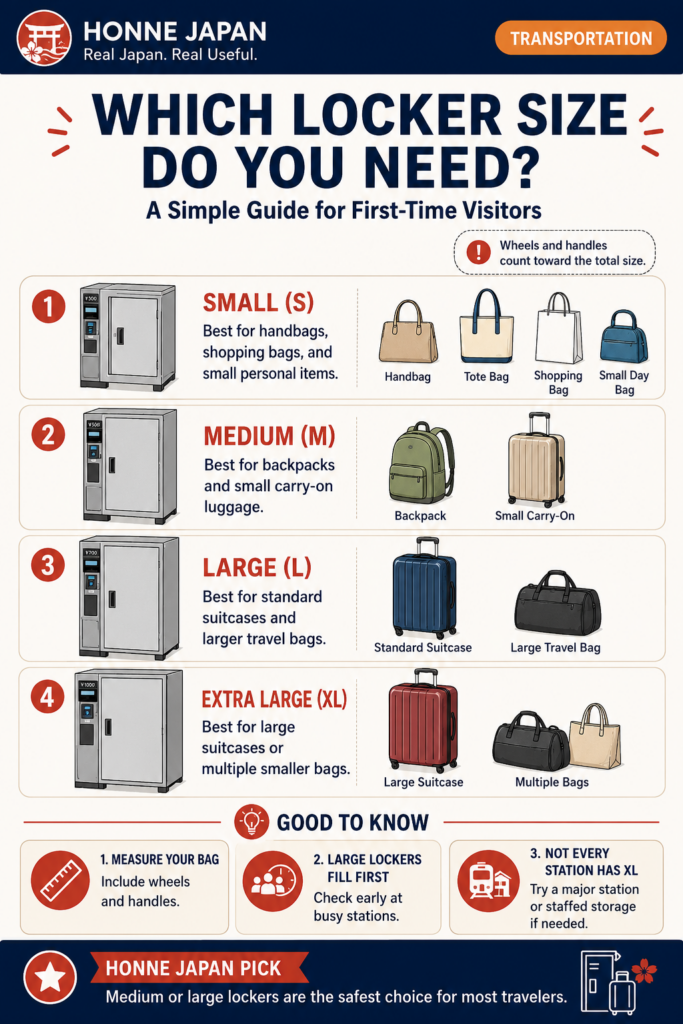
Coin Locker Sizes
The names and dimensions vary, but lockers are usually divided into several broad sizes.
| Size | Usually Suitable For |
|---|---|
| Small | Handbag, daypack or shopping bags |
| Medium | Backpack or small carry-on suitcase |
| Large | Standard suitcase |
| Extra Large | Large suitcase or multiple smaller bags |
Not every station has extra-large lockers.
Before paying:
- Check the actual compartment
- Include wheels and handles in the luggage size
- Do not force a suitcase into a smaller locker
Large lockers usually fill first at popular stations.
How Much Do Coin Lockers Cost?
Prices vary by:
- Locker size
- Station
- City
- Operator
- Reservation status
- Length of use
A practical expectation is:
| Locker Size | General Price Expectation |
|---|---|
| Small | Around ¥300–500 |
| Medium | Around ¥500–700 |
| Large | Around ¥700–1,000 |
| Extra Large or Premium | ¥1,000 or more |
These are general guidelines, not fixed national prices.
For one current JR East Multi-Ecube location inside Tokyo Station, the walk-up locker charges range from ¥300 for the smallest compartment to ¥1,400 for an extra-wide locker. Online reservation adds ¥500 at that location.
Always check the displayed tax-included price before storing your luggage.
How Is One Day Calculated?
This is easy to misunderstand.
A locker “day” may not mean exactly 24 hours from the moment you store your luggage.
Depending on the machine, an additional day may begin:
- At midnight
- During the early morning
- At a time specified by the operator
For example, Multi-Ecube treats 2:00 a.m. as the start of a new usage day for reservations, and passing that time adds another day.
Traditional lockers may use different rules.
Read the fee notice carefully, especially if leaving luggage overnight.
How Long Can You Leave Luggage?
The maximum period varies.
Some lockers are designed only for short-term use.
Multi-Ecube reservations currently allow a maximum of three days including the first day.
Other locker operators may have different limits.
If luggage remains beyond the permitted period:
- The locker may stop operating normally
- Staff may remove the luggage
- Additional storage or handling fees may apply
- You may need to contact the operator
Coin lockers are not intended for long-term luggage storage.
Are Coin Lockers in Japan Safe?
Japanese station lockers generally feel reassuring because they are:
- Located in busy public facilities
- Locked with a key, IC card or digital code
- Often near station staff or surveillance systems
- Designed specifically for temporary baggage storage
Newer systems also provide receipts, reservation records and digital access controls, which can make the process easier to trace if assistance is needed. This contributes to their strong sense of reliability, but no public locker should be treated as completely risk-free.
Keep These Items With You
Do not leave:
- Passport
- Cash
- Credit cards
- Prescription medicine
- Irreplaceable documents
- Expensive jewelry
- Fragile valuables
- Items needed for your next train or flight
Use lockers for ordinary luggage, clothing and shopping bags—not your most important possessions.
What Should You Photograph?
Before walking away, take a photo of:
- The locker number
- The bank of lockers
- The floor or platform level
- The nearest exit
- A nearby shop or landmark
- The receipt
- The physical key, if applicable
Large Japanese stations may have dozens of entrances and multiple locker areas.
A single photograph can save a great deal of time later.
What If All the Lockers Are Full?
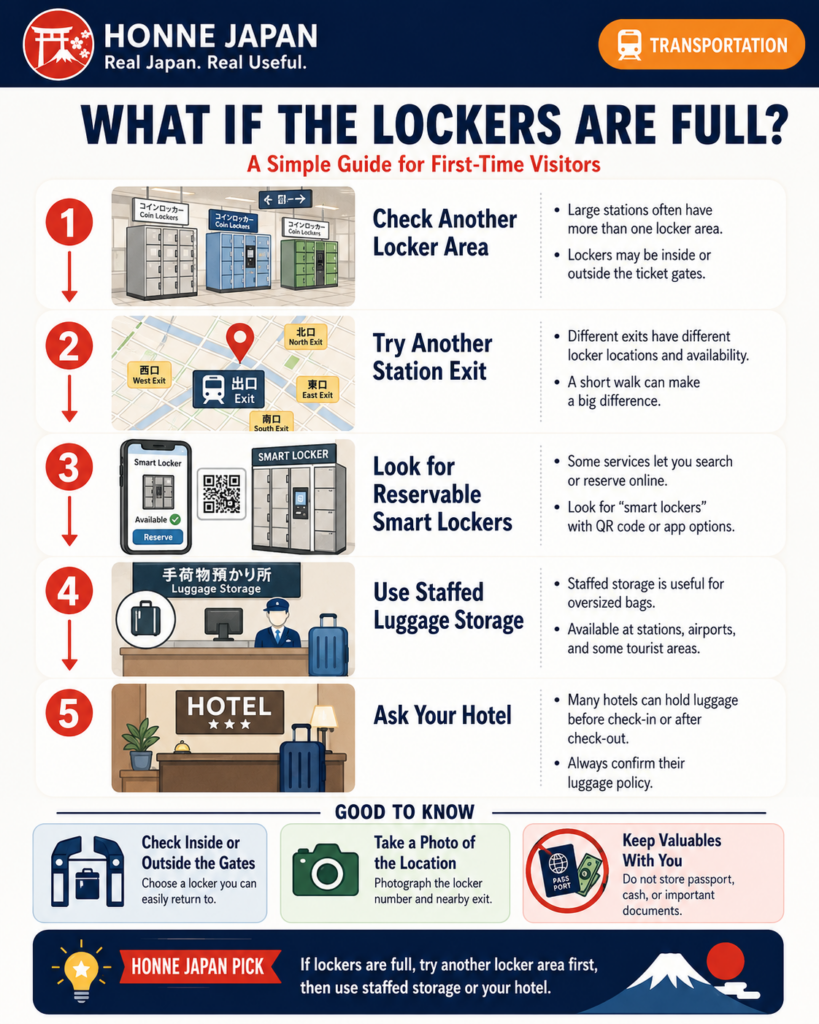
This happens frequently at:
- Major stations
- Weekends
- Public holidays
- Concerts and festivals
- Cherry blossom season
- Long holiday periods
- Check-in and checkout times
Try these solutions in order.
1. Check Another Locker Area
Large stations may have lockers:
- On another floor
- Outside a different exit
- Inside or outside the ticket gates
- In an adjacent shopping center
2. Try a Smaller Nearby Station
One stop away may have more availability.
Make sure returning there later fits your route.
3. Search for Reservable Smart Lockers
Multi-Ecube and SPACER provide locker-search functions for selected locations, and some units can be reserved.
4. Use Staffed Luggage Storage
Services such as ecbo cloak allow travelers to reserve space at participating shops and other facilities rather than use a traditional locker.
This can be useful for:
- Oversized suitcases
- Baby strollers
- Musical instruments
- Several bags
- Stations where lockers are full
5. Use a Hotel Storage Service
Many hotels hold luggage for guests:
- Before check-in
- After checkout
Ask your hotel directly about its policy.
Coin Locker or Staffed Storage?
| Situation | Better Choice |
|---|---|
| Small bag for a few hours | Coin locker |
| Returning to the same station | Coin locker |
| Large or unusual luggage | Staffed storage |
| Lockers are full | Staffed storage |
| Need a guaranteed space | Reservable locker or storage |
| Want luggage sent to a hotel | Delivery-enabled service |
| Need access during station closing hours | Check an outside facility |
Common Mistakes
Forgetting Which Exit You Used
Large stations can have many exits with similar names.
Photograph the exit number.
Leaving the Receipt Inside the Locker
Keep the receipt with you.
Using the Wrong IC Card
You must normally use the same card that locked the locker.
Storing a Train Ticket or Passport
Keep all essential travel documents with you.
Ignoring the Closing Time
Some locker areas are unavailable after the station or facility closes. Multi-Ecube specifically notes that operating hours vary by facility.
Assuming “One Day” Means 24 Hours
The charging period depends on the operator.
Choosing a Locker Inside the Gates by Accident
Check whether you can easily return to the same area later.
HONNE JAPAN PICK
For most travelers, an IC card locker outside the ticket gates is the easiest option.
It avoids:
- Searching for coins
- Carrying a physical key
- Re-entering the paid station area
- Remembering an unfamiliar key number alone
But always keep the receipt and photograph the location.
The safest locker is not merely one that locks—it is one you can find again.
FAQ
Can I use Suica to pay for a coin locker?
Yes, at compatible IC card lockers.
The same Suica normally becomes the key used to retrieve the luggage.
Can I use a credit card?
Traditional lockers may not accept credit cards.
Some smart lockers support online or cashless payment.
Do coin lockers give change?
Some machines have change functions, but many traditional lockers require exact coins.
Prepare ¥100 coins as a backup.
Can a large suitcase fit?
Yes, if a large or extra-large locker is available.
Availability varies considerably by station.
Can I open the locker and put something back?
Usually, opening the locker ends the rental.
You may need to pay again to reuse it.
Check the instructions before opening.
Can I leave luggage overnight?
Often yes, but the operator may charge an additional day at a specified cutoff time.
Check the usage limit and facility opening hours.
What happens if I lose the key?
Contact station staff or the locker operator using the information displayed near the lockers.
Identification and an additional fee may be required.
What happens if I lose the IC card?
Contact the locker operator or station staff immediately.
Keep the receipt because it can help identify the locker.
Are lockers available at every station?
No.
Major stations are more likely to have them, while small or rural stations may have few or none.
Final Thoughts
Coin lockers are one of the most useful features of traveling in Japan.
They allow you to:
- Explore before hotel check-in
- Continue sightseeing after checkout
- Shop without carrying luggage
- Visit crowded attractions more comfortably
- Use waiting time between trains effectively
The basic process is simple:
- Find a suitable locker
- Check its location and operating hours
- Store your luggage
- Pay with coins, an IC card or a smartphone
- Keep the key, card or receipt
- Photograph the location
- Return before the usage limit
Once you understand the system, coin lockers can completely change how you plan a travel day in Japan.
Instead of organizing your sightseeing around your suitcase, you can leave the suitcase behind and enjoy the city freely.
Related Articles
- How to Ride Trains in Japan
- How to Use Suica and PASMO
- How to Ride a Bus in Japan
- Luggage Delivery in Japan
- How to Navigate Japanese Train Stations
- Cash or Credit Card? How to Pay in Japan