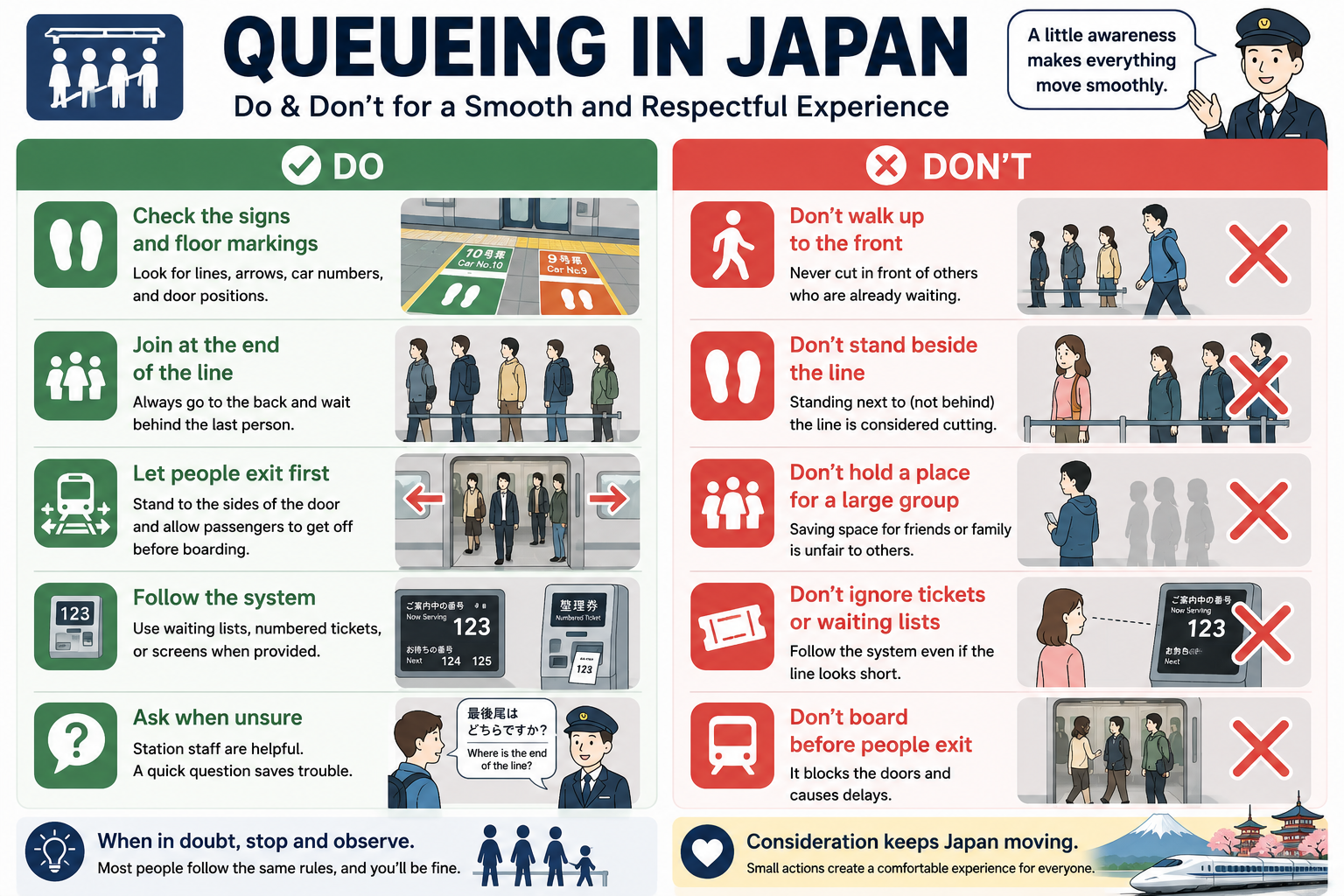
The Unwritten Rules of Waiting in Line in Japan
One of the first things many visitors notice in Japan is how neatly people wait in line.
Passengers form orderly rows on train platforms. Customers wait quietly outside popular restaurants. Even when a new store opens or a limited-edition product goes on sale, people often remain in clearly organized queues.
Japan’s official tourism guidance notes that people commonly line up for trains, shop checkouts, restaurants, store openings, and many other everyday situations.
It can look as though everyone instinctively knows where to stand.
But Japanese queues are not created by politeness alone.
They work because social expectations, clear visual instructions, and practical systems all reinforce one another.
This guide explains why queueing is so common in Japan, how different types of lines work, and what visitors should know to avoid accidentally cutting in.
🇯🇵 Quick Facts
| Item | Details |
|---|---|
| 👥 Where People Queue | Stations, restaurants, stores, bus stops and events |
| 🚆 Most Important Rule | Let passengers exit before boarding |
| 👣 What to Look For | Floor markings, arrows and “last in line” signs |
| 🗣 English Required | Usually not |
| ⚠️ Common Mistake | Joining the wrong line or standing beside it |
| ⭐ Difficulty | Easy once you observe the system |
Do Japanese People Really Queue for Everything?
Not literally everything—but lines are common wherever several people want access to the same service.
You may encounter queues at:
- Train and subway platforms
- Bus stops
- Taxi stands
- Restaurant entrances
- Convenience-store registers
- Department-store elevators
- Theme parks
- Festival food stalls
- Popular cafés
- Limited-edition product releases
- Public toilets
The queue may be clearly marked, or it may be formed informally by people observing who arrived first.
When you are uncertain, do not automatically walk toward the counter or entrance. Pause briefly and look for people waiting nearby.
Why Are Japanese Queues So Orderly?
1. Arrival Order Is Seen as Fair
The basic principle is simple:
The person who arrived first should be served first.
Cutting ahead gives one person an advantage at the expense of everyone already waiting.
In Japan, maintaining the arrival order is generally treated as the least confrontational and fairest way to share crowded public services.
People usually do not need to negotiate, argue or ask who should go first. The line answers that question automatically.
2. Crowded Cities Need Predictable Behavior
Tokyo and other major Japanese cities move enormous numbers of people through stations, platforms, shops and public facilities every day.
Orderly queues reduce confusion and make it easier for large groups to board trains or enter facilities without blocking one another. Japan’s tourism authorities specifically advise passengers to check where to line up and to wait beside train doors so people can exit first.
Queueing is therefore not only a matter of manners.
It is part of the operating system that allows densely used public spaces to function.
3. The Environment Tells People Where to Stand
Japanese queues often look unusually precise because the floor itself provides instructions.
On a train platform, you may see:
- Colored lines
- Footprint symbols
- Car numbers
- Door positions
- Arrows
- Separate markings for different train types
- One or two boarding rows
Tokyo Metro formally instructs passengers to wait at the designated platform markings until the train arrives.
This removes much of the uncertainty.
People do not have to invent a line—they simply follow the existing layout.
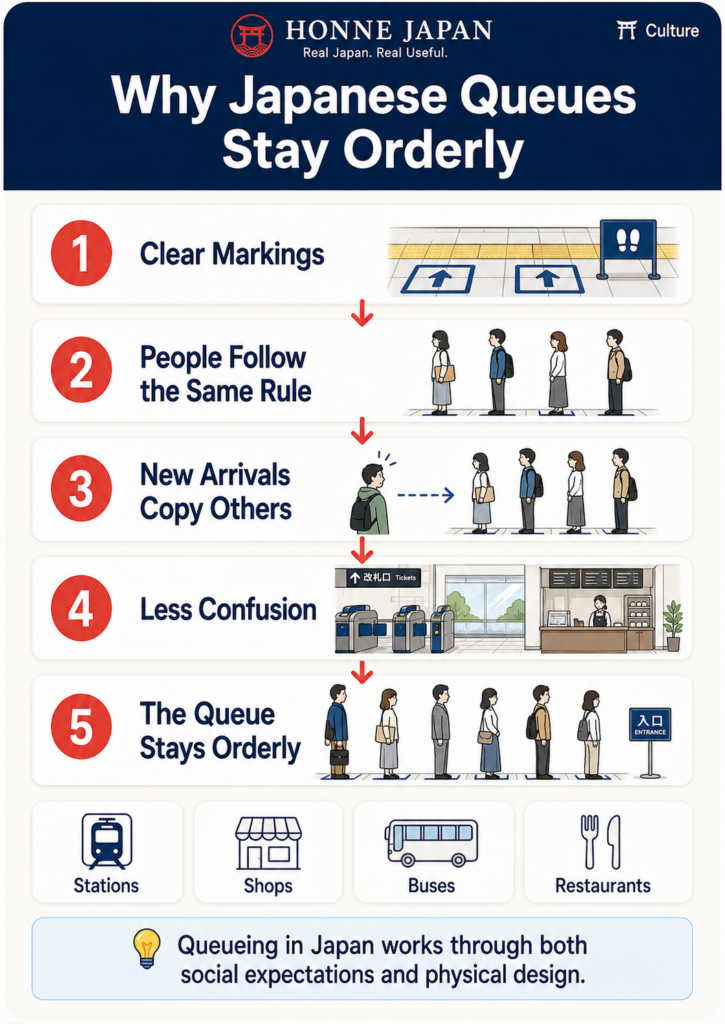
4. People Observe What Others Are Doing
Many public rules in Japan are learned through observation.
When everyone else stands behind a floor marking, a new arrival usually does the same. When passengers step aside for people leaving a train, others naturally copy the movement.
This creates a self-reinforcing pattern:
Clear Markings
      ↓
Most People Follow Them
      ↓
New Arrivals Copy the Group
      ↓
The Queue Remains Orderly
The system works without constant verbal instructions.
5. Avoiding Inconvenience to Others Is Valued
A common principle in Japanese public behavior is to avoid causing unnecessary trouble or discomfort for people nearby.
Queueing quietly helps reduce:
- Arguments
- Confusion
- Physical contact
- Blocked entrances
- Competition for position
Japan’s official visitor guidance describes consideration for others and quiet behavior in public as widely valued social expectations.
This does not mean every person in Japan behaves perfectly. It means that orderly waiting is generally recognized as the expected behavior.
Is Queueing a Recent Japanese Custom?
No. The expectation has existed for many decades.
A Japanese government survey conducted in 1961 asked people whether they tried not to cut into lines for crowded transportation and theaters. Eighty-one percent said they made an effort not to cut in.
That historical survey does not describe every person or every situation today, but it shows that orderly queueing was already treated as a recognizable public norm more than 60 years ago.
Modern floor markings, station announcements and digital signs have made the behavior even easier to follow.
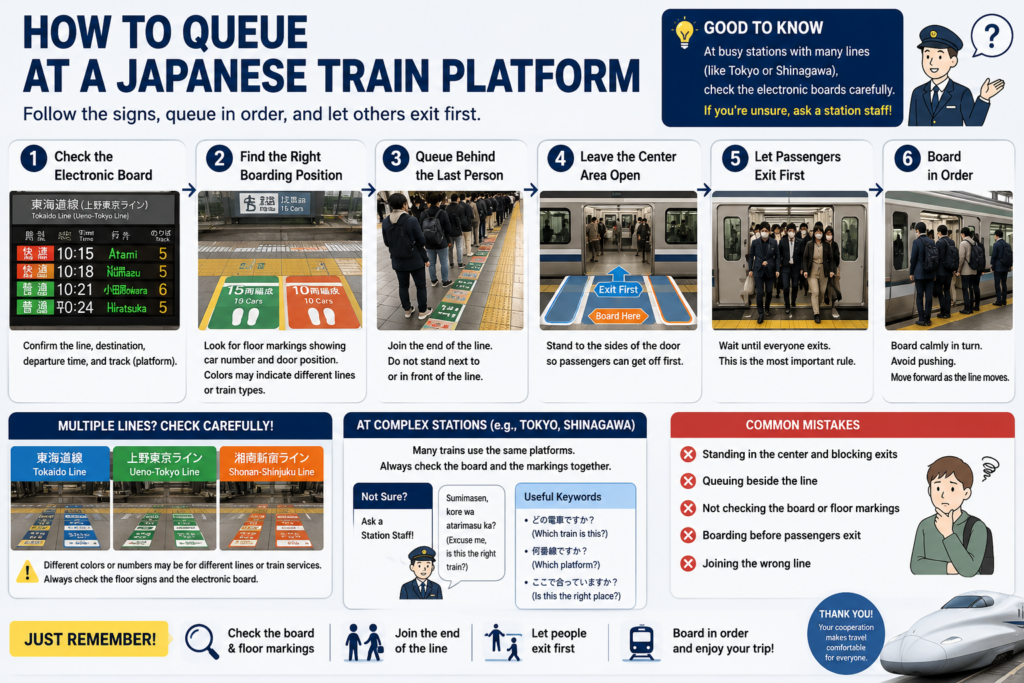
How to Queue at a Japanese Train Station
Train platforms are where queueing rules are most visible.
Step 1: Find the Correct Boarding Position
Check the platform floor or overhead signs for:
- Your train type
- Car number
- Door number
- Reserved or non-reserved seating
- Boarding line
Some platforms serve multiple types of trains, so different colored markings may indicate different boarding positions.
Step 2: Stand Behind the Last Person
Do not stand beside the existing line unless there are clearly two parallel boarding rows.
If two lines are marked, join the shorter appropriate row.
Step 3: Leave Space for Passengers to Exit
Passengers waiting to board normally stand to the sides of the door.
The center area is left open so passengers can leave first. JNTO identifies this as standard public-transport etiquette.
Step 4: Board in Order
After everyone has exited, the two waiting lines usually move inward and board.
Avoid pushing past the people ahead of you, even when the train is crowded.
One Line or Two Lines?
This is where visitors sometimes become confused.
A platform may have:
- One single queue
- Two parallel queues
- Separate queues for different trains
- Different colored lines for different door positions
Do not assume every person standing near the door belongs to one line.
Look at the markings below their feet.
For example:
Blue Line
Local Train

Red Line
Express Train
Joining the wrong line may place you at a door that does not open for your train.
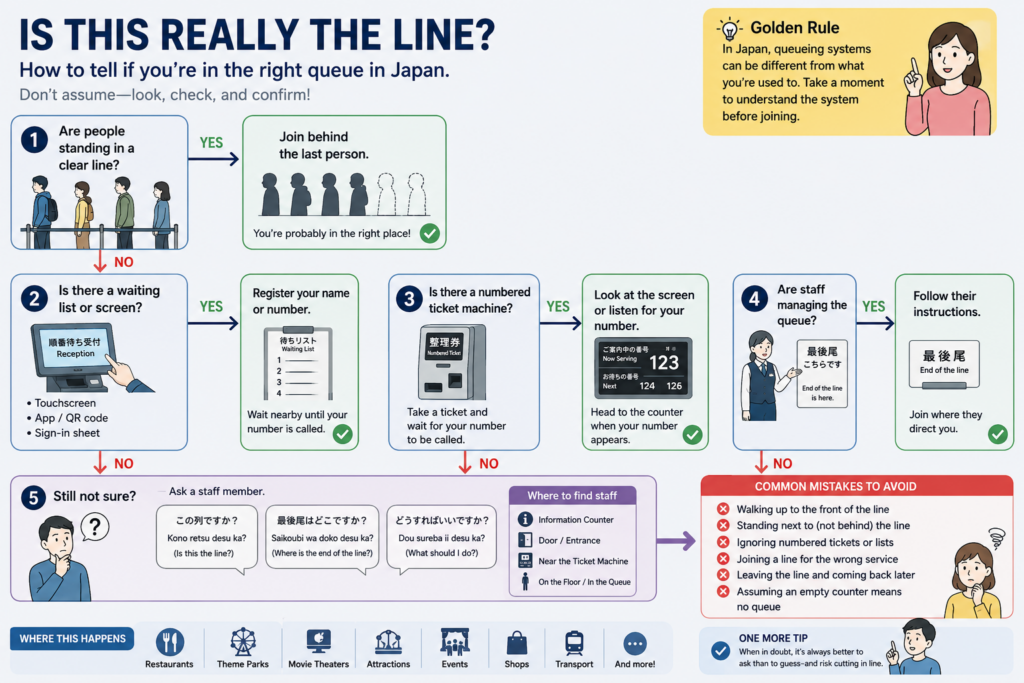
How Restaurant Queues Work
Popular Japanese restaurants often have their own waiting systems.
You may need to:
- Stand in a physical line
- Write your name on a waiting list
- Take a numbered ticket
- Register on a touchscreen
- Scan a QR code
- Buy a meal ticket before joining the line
- Wait elsewhere until your number is called
Never assume that the people standing outside are simply looking at the menu.
Before joining, check for:
受付
Reception

順番待ち
Waiting List

整理券
Numbered Ticket

最後尾
End of the Line
Some restaurants require customers to complete registration first and then wait nearby. Standing in the visible line without registering may not reserve your place.
How Checkout Lines Work
Japanese shops generally use one of two systems.
Separate Line for Each Register
Each register has its own queue.
Choose one and wait behind the last customer.
One Shared Line
Everyone waits in one line and moves to the next available register.
Look for:
- Floor arrows
- Ropes or barriers
- A sign indicating where the line begins
- Staff directing customers
A common mistake is walking directly toward an empty-looking register while a shared queue is waiting several meters away.
Bus Stop Queues
At busy bus stops, passengers may line up behind:
- A painted boarding position
- A bus route number
- A pole or sign
- Other waiting passengers
Some stops serve several routes from the same area.
Check whether the queue is for your bus before joining it.
Passengers generally board in arrival order, although elderly passengers, people with disabilities and passengers with small children may need extra space or time.
Elevators and Escalators
Elevator queues can be less obvious than train queues.
People may wait slightly away from the doors to allow passengers to exit.
Do not stand directly in front of the elevator.
For escalators, follow posted signs and local safety instructions rather than copying assumptions about which side to stand on. Practices can differ by region and location, and operators increasingly discourage walking on escalators.
What Counts as Cutting in Line?
The following actions may be viewed as cutting:
- Walking in front of people who arrived earlier
- Standing beside the front of an existing line
- Entering through a barrier from the side
- Joining friends near the front after they have been waiting
- Sending one person to hold a place for a large group
- Leaving a queue and later returning without explanation
- Ignoring a numbered-ticket system
Japanese people may not always confront someone directly.
Instead, you may notice:
- Uncomfortable silence
- People looking toward staff
- Quiet comments
- A staff member asking you to move
The absence of an argument does not necessarily mean that nobody noticed.
Can Someone Hold Your Place?
For a couple or a parent with a young child, temporarily holding a place is often understandable.
However, one person holding a place for a large group can feel unfair to the people waiting behind.
When several people plan to enter together, the safest approach is for the whole group to join the line together.
When you must leave briefly, tell the person behind you or ask the staff.
What If You Cannot Find the End of the Line?
Look for a sign saying:
最後尾
Saikōbi
End of the Line
At popular events, a staff member may hold a sign displaying these words.
You can also ask:
Saikōbi wa dochira desu ka?
最後尾はどちらですか?
Where is the end of the line?
Or:
Kono retsu desu ka?
この列ですか?
Is this the line?
Even without Japanese, pointing toward the line and asking “Last?” will usually be understood.
When Japanese Queues Are Not Perfect
Japan should not be romanticized as a place where nobody ever pushes, cuts or becomes impatient.
Queues can become disorderly during:
- Rush hour
- Train disruptions
- Major festivals
- Emergency situations
- Limited product releases
- Very crowded events
Some people ignore the rules, and different places may organize lines differently.
The important point is not that Japanese people are naturally or universally more disciplined.
It is that orderly queueing is clearly expected, visibly supported and usually followed.
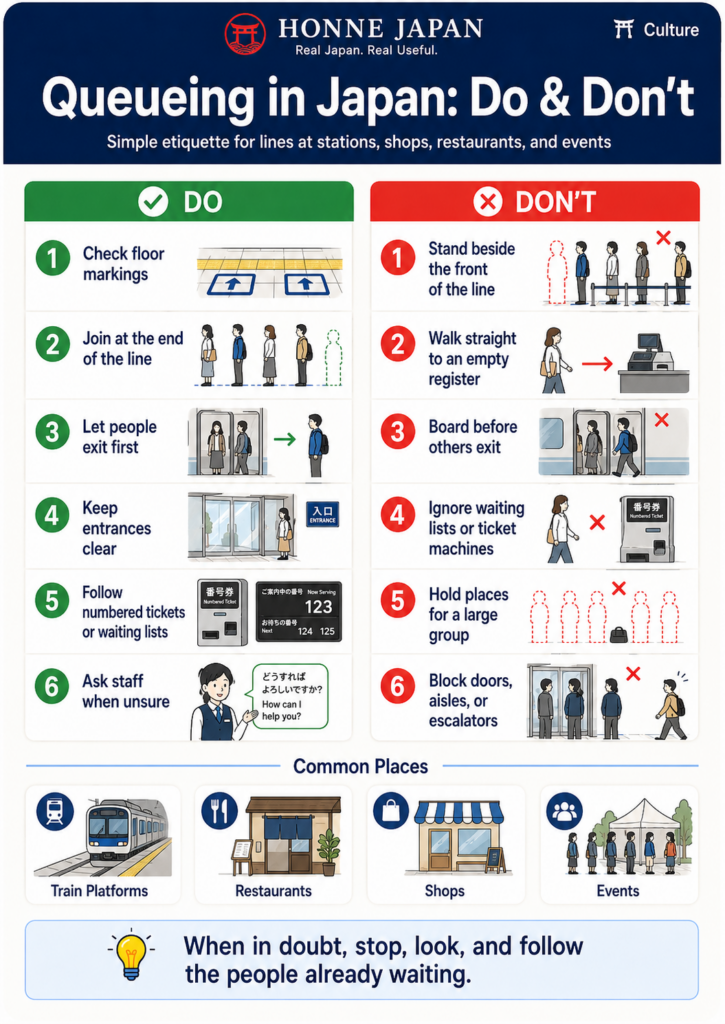
A Simple Queueing Checklist
✅ Do
- Check the floor markings.
- Look for the end of the line.
- Let people exit first.
- Follow the arrival order.
- Keep entrances and walkways clear.
- Ask staff when the system is unclear.
- Stay with your group when possible.
❌ Don’t
- Stand beside the front of a line.
- Assume an empty counter has no queue.
- Enter before passengers have exited.
- Hold a place for a large group.
- Ignore numbered tickets or waiting lists.
- Block escalators, elevators or train doors.
🇯🇵 HONNE JAPAN PICK
The easiest rule to remember is:
Stop, look at the floor, and watch what the people ahead of you do.
Japanese queues rarely require much conversation.
The markings, signs and movements of other people usually explain the system.
When something is unclear, asking where the end of the line is will prevent most mistakes.
FAQ
Is cutting in line considered rude in Japan?
Yes. It is generally considered unfair to the people who arrived earlier.
Why are there two lines on train platforms?
Two rows allow passengers to board efficiently after people have exited. However, some colored lines may be for different train types, so check the platform markings.
Should I let people exit the train first?
Yes. Stand beside the door and leave the center open for exiting passengers. This is specifically recommended in official Japanese transport etiquette guidance.
Can my friend join me near the front?
One person briefly rejoining a partner may sometimes be accepted, but bringing several people into the front of the line can be viewed as cutting.
What does 最後尾 mean?
It means “the end of the line.”
What should I do when there is no visible line?
Look for a waiting list, numbered ticket machine, floor arrow or nearby staff member before approaching the counter.
Final Thoughts
Japanese queues are orderly not because everyone follows an unexplained national instinct.
They work because three elements support one another:
- A shared expectation of fairness
- Clear physical guidance
- People observing and copying the system
For visitors, the key is not to memorize every possible rule.
Simply pause, identify the end of the line, follow the markings and let other people exit first.
Once you understand those basic principles, waiting in line in Japan becomes remarkably easy—and you may begin to notice just how much invisible coordination keeps everyday life moving smoothly.
Related Articles
- How to Ride Trains in Japan
- How to Ride the Shinkansen in Japan
- Japanese Train Etiquette Explained
- Why Japanese Trains Are So Quiet
- Why Do Japanese People Remove Their Shoes?
- How Japanese Convenience Stores Really Work