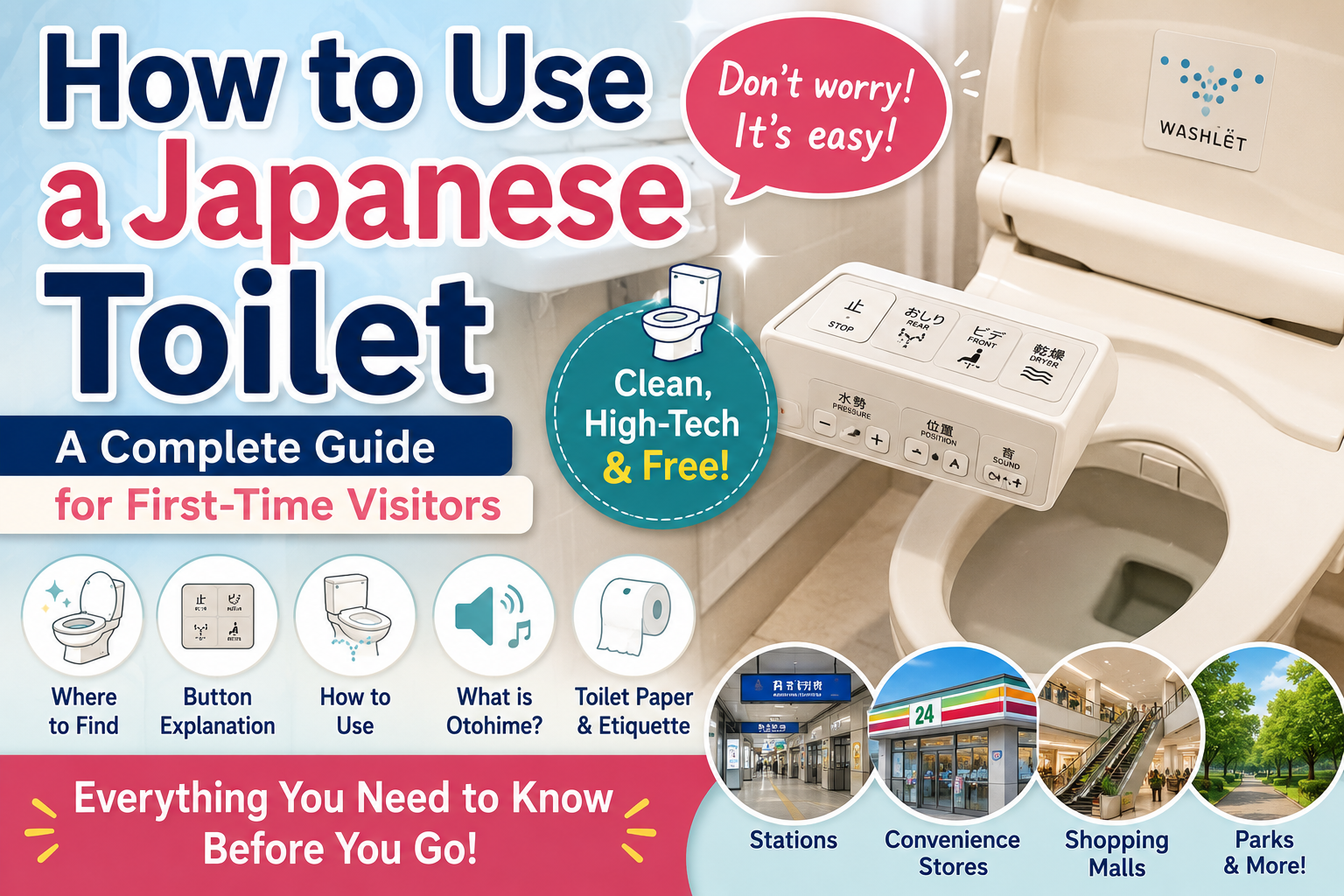
Everything First-Time Visitors Need to Know
Japan is famous for its clean, high-tech toilets.
But for first-time visitors, using one can sometimes be confusing.
You may see:
- A control panel with many buttons
- A heated seat
- A bidet function
- An automatic lid
- A flushing button in an unexpected place
- A sound effect that starts playing suddenly
The good news is that public toilets in Japan are usually clean, safe, and easy to use once you understand the basics.
This guide explains:
- Where to find public toilets
- Whether they are free
- How to flush
- How to use a bidet
- What the buttons mean
- What “Otohime” is
- Which toilets are available for families and wheelchair users
- Important toilet etiquette
Quick Answer
Public toilets in Japan are usually:
- Free
- Clean
- Well maintained
- Easy to find in stations and shopping areas
- Equipped with toilet paper
- Safe to use
- Available in Western-style and Japanese-style designs
The main thing that confuses visitors is not the toilet itself.
It is the control panel.
Before pressing anything, look for these common labels:
- Stop
- Rear
- Front
- Dry
- Flush
- Sound
Where Can You Find Public Toilets in Japan?
Public toilets are available in many places.
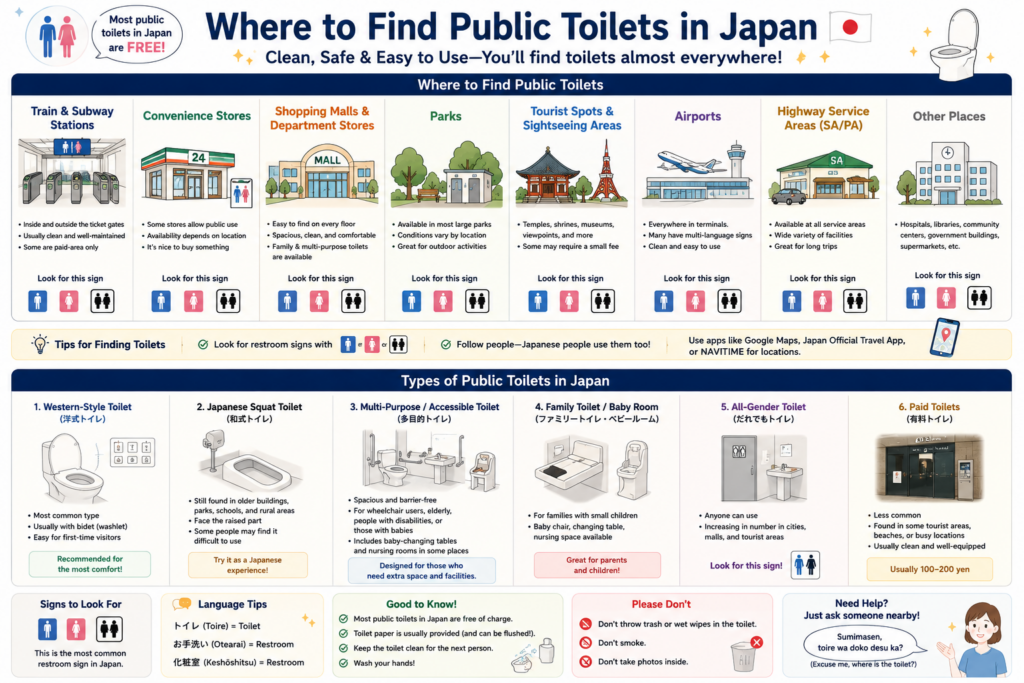
Common locations include:
- Train stations
- Subway stations
- Department stores
- Shopping malls
- Parks
- Museums
- Tourist attractions
- Airports
- Highway service areas
- Public buildings
- Some convenience stores
- Some supermarkets
Train Stations
Stations are one of the most reliable places to find a toilet.
However, some toilets are located inside the ticket gates.
This means you may need to enter the paid area before using them.
Larger stations often have:
- Standard toilets
- Accessible toilets
- Baby-changing areas
- Nursing rooms
- Ostomate facilities
Shopping Malls and Department Stores
These are often the easiest and most comfortable toilets to use.
They are usually:
- Clean
- Spacious
- Well signed
- Equipped with modern facilities
- Available on several floors
Convenience Stores
Some convenience stores allow customers to use the restroom.
Others do not.
Availability depends on:
- Store location
- Store size
- Local policy
- Time of day
- Security concerns
Look for a toilet sign or ask staff politely.
You can say:
Toire o tsukatte mo ii desu ka?
This means:
“May I use the toilet?”
It is polite to buy something small if you use a convenience-store restroom.
Parks
Many public parks have free toilets.
They are practical, but the condition varies.
Large city parks are generally well maintained.
Small neighborhood parks may have older or more basic facilities.
Are Public Toilets Free in Japan?
Yes.
Most public toilets in Japan are free to use.
This includes toilets in:
- Train stations
- Parks
- Shopping malls
- Department stores
- Airports
- Museums
- Public facilities
Paid public toilets are uncommon.
This surprises many international visitors because clean public toilets in some countries require a fee.
In Japan, free restroom access is generally considered part of the service provided by stations, shops, public spaces, and commercial facilities.
Are Public Toilets Clean?
Many are very clean.
Japan has a strong social expectation that shared spaces should be left clean for the next person.
Public toilets in:
- Airports
- Major train stations
- Department stores
- Shopping malls
are usually cleaned regularly.
However, not every toilet is perfect.
Older facilities in:
- Small parks
- Rural stations
- Busy nightlife areas
may be more basic.
Still, the general standard is high.
What Types of Toilets Will You Find?
You will mainly see four types.
1. Western-Style Toilet
This is the standard seated toilet used in many countries.
Most modern public toilets in Japan are Western-style.
They may include:
- Heated seats
- Bidet functions
- Automatic flushing
- Automatic lids
- Deodorizing functions
- Seat-cleaning solution
2. Japanese Squat Toilet
This is a floor-level toilet that you squat over.
It is still found in:
- Older stations
- Parks
- Schools
- Traditional buildings
- Rural facilities
When using a Japanese squat toilet, face the raised hood at the front.
Do not face the door.
Many public facilities now offer both Western and Japanese-style toilets.
3. Accessible Toilet
Accessible toilets may be labeled:
- Accessible Toilet
- Multipurpose Toilet
- Barrier-Free Toilet
- 多目的トイレ
They are designed for people who may need:
- Wheelchair access
- More space
- Support rails
- Assistance from another person
- Ostomate facilities
- Baby-changing equipment
Do not use these toilets for a long time if a standard toilet is available and you do not need the extra space.
4. Family or Baby-Friendly Toilet
Some facilities have:
- Baby chairs
- Changing tables
- Child-sized toilets
- Nursing areas
- Family toilets
These are especially common in:
- Shopping malls
- Airports
- Large stations
- Department stores
- Family restaurants
How to Use a Western-Style Japanese Toilet
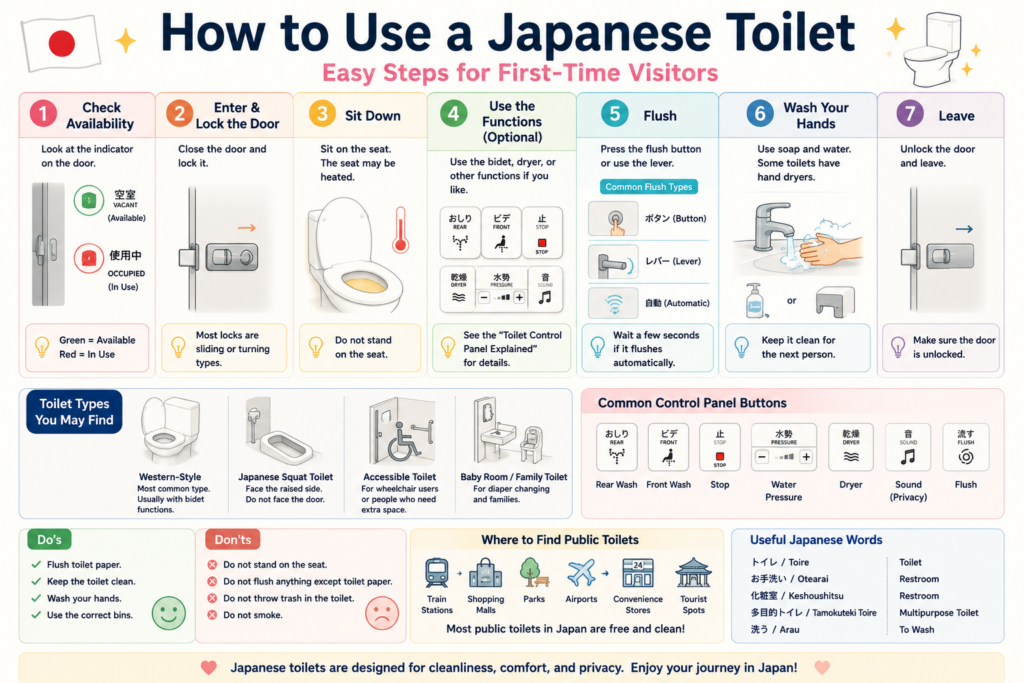
The basic process is simple.
Step 1: Check Whether the Stall Is Available
Look for:
- Green or blue indicator: usually vacant
- Red indicator: usually occupied
- 空室: vacant
- 使用中: occupied
Step 2: Enter and Lock the Door
Slide or turn the lock.
Some doors show a red occupied indicator after locking.
Step 3: Sit Normally
Use the toilet as you would in any other country.
Do not stand on a Western-style toilet seat.
Step 4: Use the Bidet If You Want
The bidet is optional.
You do not have to use it.
Press:
- Rear
- Front
to start the water.
Press:
- Stop
to stop it.
Step 5: Flush
The flush control may be:
- A lever on the toilet tank
- A wall button
- A button on the control panel
- A hand sensor
- Automatic
Look for:
- Flush
- 流す
- 大
- 小
Step 6: Wash Your Hands
Use the sink outside the stall.
Soap is usually available, but not always.
Hand dryers and paper towels vary by location.
Japanese Toilet Buttons Explained
Japanese toilet control panels can look complicated, but only a few buttons matter.
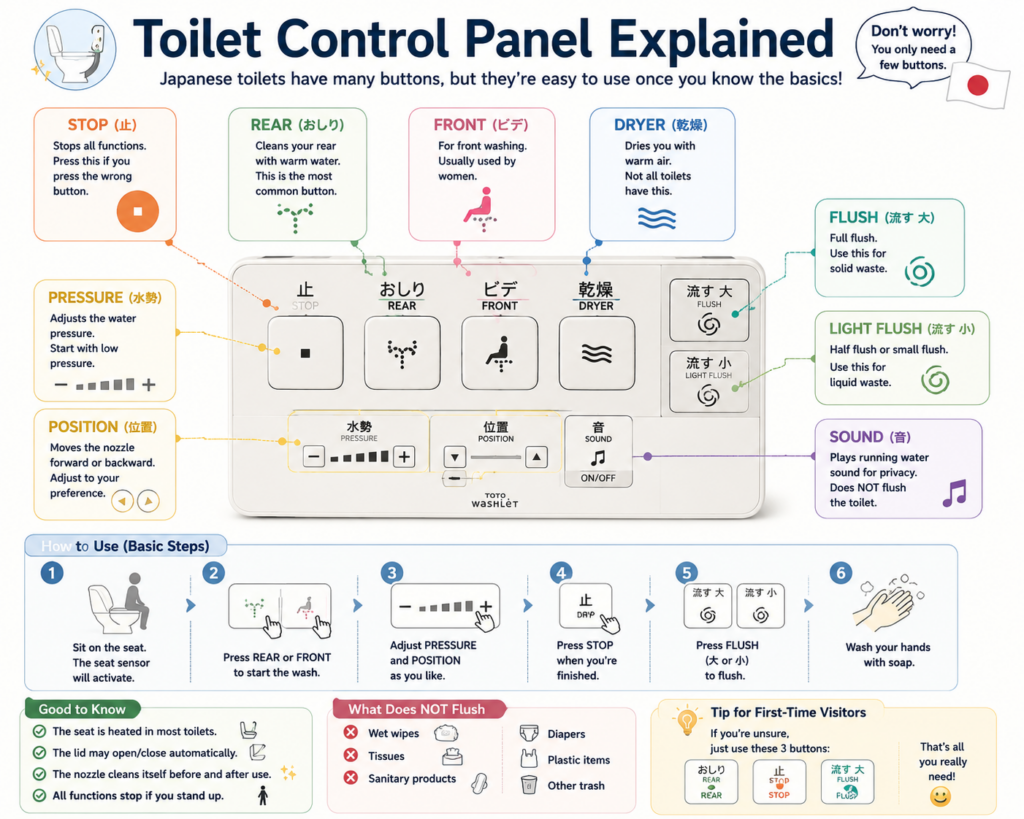
Stop
Usually marked:
- STOP
- 止
- 停止
This stops:
- Bidet water
- Dryer
- Other active functions
If you press the wrong button, press Stop.
Rear Wash
Usually marked:
- Rear
- おしり
- Wash
- Bidet
This sprays water for rear washing.
Front Wash
Usually marked:
- Front
- ビデ
- Feminine
This is designed for front washing.
Water Pressure
Usually marked:
- Weak
- Strong
- 弱
- 強
- Water Pressure
You can adjust the strength of the water spray.
Start with a low setting.
Nozzle Position
Some panels let you move the nozzle forward or backward.
Look for:
- Position
- 前
- 後
Dry
Usually marked:
- Dry
- 乾燥
This activates warm air.
Not all toilets have this function.
Flush
Usually marked:
- Flush
- 流す
Sometimes there are two options:
- 大: large flush
- 小: small flush
Sound
Usually marked:
- Sound
- 音
- 音姫
- Privacy
This plays a flushing sound or other audio.
It does not necessarily flush the toilet.
This is one of the most common mistakes visitors make.
What Is a Washlet?
“Washlet” is a well-known Japanese term commonly used for a toilet seat with a bidet function.
The general function is simple:
- Sit on the seat.
- Press Rear or Front.
- Adjust water pressure if necessary.
- Press Stop.
Some advanced toilets also offer:
- Heated water
- Heated seats
- Adjustable nozzle position
- Deodorizing
- Warm-air drying
- Automatic cleaning
You do not need to use every feature.
For a first-time user, these three buttons are enough:
- Rear
- Front
- Stop
Is the Bidet Safe to Use?
Generally, yes.
The nozzle is designed for personal washing and usually cleans itself before or after use.
However:
- Start with low water pressure.
- Do not press the button while standing.
- Do not put your face near the toilet.
- Press Stop if you feel uncomfortable.
- Follow any instructions shown.
The water spray will normally not activate unless someone is seated because many toilets have a seat sensor.
What Is Otohime?
Otohime is a sound device commonly found in Japanese toilets.
It plays a flushing sound to provide privacy.
The name is often written:
音姫
The device was developed because some people repeatedly flushed the toilet to hide bathroom sounds.
That wasted water.
Otohime provides the sound without requiring repeated flushing.
Today, similar sound functions may be built into:
- Wall-mounted devices
- Toilet control panels
- Automatic sensors
Important
Pressing the sound button does not always flush the toilet.
Look for a separate button marked:
- Flush
- 流す
- 大
- 小
How to Flush a Japanese Toilet
Flushing can be surprisingly confusing because the control is not always in the same place.
Common Flush Types
Lever
A traditional lever may be attached to:
- The tank
- The side of the toilet
- A pipe behind the toilet
Wall Button
A large button may be installed on the wall.
It may say:
- Flush
- 流す
Control Panel Button
Some electronic panels include a flush button.
Hand Sensor
Hold your hand near the sensor.
Do not touch it unless necessary.
Automatic Flush
Some toilets flush automatically when you stand up or leave the stall.
Wait a few seconds before searching for another button.
What Do “Large” and “Small” Mean?
You may see:
- 大
- 小
These mean:
- 大: large flush
- 小: small flush
Use the large flush for solid waste.
Use the small flush for liquid waste.
Some modern toilets choose automatically.
Can You Flush Toilet Paper in Japan?
Yes.
Standard toilet paper can be flushed in Japanese toilets.
In most cases, you should place used toilet paper directly into the toilet.
Do not place it in a separate bin unless a sign specifically tells you to.
Do Not Flush
- Wet wipes
- Baby wipes
- Sanitary products
- Diapers
- Paper towels
- Tissues
- Plastic
- Food
- Other trash
Only flush toilet paper and human waste.
Why Is There Sometimes a Small Trash Bin?
Women’s stalls usually have a small sanitary bin.
It is intended for:
- Sanitary pads
- Tampons
- Other hygiene products
It is not for:
- Used toilet paper
- Drink containers
- Food wrappers
- General travel trash
Used toilet paper should normally be flushed.
Why Are There No Large Trash Bins?
Public toilets often do not have general waste bins.
This is common throughout Japan.
People are generally expected to carry personal trash until they find an appropriate waste bin.
This is similar to the broader issue of limited public trash bins in Japan.
Related guide:
Where Are the Trash Bins in Japan?
Can You Use Toilet Paper for Free?
Yes.
Public toilets normally provide toilet paper at no additional cost.
However, very old or basic toilets may occasionally run out.
Carrying a small packet of tissues is useful when traveling, especially in:
- Rural areas
- Small parks
- Older public facilities
Do not flush ordinary pocket tissues unless they are specifically labeled as flushable.
Is There Soap?
Soap is available in many public toilets, especially in:
- Airports
- Department stores
- Shopping malls
- Major stations
- Modern public buildings
However, soap may not be available in every park or older station toilet.
It can be useful to carry:
- Hand sanitizer
- Small wet wipes
- Pocket tissues
Are There Paper Towels?
Sometimes.
Many Japanese public toilets use:
- Hand dryers
- No drying equipment
- Paper towels at higher-end facilities
Many Japanese people carry a small hand towel.
Travelers may find it useful to carry one as well.
Can You Drink Water from the Sink?
Tap water in Japan is generally safe to drink, but public toilet sinks are intended for handwashing.
It is better to refill a bottle from:
- A drinking fountain
- A water dispenser
- A restaurant
- Your hotel
- A clearly marked drinking-water tap
Do not drink from a tap marked:
- Not Drinking Water
- 飲用不可
- 飲めません
How to Use a Japanese Squat Toilet
A squat toilet can look unfamiliar, but the process is straightforward.
Step 1: Face the Raised Hood
The raised part is the front.
Face it.
Step 2: Place Your Feet on Either Side
There may be foot markings.
Step 3: Lower Your Clothing Carefully
Keep clothing away from the floor.
Step 4: Squat
Balance with your feet flat where possible.
Use support rails if provided.
Step 5: Use Toilet Paper
Place used toilet paper in the toilet.
Step 6: Flush
Use the lever, button, or pedal.
Squat toilets can be difficult for people with:
- Knee problems
- Mobility limitations
- Balance concerns
Look for a Western-style stall instead.
Are Public Toilets Gender-Segregated?
Most public toilets have separate men’s and women’s areas.
Look for:
- Male and female icons
- Men / Women
- 男 / 女
Some facilities also provide:
- All-gender toilets
- Family toilets
- Multipurpose toilets
The availability varies.
What Is an Ostomate Facility?
Some accessible toilets display an ostomate symbol.
These toilets provide special equipment for people with a stoma.
Facilities may include:
- A washing sink
- A low-level water outlet
- Space for medical supplies
- A changing platform
Travelers who do not need these facilities should avoid occupying them unnecessarily.
Baby Chairs and Changing Tables
Many Japanese public toilets provide baby equipment.
Baby Chair
A small wall-mounted seat inside the stall.
It allows a parent to place a young child safely while using the toilet.
Changing Table
A fold-down table used for changing diapers.
After using it:
- Clean the surface if necessary.
- Dispose of diapers only in a designated bin.
- Do not leave wipes or trash behind.
Not every toilet provides diaper bins.
Public Toilet Etiquette in Japan
Japanese public toilets are usually clean because users are expected to help keep them that way.
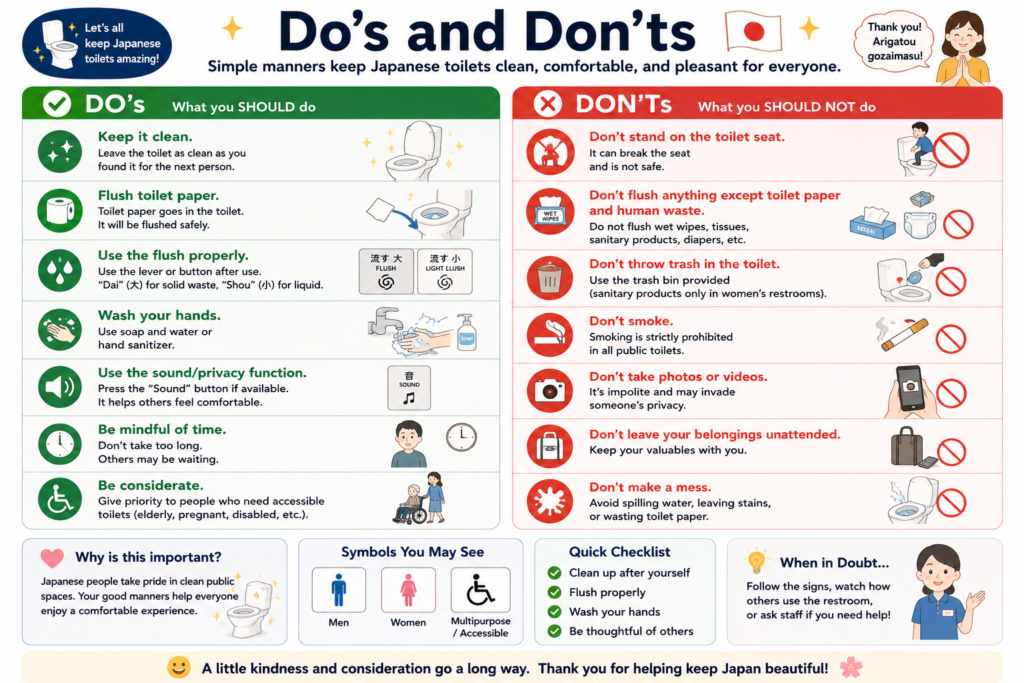
Do
- Leave the stall clean.
- Flush after use.
- Put toilet paper in the toilet.
- Wash your hands.
- Use the correct bin for sanitary products.
- Give priority to people who need accessible toilets.
- Report serious problems to staff.
Do Not
- Stand on Western toilet seats.
- Throw trash into the toilet.
- Flush wet wipes or sanitary products.
- Occupy an accessible toilet unnecessarily.
- Smoke.
- Take photos where people may be present.
- Use the toilet as a luggage storage area.
- Stay inside for an unusually long time.
Can You Bring Luggage into the Toilet?
Larger toilets may have:
- Luggage shelves
- Bag hooks
- Space beside the toilet
- Larger accessible stalls
Do not leave valuables unattended outside.
If your suitcase does not fit:
- Use a larger stall if appropriate.
- Ask a travel companion to watch it.
- Use a station coin locker.
Related guide:
How to Use Coin Lockers in Japan
Toilet Signs You Should Know
| Japanese | Pronunciation | Meaning |
|---|---|---|
| トイレ | Toire | Toilet |
| お手洗い | Otearai | Restroom |
| 化粧室 | Keshōshitsu | Restroom / powder room |
| 男 | Otoko | Men |
| 女 | Onna | Women |
| 多目的トイレ | Tamokuteki toire | Multipurpose toilet |
| バリアフリー | Baria furī | Barrier-free |
| 空室 | Kūshitsu | Vacant |
| 使用中 | Shiyō-chū | Occupied |
| 流す | Nagasu | Flush |
| 大 | Dai | Large flush |
| 小 | Shō | Small flush |
| おしり | Oshiri | Rear wash |
| ビデ | Bide | Front wash |
| 止 | Tomaru | Stop |
| 乾燥 | Kansō | Dry |
| 音姫 | Otohime | Privacy sound |
Useful Japanese Phrases
Where is the toilet?
Toire wa doko desu ka?
May I use the toilet?
Toire o tsukatte mo ii desu ka?
Is there a Western-style toilet?
Yōshiki toire wa arimasu ka?
The toilet will not flush.
Toire ga nagaremasen.
There is no toilet paper.
Toiretto pēpā ga arimasen.
Common Mistakes First-Time Visitors Make
Pressing the Sound Button Instead of Flush
The sound button may only play audio.
Look for:
- Flush
- 流す
- 大
- 小
Using Too Much Water Pressure
Start with the lowest bidet setting.
Standing on a Western Toilet
Never stand on the seat.
Use a squat toilet if you prefer to squat.
Throwing Toilet Paper in the Bin
In Japan, normal toilet paper should usually be flushed.
Flushing Wet Wipes
Even wipes labeled “flushable” can cause problems.
Use the bin unless the facility clearly says otherwise.
Leaving Before the Toilet Flushes
Some toilets flush automatically after a short delay.
Check that the bowl has cleared before leaving.
Frequently Asked Questions
Are public toilets free in Japan?
Yes. Most public toilets are free.
Are Japanese public toilets safe?
Generally, yes. Toilets in stations, malls, airports, and public buildings are widely used and usually safe.
Can I flush toilet paper?
Yes. Standard toilet paper should normally be flushed.
Do I have to use the bidet?
No. It is completely optional.
What should I press if I make a mistake?
Press Stop.
What is the difference between Rear and Front?
Rear is for rear washing. Front is designed for front washing.
Why does the toilet make a sound?
It may be Otohime, a privacy sound function.
Does Otohime flush the toilet?
Usually no. It only plays a sound.
Why can’t I find the flush button?
The toilet may use:
- A lever
- A wall button
- A hand sensor
- Automatic flushing
Are toilets available in convenience stores?
Some stores have them, but not all.
Do Japanese toilets have toilet paper?
Usually yes.
Should I carry tissues?
It is useful, especially in older or rural facilities.
Can children use the bidet?
They can, but adult supervision is recommended because the water pressure may surprise them.
Can I use an accessible toilet with children?
Family-friendly equipment may be inside accessible toilets, but give priority to people who need the accessibility features.
Are squat toilets common?
They still exist, but Western-style toilets are now much more common in modern facilities.
Final Thoughts
Japanese public toilets may look complicated, but they are designed to make the experience cleaner, more private, and more comfortable.
For most visitors, remembering a few basic points is enough:
- Public toilets are usually free.
- Standard toilet paper goes into the toilet.
- Press Stop if you activate the wrong function.
- The sound button may not be the flush button.
- Look for Flush, 流す, 大, or 小.
- Start bidet water pressure on a low setting.
- Leave the toilet clean for the next person.
Once you understand the control panel, Japanese toilets become much less intimidating.
You may even wonder why every country does not use them.